Concept
Elastic Volume-weighted MA
Elastic Volume-weighted MA is a Trend concept. The Library holds 1 implementation, a working definition you can pull into Quant.
eVWMA
Top Elastic Volume-weighted MA indicator
The top custom implementation, built on the original standard Elastic Volume-weighted MA formula.
1 total
From studying Elastic Volume-weighted MA to trading it: take the implementation below into Quant and backtest it instantly.
What is an Elastic Volume-weighted MA?
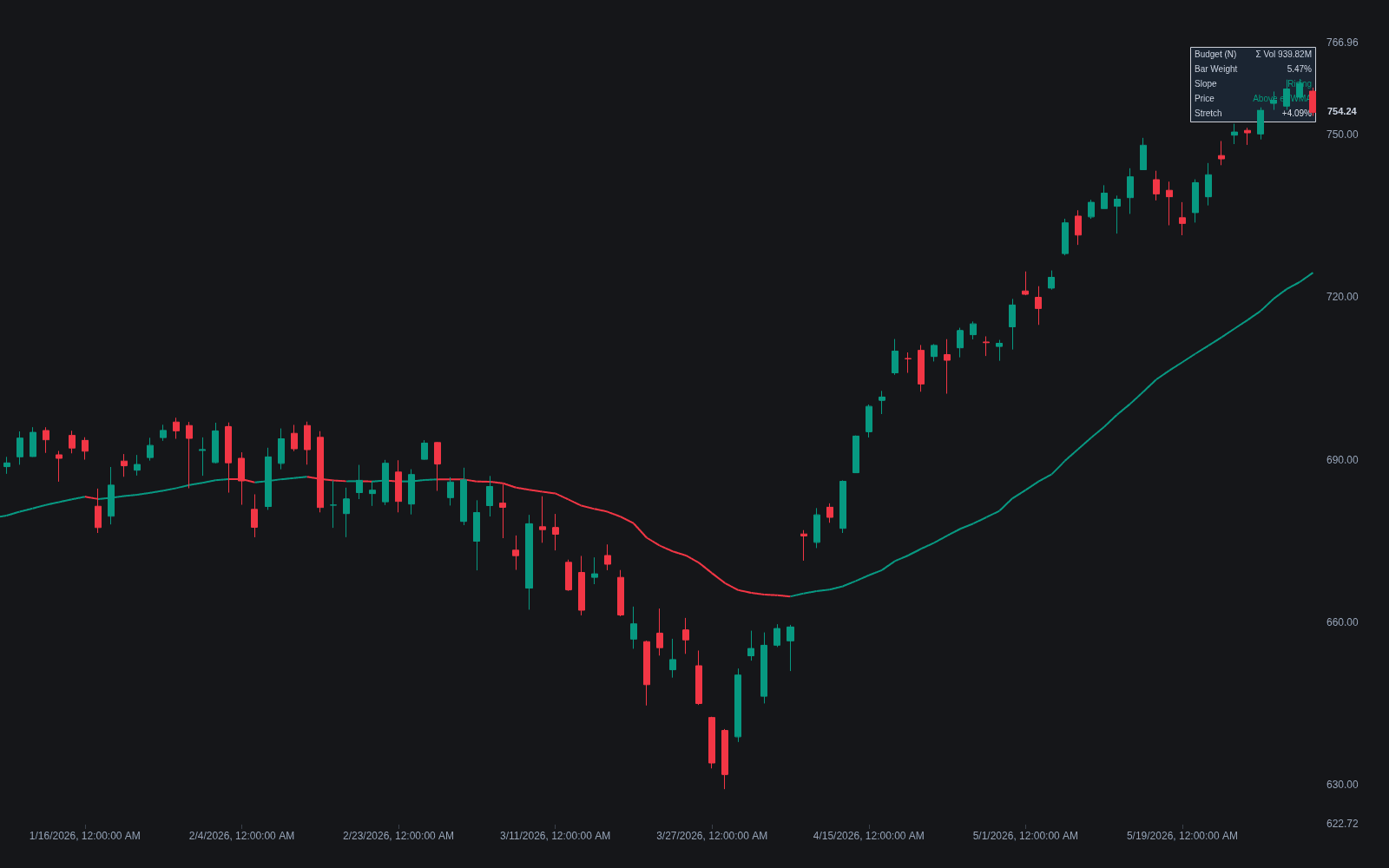
The elastic volume-weighted moving average (eVWMA), introduced by Christian Fries, is a recursive average in which volume sets each bar's influence. Each update scales the prior value by (N minus volume) over N and adds price scaled by volume over N, where N is a chosen volume budget. Structurally it is an EMA whose smoothing constant is the bar's share of that budget instead of a fixed number: heavy bars move it sharply, quiet bars barely move it, and a zero-volume bar leaves it unchanged.
Fries published the method in Technical Analysis of Stocks & Commodities in 2001, starting from a criticism of conventional averages: an SMA or EMA runs on a clock of bars, so an illiquid afternoon counts as much as a frantic open. The eVWMA instead measures its memory in shares or contracts changing hands; a bar transacting ten percent of the budget rewrites ten percent of the line, whatever the calendar says.
Fries proposed setting N to the number of shares outstanding, under a model in which each trade randomly replaces existing holdings; the line then approximates the average price at which the current shareholder base acquired its shares. That makes the eVWMA a cost-basis reading, closer in spirit to an anchored volume-weighted average price than to a fixed-window average. Where float data does not exist, implementations substitute a multiple of recent cumulative volume, and that choice dominates the line's speed.
The result is an average that self-regulates across regimes without retuning: in a fast, high-participation market it behaves like a short average and hugs price, while in a dull one it lengthens, refusing to chase drift on thin trade. That places it alongside adaptive designs such as the adaptive-lookback MA, though it adapts to participation rather than volatility. Community implementations range from everget's straight port to LazyBear's envelope build and Spreadburn's trend-colored variant.
How to identify the eVWMA on a chart
The eVWMA plots as a single overlay line, so identification is less about shape and more about recognizing its volume-driven behavior.
- 1Apply an eVWMA indicator to the price panel; it renders as a smooth overlay comparable to an exponential average of moderate length.
- 2Watch high-volume bars: the line jumps toward price far more than a fixed-period average would, since a heavy bar consumes a big share of the budget.
- 3Watch quiet stretches: the line flattens and glides, staying put through low-volume drift and thin sessions.
- 4Overlay a conventional average of similar speed; the two track closely while volume is steady and separate sharply after volume shocks, the eVWMA's signature.
- 5Check the volume budget N (shares outstanding, or a lookback times a multiplier); that single input decides whether the line reads fast or slow.
How it's calculated
A moving average whose smoothing weight on each bar is that bar's share of recent volume rather than a fixed constant.
Published by Christian Fries in 2001; the original sets N to the instrument's share float, and platforms commonly substitute an n-bar volume sum.
Each bar replaces a volume-proportional fraction of the prior average with the current price, so the average adapts quickly on heavy volume and barely moves on thin volume.
How traders use it
- As a participation-weighted trend line: slope, side-of-line and crossover logic all work as with any average, with the property that only volume-backed moves relocate the line quickly.
- As a cost-basis proxy: with a float-scale budget, price stretched far above the eVWMA is read as holders sitting on large open profits, a condition worth knowing, though not a timing signal by itself.
- As a self-adjusting base for bands: envelope versions project percentage bands around the line, an MA envelope whose center responds to activity instead of needing a period tuned per market.
- In crossover systems: a fast and a slow eVWMA, or an eVWMA against a conventional average, give moving average crossovers that thin-trade drift is less able to trigger, filtering breakout attempts that lack participation.
- As dynamic support and resistance: in trending markets, pullbacks toward a rising eVWMA are watched for continuation entries, the standard dynamic S/R via MA playbook run on a volume-aware line.
eVWMA vs other moving averages
VWMA: The VWMA weights the last N bars by raw volume and forgets anything older than the window. The eVWMA has no window: old prices fade gradually, at a rate set by subsequent traded volume rather than by bar count.
EMA: An EMA applies the same smoothing constant every bar, so time alone decays old prices. The eVWMA's constant is the bar's volume divided by the budget, so decay happens only as real trade occurs; the two are identical in form but behave very differently around volume spikes.
Adaptive-lookback MA: Averages in the KAMA lineage modulate their speed using volatility or trend-efficiency measures computed from price itself. The eVWMA adapts using volume, an input external to price, so it accelerates on participation rather than on movement.
Concept family
Trend
100 concepts mapped · 100 in the Library
Elastic Volume-weighted MA FAQ
Turn Elastic Volume-weighted MA into a trading strategy.
Take the implementation from this page into Quant, then build on it, backtest it on real data, and keep refining it in conversation.