Elliptic Filter
 By LuxAlgoJun 28, 2026
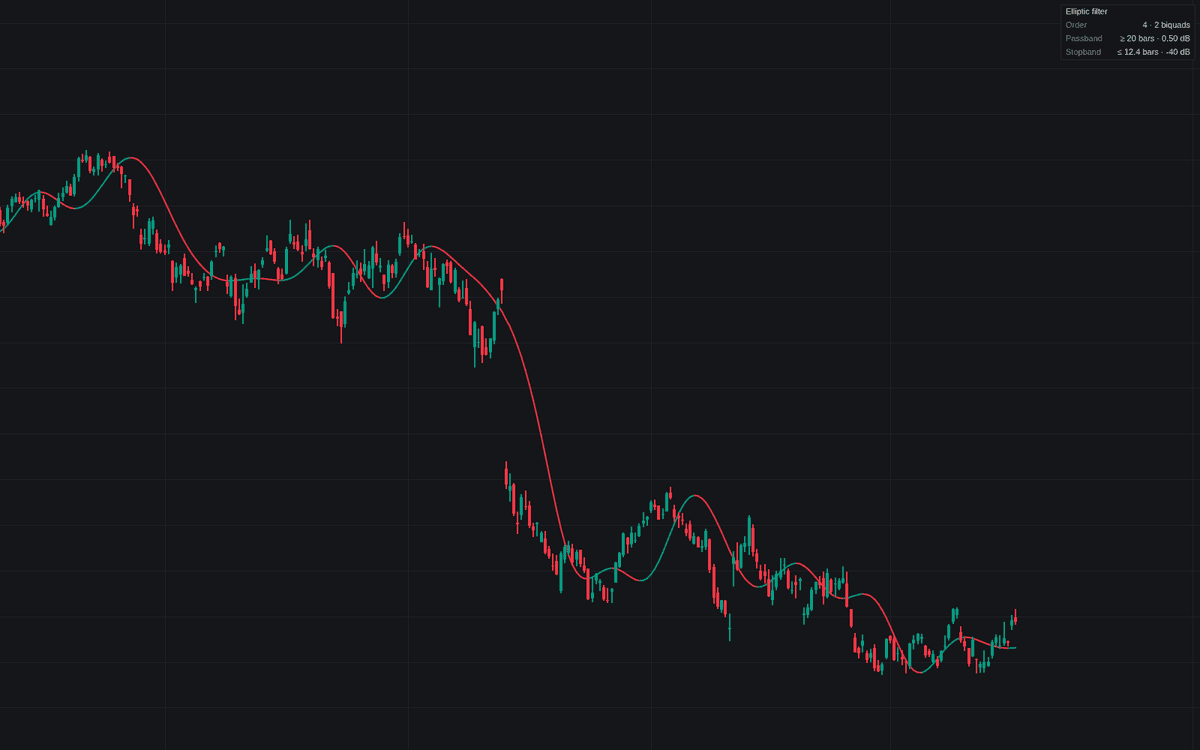

Elliptic Filter runs the genuine Cauer design procedure on the chart: the elliptic filter realized exactly rather than approximated. Four targets (cutoff period, order, passband ripple, stopband attenuation) fully specify the filter; the coefficients are generated once and applied as cascaded second-order sections, each normalized so the smoothed line tracks the price level exactly. The payoff is the fastest passband-to-stopband transition any classical design achieves at a given order.
How to Trade the Elliptic Filter?
- Slope: with Directional coloring the line flips color as it rises or falls, and the Turned Up / Turned Down alerts mark confirmed troughs and crests in the filter itself.
- Price crossings: the source crossing the filter carries its own alert pair; the matching triangles ship disabled because the sharp cutoff rings after gaps and impulse bars.
- Dashboard: reports the realized order and section split, the passband edge with its ripple, and the derived stopband edge. The gap between the edges is the transition band the design minimizes.
Elliptic Filter Settings
- Source (default close): series the filter smooths.
- Cutoff Period (default 20): passband edge in bars. Slower swings are kept within the ripple bound.
- Order (default 4): number of poles; higher narrows the transition band but deepens post-impulse ringing.
- Passband Ripple (dB) (default 0.5): bounded amplitude wobble allowed in kept wavelengths; more ripple buys a sharper cutoff.
- Stopband Attenuation (dB) (default 40): floor to which rejected wavelengths are held.
- Show Dashboard (on) with Location (Top Right) and Size (Small); style: Line Coloring (Directional), Line Width (2), Crossing Markers (off).
Frequently Asked Questions

Original indicatorBuilt in-house by LuxAlgo
The Library is free. Quant makes it yours.
Pull any concept or indicator into Quant: rebuild it, retune it, or turn it into a backtested strategy of your own.