Gaussian Filter
 By LuxAlgoFeb 10, 2026
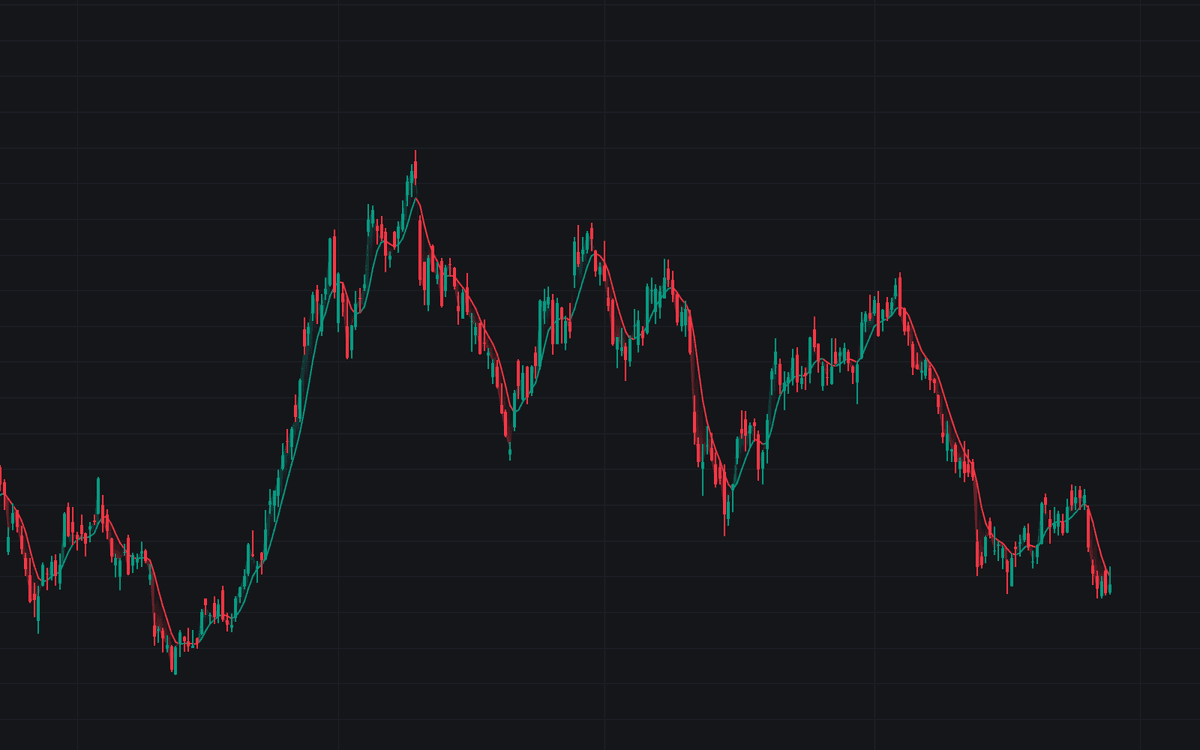

Gaussian Filter smooths price by running it through the same simple smoothing stage up to four times in a row, so the cascade's combined response approaches the Gaussian bell and the line comes out round and steady. This build follows John Ehlers' published recursive recipe for the Gaussian filter: the per-stage coefficient is derived from the period and pole count, and the selected pole's output is the plotted line. The result reads as a trend baseline: slope carries the regime, and price's side of the line frames the structure around it.
How to Trade the Gaussian Filter?
- Slope color: with Slope Trend Coloring on, the line is bullish while rising and bearish while falling. Slope turns are alertable in both directions and make clean regime markers.
- Price crossings: the standard moving-average crossover grammar on a smoother line, with fewer whipsaw crosses than a raw average; optional triangles mark them, and both directions are alertable.
- Fill direction: the gradient between price and filter shows which side price is riding. Persistent one-sided fills characterize trends, alternating fills congestion.
Gaussian Filter Settings
- Source (default close): the series being smoothed; feeding another indicator's output through it covers the pre-smoother use.
- Period (default 14): the cutoff the per-stage coefficient is derived from. Longer gives a rounder, slower line, shorter tracks price but passes more noise.
- Poles (default 4): identical stages in series. Each extra pole adds smoothness and lag at the same period and pushes the response closer to the bell; one pole behaves much like an EMA, and four is the cap in Ehlers' original.
- Style: Slope Trend Coloring (on), Price / Filter Gradient Fill (on), Price Crossing Markers (off), plus bullish, bearish and neutral colors.
Frequently Asked Questions

Original indicatorBuilt in-house by LuxAlgo
The Library is free. Quant makes it yours.
Pull any concept or indicator into Quant: rebuild it, retune it, or turn it into a backtested strategy of your own.