Concept
Elliptic Filter
Elliptic Filter is a Trend concept. The Library holds 1 implementation, a working definition you can pull into Quant.
Top Elliptic Filter indicator
The top custom implementation, built on the original standard Elliptic Filter formula.
1 total
From studying Elliptic Filter to trading it: take the implementation below into Quant and backtest it instantly.
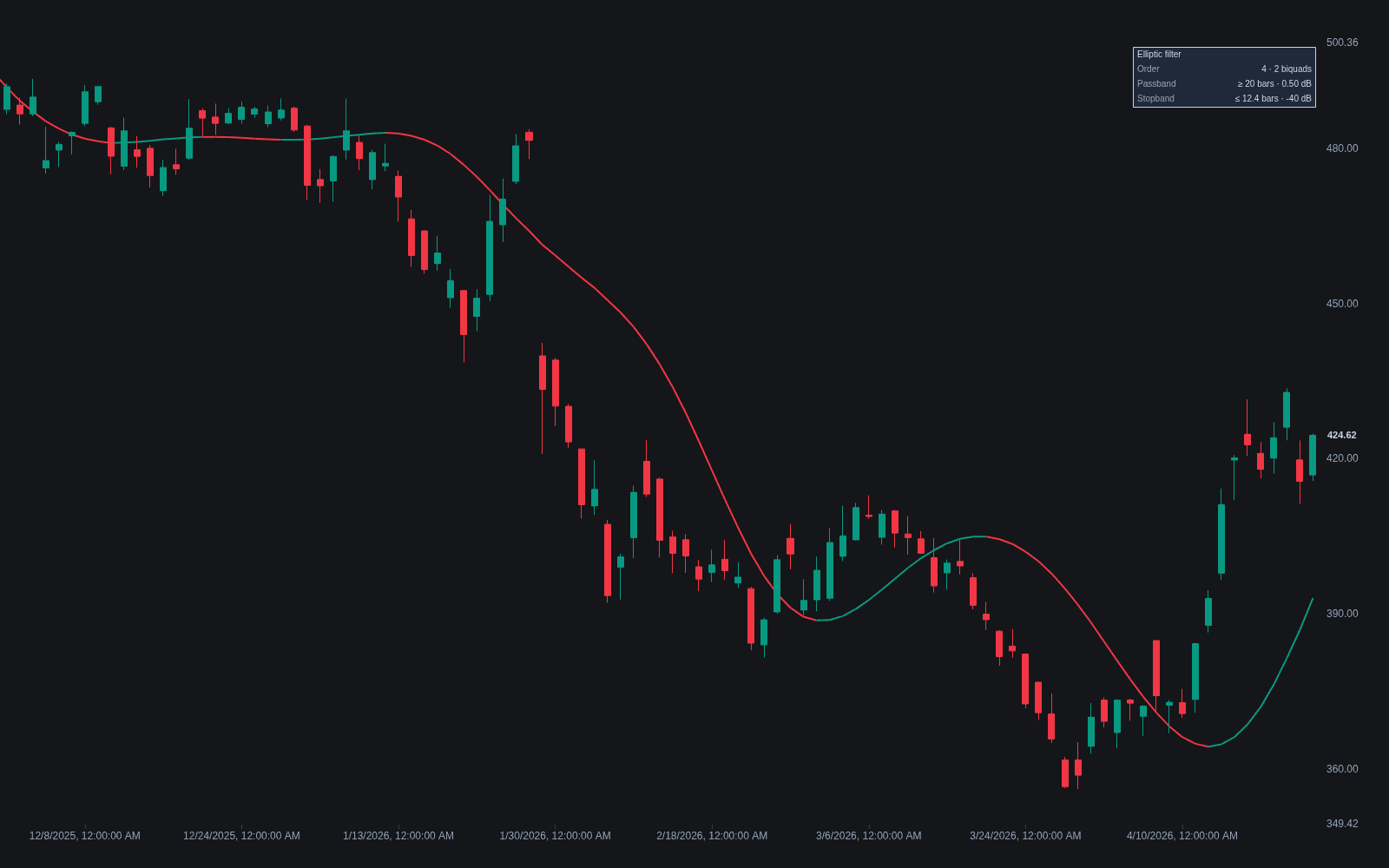
What is an elliptic filter?
An elliptic filter, also called a Cauer filter after the German engineer Wilhelm Cauer, is the most aggressive of the classical low-pass designs: for a given filter order it achieves the fastest possible transition from passband to stopband. It buys that sharpness by allowing controlled ripple in both bands, so the wavelengths it keeps are passed with a small, bounded wobble in amplitude, and the wavelengths it rejects are attenuated to a specified floor rather than ever more deeply.
In trading terms, an elliptic design is the extreme answer to a real question: how cleanly can you separate the swing you care about from the noise just below it? A trader trying to isolate, say, everything slower than 20 bars while killing everything faster than 15 needs a narrow transition band, and only high selectivity delivers that at low order. Elliptic filters make that separation with fewer poles, hence potentially less overall delay, than a Butterworth filter forced to the same spec.
The reason they remain rare on charts is the fine print. Sharp cutoffs come with the worst phase distortion of the classical designs and pronounced ringing: a gap or impulse bar sets off a decaying oscillation in the output that can be mistaken for structure. Passband ripple also means the smoothed line slightly exaggerates some swing amplitudes and shrinks others even in clean data. Most practitioners who want strong selectivity in market data stop at Butterworth or Chebyshev designs, or use band-limiting constructions built for price series such as the roofing filter; the elliptic filter is mainly worth knowing as the boundary case of the selectivity-versus-artifacts tradeoff.
How it's calculated
There is no compact bar-domain formula. An elliptic filter is specified by four design targets and realized as a recursive equation, typically cascaded second-order sections of the standard form:
Coefficients come from a design step involving Jacobi elliptic functions; in practice they are generated by filter-design software or tables, not hand-derived.
In the limit of zero passband ripple the design tends to a Chebyshev Type II response; with both ripples driven to zero it tends to Butterworth.
Higher orders are implemented as cascaded biquad sections for numerical stability.
How traders use it
- As a surgical band separator in research settings: when decomposing price into a slow component and a fast component with minimal spectral overlap, elliptic designs give the cleanest split per unit of filter order.
- As a pre-filter ahead of cycle tools such as dominant cycle detection, where leakage from adjacent wavelengths corrupts the measurement and sharp cutoffs help.
- Rarely as a direct trading smoother; the ringing after impulsive bars prints false wiggles that crossover or slope rules will trade. Anyone using one on raw signals should test behavior around gaps explicitly.
- As a reference point when evaluating gentler filters: comparing a strategy's behavior under Bessel, Butterworth, and elliptic smoothing shows how sensitive the edge is to the selectivity-versus-artifacts tradeoff.
Elliptic filter vs the other classical designs
Chebyshev filters: Chebyshev designs allow ripple in one band only and roll off slower than elliptic at equal order. The elliptic filter is the limiting case that allows ripple in both bands to maximize cutoff sharpness.
Butterworth filter: Butterworth is ripple-free with a monotonic, gentler rolloff. It needs a higher order to match an elliptic transition band, but its step response is far better behaved on gappy market data.
Bessel filter: The opposite end of the spectrum: Bessel maximizes waveform fidelity with almost no ringing and the softest rolloff, while elliptic maximizes selectivity and accepts the worst phase behavior.
Concept family
Trend
100 concepts mapped · 100 in the Library
Elliptic Filter FAQ
Turn Elliptic Filter into a trading strategy.
Take the implementation from this page into Quant, then build on it, backtest it on real data, and keep refining it in conversation.