Concept
Gaussian Filter
Gaussian Filter is a Trend concept. The Library holds 1 implementation, a working definition you can pull into Quant.
Top Gaussian Filter indicator
The top custom implementation, built on the original standard Gaussian Filter formula.
1 total
Want to trade Gaussian Filter? The implementation below is one prompt away from a backtested strategy in Quant.
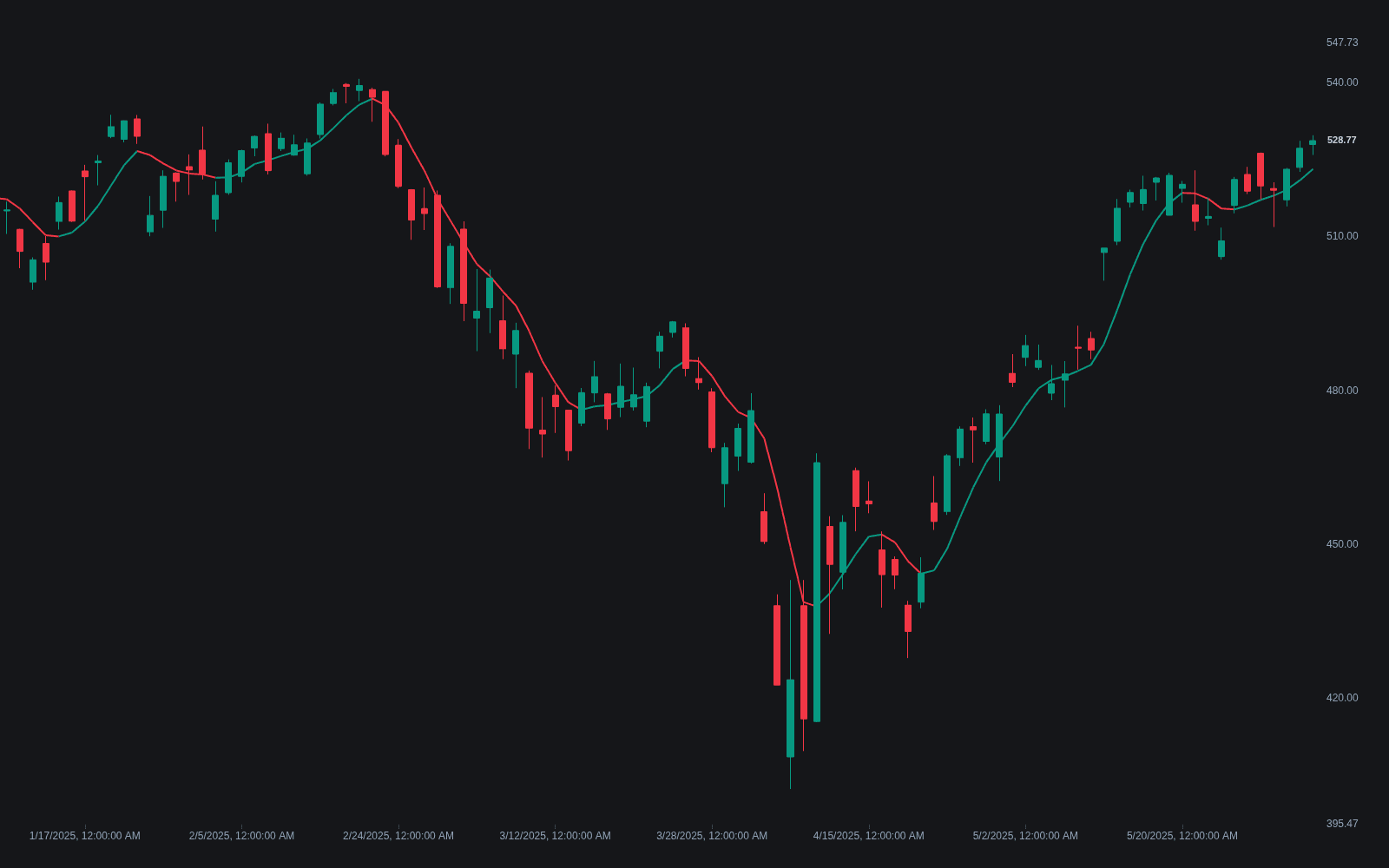
What is a Gaussian Filter?
A Gaussian filter smooths price with a weighting that follows the Gaussian bell curve, the shape of the normal distribution named for Carl Friedrich Gauss. In the direct form, a windowed FIR smoother with bell-curve weights, each bar's weight falls off exponentially with the squared distance from the window's center, so the middle of the lookback dominates and the edges taper smoothly toward zero. In the recursive form common on charting platforms, price is run through several identical one-pole smoothing stages in series; by the central limit theorem, cascading identical smoothers pushes the combined response toward that same bell shape.
Traders reach for it because of how it degrades noise. An SMA's rectangular window treats the oldest bar the same as the newest and drops it abruptly, which lets ripple through and makes the average lurch when a large bar exits the window; the Gaussian taper removes both effects, and its step response is essentially free of overshoot and ringing. The price is the universal one: lag. Period and pole count set the trade-off, with each extra pole adding smoothness and delay, and a one-pole version behaving much like an EMA.
How to calculate a Gaussian Filter
Two constructions are common, one direct and one recursive. Both take a period; the recursive form adds a pole count.
- 1Direct (FIR) form: choose a window length and a width parameter (sigma). Weight each bar by the bell curve evaluated at its distance from the window's center, normalize the weights to sum to one, and output the weighted average of price.
- 2Recursive form: choose a cutoff period and a pole count N (a small integer; each pole is one smoothing stage). Derive the per-stage smoothing coefficient from the cutoff and N, then pass price through N identical one-pole stages in series.
- 3Tune to purpose: longer periods and higher pole counts give a rounder, slower line; shorter periods and fewer poles track price more closely but let more noise through.
How it's calculated
The Gaussian filter smooths price by passing it through N identical one-pole stages whose combined impulse response approximates a normal curve.
This is John Ehlers' recursive Gaussian filter; expanding the cascade gives the published binomial forms, e.g. 2 poles: GF_t = alpha^2 × x_t + 2 × (1 - alpha) × GF_{t-1} - (1 - alpha)^2 × GF_{t-2}.
More poles mean more smoothing and more lag at the same period.
A separate FIR variant weights the last few bars by a sampled normal curve and divides by the weight sum; the recursive version above is the common TA implementation.
How traders use it
- As a trend baseline: the filter's slope and price's position relative to it give a bias read with fewer flips than a raw moving average of similar length.
- As the centerline of a channel: bands drawn a volatility multiple around the filter turn it into a mean-plus-envelope system for riding trends or fading extremes.
- As a pre-smoother: running price or an indicator input through a Gaussian stage before computing momentum reduces false crossings, at the cost of added delay.
- In crossover logic: pairs of Gaussian filters of different lengths, or price crossing the filter, reuse the standard moving average crossover grammar with smoother lines.
Gaussian Filter vs related filters
Ehlers SuperSmoother: Both come from the DSP tradition John Ehlers brought to trading. The SuperSmoother is a specific two-pole recursive design aimed at removing very short cycle noise with minimal lag; a Gaussian filter targets the bell-shaped response and grows smoother, and slower, as poles are added.
ALMA: ALMA is a Gaussian-weighted average with an offset parameter that shifts the bell's peak toward recent bars to cut lag. A plain Gaussian filter keeps the kernel centered or uses the recursive cascade, so it is more symmetric but laggier at the same length.
SMA: The SMA is the rectangular-window case: equal weights with hard edges. The Gaussian's taper suppresses the ripple and the exit-jump an SMA shows when a large bar leaves its window.
Concept family
Trend
100 concepts mapped · 100 in the Library
Gaussian Filter FAQ
Turn Gaussian Filter into a trading strategy.
Take the implementation from this page into Quant, then build on it, backtest it on real data, and keep refining it in conversation.