Concept
Impulse Leg
Impulse Leg is a Market Structure concept. The Library holds 1 implementation, a working definition you can pull into Quant.
Top Impulse Leg indicator
The top custom implementation, built on the original standard Impulse Leg formula.
1 total
Want to trade Impulse Leg? The implementation below is one prompt away from a backtested strategy in Quant.
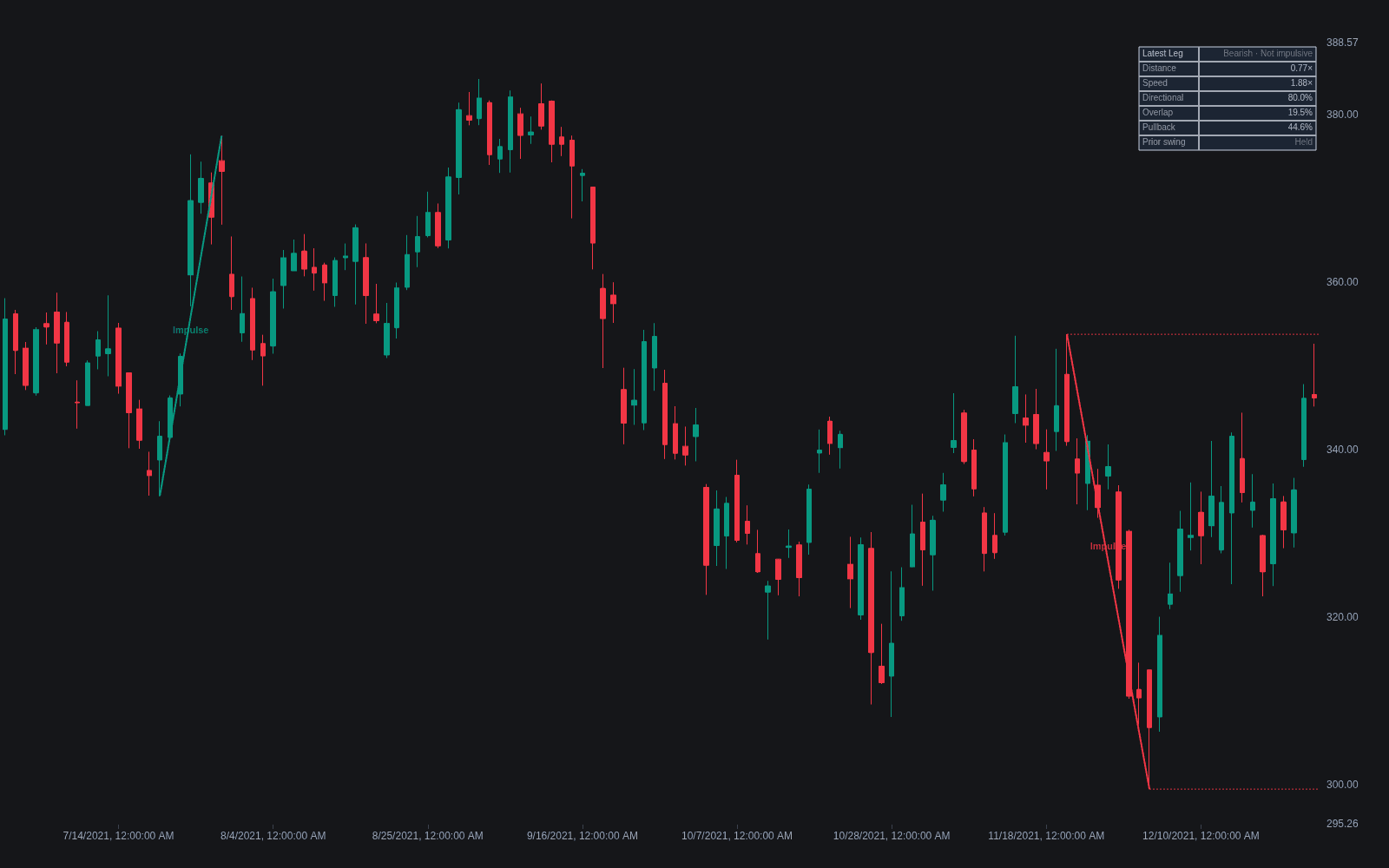
What is an Impulse Leg?
An impulse leg is the directional segment of market structure: the fast, one-sided move that travels with the prevailing trend and does the structural work of taking out prior swing points. Relative to the moves around it, an impulse leg covers more distance in less time, with large candle bodies, little overlap between bars, and shallow intrabar pullbacks. In structure terms it is the leg that prints a break of structure; the slower counter-move that follows and retraces part of it is the corrective leg.
The idea is older than the vocabulary. Dow Theory described trends a century ago as advancing waves separated by reactions, and Ralph Nelson Elliott built his 1938 Wave Principle around the same asymmetry: motive waves travel, corrective waves consolidate. Modern structure trading stripped the distinction down to the bare observation that trends move in impulses and rest in corrections, with no counts or ratios attached. Smart Money Concepts adds its own word, displacement, for an especially violent impulse that leaves imbalances behind.
Alternating impulses and corrections are the basic rhythm of a trend: expansion, then retracement, then expansion again. That alternation is what swing structure grammar formalizes, and it repeats at every scale, since each impulse is itself built from smaller impulses and corrections, as fractal nesting describes. Elliott analysis maps impulses onto motive waves, though Elliott adds internal count requirements the everyday term does not carry.
The label matters because most structure decisions hang on it. Trend direction is defined by which way the impulses point, entries are staged inside the corrections that follow them, and the first genuine impulse against the trend is the raw material of a change of character. The classification is partly subjective in real time: a leg that starts impulsively can stall, overlap, and end up corrective, so labels firm up only after the leg completes.
How to identify an impulse leg on a chart
Impulse legs are judged relative to the legs around them, so identification is comparative rather than absolute.
- 1Mark the swing points first, using swing highs and lows, a fractal marker, or a zigzag tool, so every leg has a defined start and end.
- 2Compare speed and distance: an impulse covers noticeably more ground per bar than its neighbors, with full-bodied candles stacked one way and little bar-to-bar overlap.
- 3Check what the leg accomplishes. The clearest impulses take out a prior swing point and print a break of structure; a fast push that dies short of one is only a candidate.
- 4Inspect the pauses inside it: impulses rest in brief, shallow consolidations, while deep overlapping retracements mid-leg argue the move is corrective.
- 5Wait for completion before trusting the label; a leg's extent and character are fixed only once a new swing point forms at its end.
How traders use it
- To define trend state: while impulse legs point one way and corrections hold above (or below) the prior swing point, the trend is treated as intact; the first impulsive leg against that direction is an early warning of a character change.
- To stage entries: rather than chasing the impulse, traders commonly wait for the corrective leg to retrace part of it and enter in the impulse direction at structure or retracement levels inside the prior leg.
- To anchor tools and risk: the impulse's origin and extreme anchor retracement and projection measurements, and its origin doubles as the invalidation point for continuation trades.
- To grade breakouts: the character of the exit leg separates conviction from trap; an impulsive escape that holds outside the range reads as genuine, while a labored push that folds back inside marks a false breakout.
- To align timeframes: many playbooks require the higher-timeframe leg and the entry-timeframe impulse to point the same way, the discipline covered under multi-timeframe structure alignment.
Impulse leg vs related concepts
Corrective Leg: The other half of the alternation. Corrections are slow, overlapping, and retrace part of the impulse; impulses are fast, one-sided, and do the structural damage. Each is defined relative to the other, and a leg is only ever read as one of the two.
Break of Structure: An event versus a segment. The break of structure is the moment a swing point gives way; the impulse leg is the move that produces it. Not every impulse breaks structure, but nearly every clean break is printed by an impulse.
Zigzag Structure: The rendering versus the reading. A zigzag reduces price to alternating legs by a fixed reversal rule and treats them all equally; calling one leg impulsive and the next corrective is an interpretive layer the zigzag itself does not supply.
Concept family
Market Structure
31 concepts mapped · 31 in the Library
Impulse Leg FAQ
Turn Impulse Leg into a trading strategy.
Take the implementation from this page into Quant, then build on it, backtest it on real data, and keep refining it in conversation.