Sine-weighted MA
 By LuxAlgoMar 22, 2026
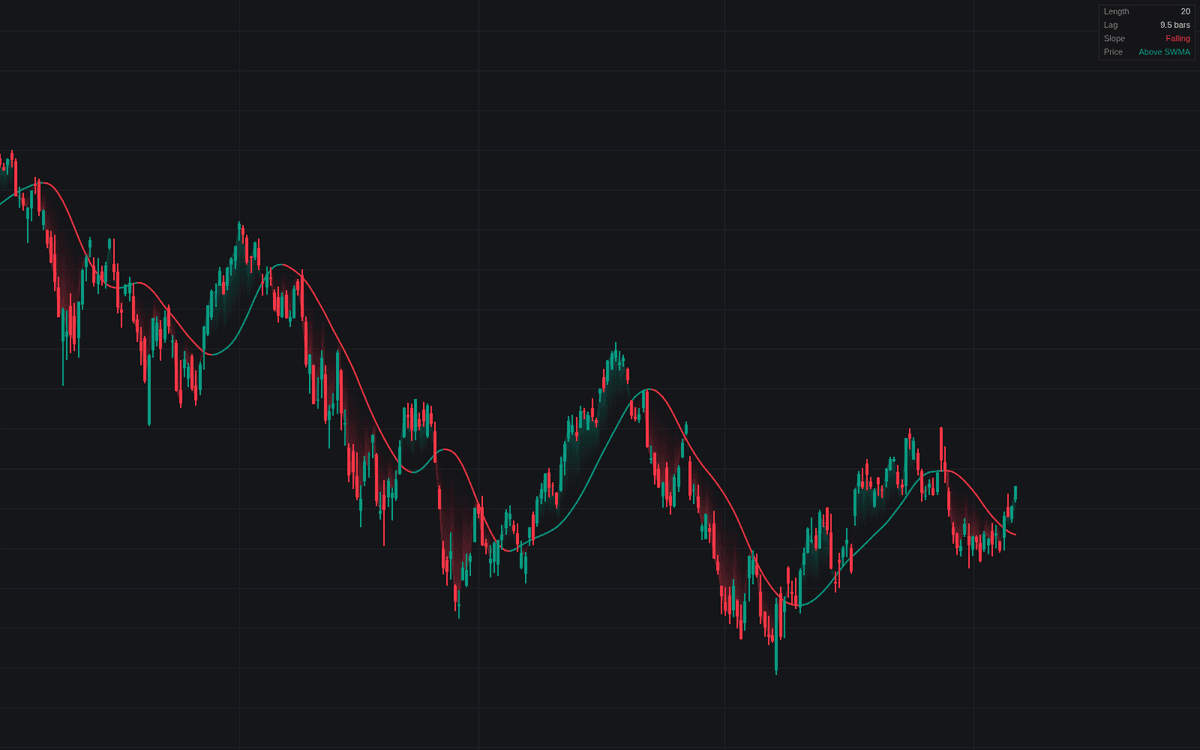

Sine-weighted MA draws the half-sine-windowed smoother as a single slope-colored line with an optional faster companion, the definitive clean take on the sine-weighted moving average. Weights peak mid-window and fade toward zero at both ends, so bar-to-bar jitter is heavily damped and the slope flips rarely; the cost is delay of about half the window, which the dashboard quotes exactly as (N − 1) / 2 bars.
How to Trade the Sine-weighted MA?
- Slope color: the line paints bullish while rising and bearish while falling, the low-jitter trend read this weighting exists for.
- Price side of the line: the gradient fill leans bullish while the source holds above the SWMA and bearish below it, the second classic baseline read.
- Fast SWMA crossings: with the pair enabled, the 10-bar line crossing the 20-bar baseline gives steadier crossover legs than equal-weighted averages of the same lengths.
It earns its keep among the trend-following toolkit's slower lines wherever dodging whipsaw is worth more than an early entry: as a pair's slow leg, a slope filter, or a pre-smoothing stage feeding other studies.
Sine-weighted MA Settings
- Source (default close): the series the average smooths.
- Length (default 20): window size N; each bar is weighted by sin(π(i+1)/(N+1)), so raising it buys smoothness at the price of roughly half a window of extra delay.
- Fast SWMA (default off) and Fast SWMA Length (default 10): the crossover companion; keep it shorter than the main length.
- Show Dashboard (default on): length, lag, slope and price position at a glance.
- Style: Slope Trend Coloring (default on), Price / SWMA Gradient Fill (default on), Price Crossing Markers (default off), Line Width (default 2). These control presentation only.
Frequently Asked Questions

The Library is free. Quant makes it yours.
Pull any concept or indicator into Quant: rebuild it, retune it, or turn it into a backtested strategy of your own.