Structure Invalidation
 By LuxAlgoMay 23, 2026
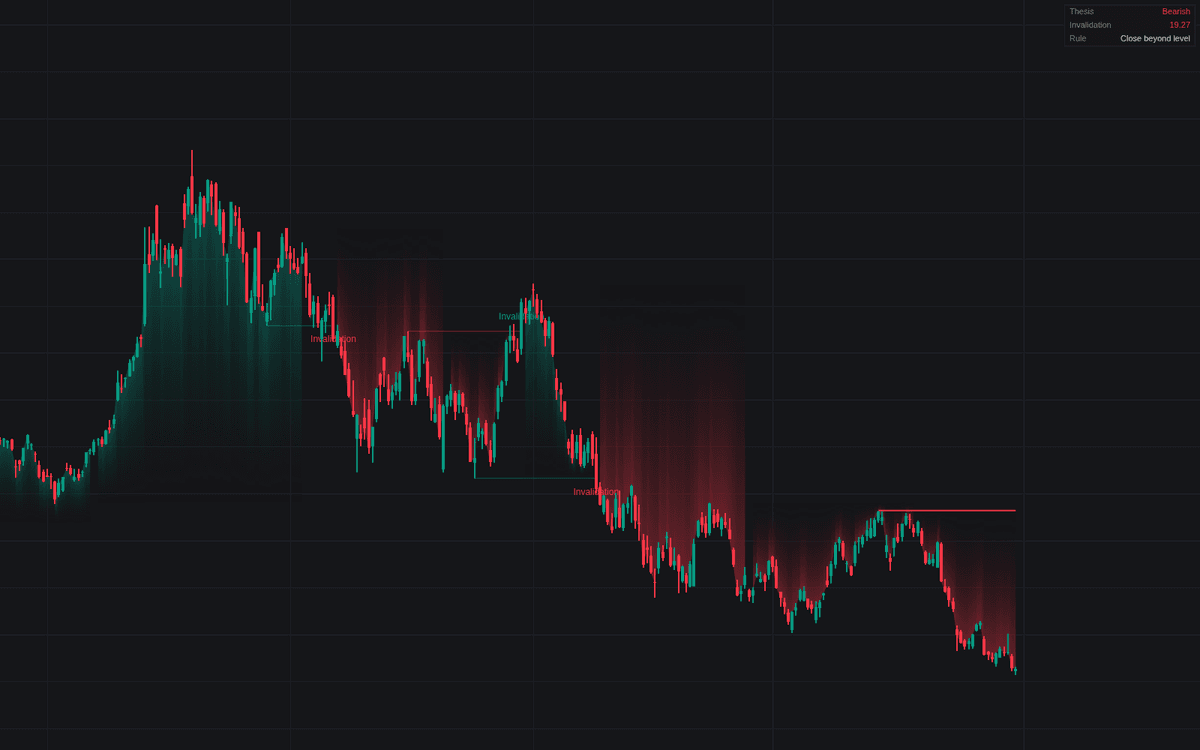

Structure Invalidation keeps the level that would prove a structural thesis wrong visible at all times, the first dedicated build of structure invalidation as its own tool. A swing rule confirms pivots, the newest one in the thesis direction becomes the protected swing, and its level extends right. When the rule declares a decisive break, an Invalidation label prints, the line freezes, the bias flips and the panel updates. The stated rule applies mechanically, never renegotiated.
How to Trade the Structure Invalidation?
- Invalidation event: the protected swing breaks per the active rule. The thesis is falsified, and the same break opens the opposite structure.
- Displaced or not: the label tooltip reports whether the breaking close cleared the level by the Displacement Multiple in ATRs. Displacement argues a genuine break over a sweep.
- Reclaimed: a close back through within the Acceptance Window retags the event as sweep-like; the structure stays invalid either way.
- Distance fill: the gradient between price and the level shows the room the thesis has left.
Structure Invalidation Settings
- Swing Length (default 10): bars each side confirming a swing; larger values track external structure, smaller internal.
- Invalidation Rule (default Close beyond level): also Wick beyond level (fastest, most sweep-exposed) or Higher timeframe close.
- Higher Timeframe (default 240 minutes): timeframe the HTF rule closes on; falls back to a chart close if not higher.
- ATR Length (default 14) and Displacement Multiple (default 1.0): the yardstick for grading break character.
- Acceptance Window (default 3): bars in which a close back through tags the break as reclaimed.
- Display: Distance To Invalidation Fill and Show Thesis Panel (both on), Label Size (Small).
Frequently Asked Questions

Original indicatorBuilt in-house by LuxAlgo
The Library is free. Quant makes it yours.
Pull any concept or indicator into Quant: rebuild it, retune it, or turn it into a backtested strategy of your own.