Concept
Structure Invalidation
Structure Invalidation is a Market Structure concept. The Library holds 1 implementation, a working definition you can pull into Quant.
Top Structure Invalidation indicator
The top custom implementation, built on the original standard Structure Invalidation formula.
1 total
The Structure Invalidation implementation below can become a backtested trading strategy — describe your rules and Quant writes the code.
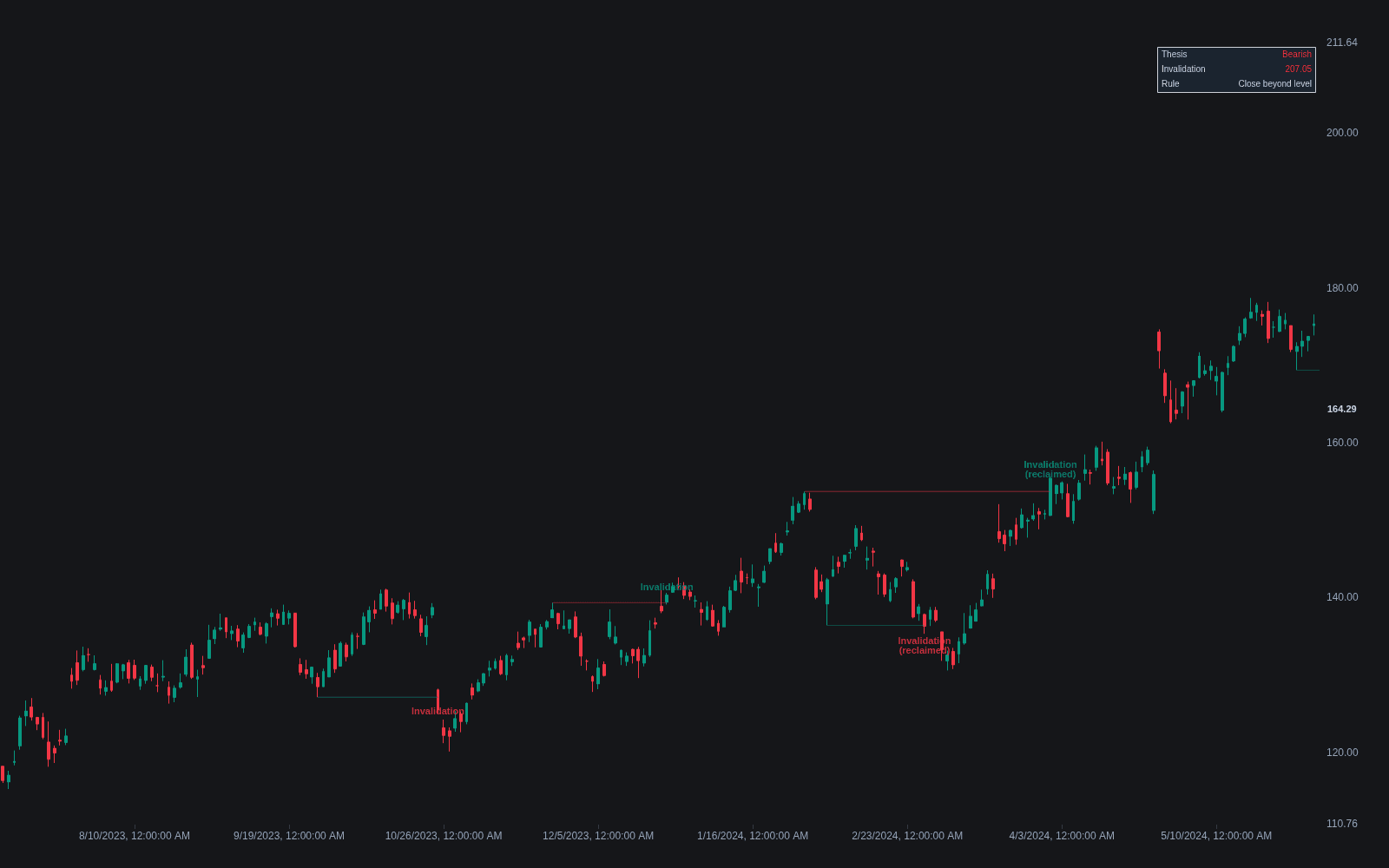
What is structure invalidation?
Structure invalidation is the event that proves a structural trade thesis wrong: price decisively takes out the swing point on which the thesis depends. If a long is built on the premise that a higher low will hold and the trend of higher highs and higher lows will continue, a decisive break below that higher low invalidates the premise. The concept separates two things traders often blur, namely a trade losing money and a trade being wrong. A position can be underwater while its structure is intact, and it can be structurally dead while barely offside.
The idea exists because every structural method needs a falsification point to be testable. A break of structure in the trend direction confirms continuation; the same event against the position is invalidation, and against the prevailing trend it is a change of character. Defining in advance exactly which level kills the idea converts a vague hope into a checkable claim, and it is the reasoning behind placing a structure stop beyond that level rather than at an arbitrary dollar distance.
The practical difficulty is deciding what counts as decisive. Wicks through a swing point are frequently liquidity sweeps that reverse immediately, so many traders require a candle close beyond the level, or a close on a specific timeframe, before declaring the structure invalid. There is no universally correct rule; there is only the discipline of choosing one before entry and honoring it.
How to identify structure invalidation on a chart
Invalidation is only observable relative to a stated thesis, so start by naming the level the idea depends on.
- 1Define the protected swing: for a long, the swing low whose failure breaks the sequence of higher lows; for a short, the mirrored swing high.
- 2Decide the invalidation criterion in advance: wick beyond the level, close beyond it, or a close on a higher timeframe. Each trades off speed against noise.
- 3Distinguish internal from external structure; a break of a minor internal pivot often reprices the entry, while a break of the external swing kills the whole idea.
- 4When the level breaks, check the character of the break: displacement and acceptance beyond the level argue genuine invalidation, while an instant reclaim suggests a sweep.
- 5Once your stated criterion triggers, treat the structure as invalid even if price hovers nearby; renegotiating the rule after the fact defeats its purpose.
How traders use it
- As the logic behind stop placement: stops go beyond the invalidation swing, often padded past obvious stop pockets, so the position exits when the idea is wrong rather than when noise is loud.
- As a re-entry framework: invalidation of a bullish structure is not merely an exit signal, since the same break is the first evidence of a bearish structure that may set up the opposite trade.
- As a position-management boundary: partial profits, stop trailing, and adding are all defined relative to which swings remain unbroken, keeping management mechanical instead of emotional.
- As a review tool: journaling whether losing trades exited on true invalidation or on premature fear separates bad ideas from bad execution. The honest limitation is that any close-based rule will occasionally exit late, and any wick-based rule will occasionally exit on a sweep that reverses.
Structure invalidation vs adjacent concepts
Structure stop: The structure stop is the order; structure invalidation is the event it encodes. The stop is placed beyond the invalidation level so the market, not the trader's mood, decides when the thesis is dead.
Change of character: A change of character is invalidation viewed at market scale: the first structural break against the prevailing trend. Invalidation of an individual trade can occur on internal structure without any market-level change of character.
Swing failure pattern: A swing failure pattern is a wick through a swing that immediately fails, which is precisely the event close-based invalidation rules are designed not to react to. One trader's invalidation print is another's swing failure entry.
Concept family
Market Structure
31 concepts mapped · 31 in the Library
Structure Invalidation FAQ
Turn Structure Invalidation into a trading strategy.
Take the implementation from this page into Quant, then build on it, backtest it on real data, and keep refining it in conversation.