UHL Adaptive MA
 By LuxAlgoJun 1, 2026
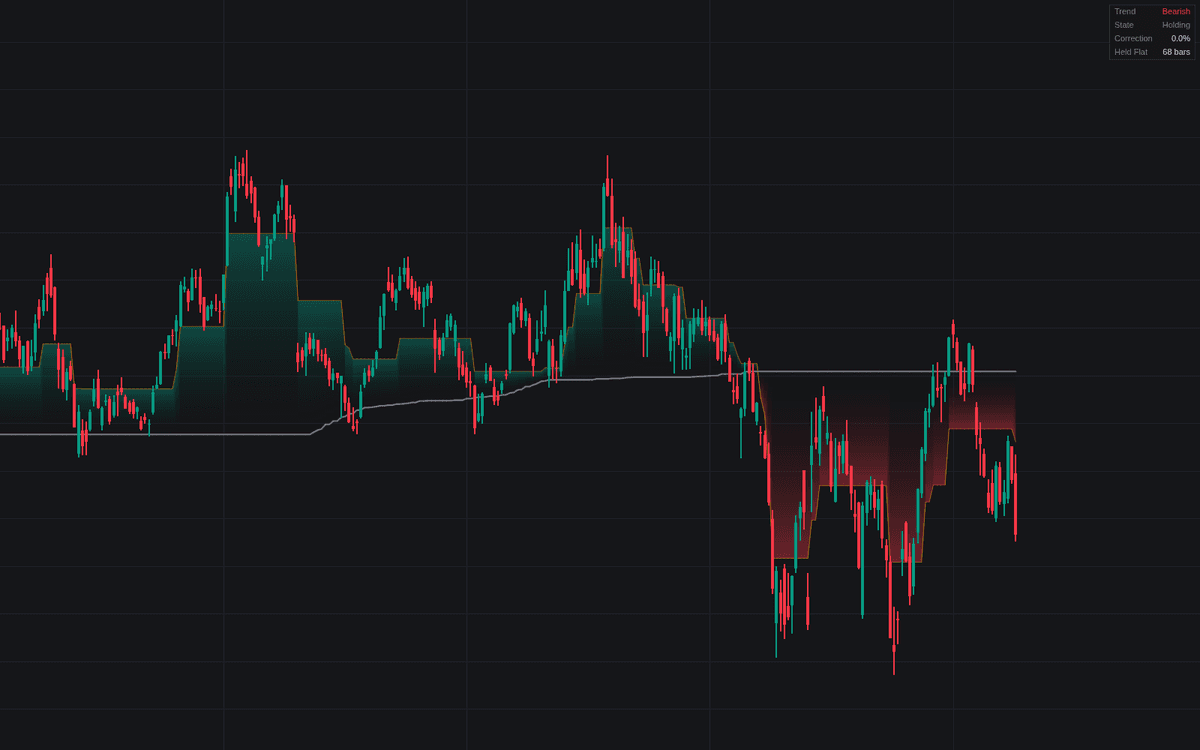

UHL Adaptive MA plots Andreas Uhl's corrected moving average: a baseline that holds perfectly flat until price moves further than its own recent variance justifies, then steps toward the simple average by a re-derived fraction. This build gives the concept its clean, complete form (the slow Corrected MA plus a fast Trend-Step Line made by applying the same variance gate directly to the raw source) and adds a dashboard reporting the trend state, the gate's hold-or-step status, the correction factor, and how long the line has held flat.
How to Trade the UHL Adaptive MA?
- Stepping up or down: a slope turn out of a hold means movement has outrun the recent noise, the start of a statistically meaningful move, covered by the step alerts.
- Holding flat: price is back inside the variance band; congestion, and the natural stand-aside state.
- Two-line crossings: the Trend-Step Line crossing the corrected baseline defines the bullish and bearish states; triangle markers are optional and the crossover alerts work regardless.
UHL Adaptive MA Settings
- Source (default close): series the variance-gated correction is applied to.
- Lookback Length (default 100): sets the noise estimate and the moving-average target together. Longer widens the noise band for flatter lines with later, larger steps.
- Show Trend-Step Line (default enabled): plots the fast corrected line whose crossings define the two-line states.
- Show Dashboard (default enabled): the state panel; position and text size are adjustable.
- Style toggles: Slope Coloring and Adaptivity Gradient (both default enabled) color the line by step direction and saturate it by correction strength; Trend Gradient Fill (default enabled), Crossover Markers (default disabled), Line Width (default 2).
Frequently Asked Questions

Original indicatorBuilt in-house by LuxAlgo
The Library is free. Quant makes it yours.
Pull any concept or indicator into Quant: rebuild it, retune it, or turn it into a backtested strategy of your own.