Concept
Upthrust
Upthrust is a Wyckoff concept. The Library holds 1 implementation, a working definition you can pull into Quant.
UT
Top Upthrust indicator
The top custom implementation, built on the original standard Upthrust formula.
1 total
From studying Upthrust to trading it: take the implementation below into Quant and backtest it instantly.
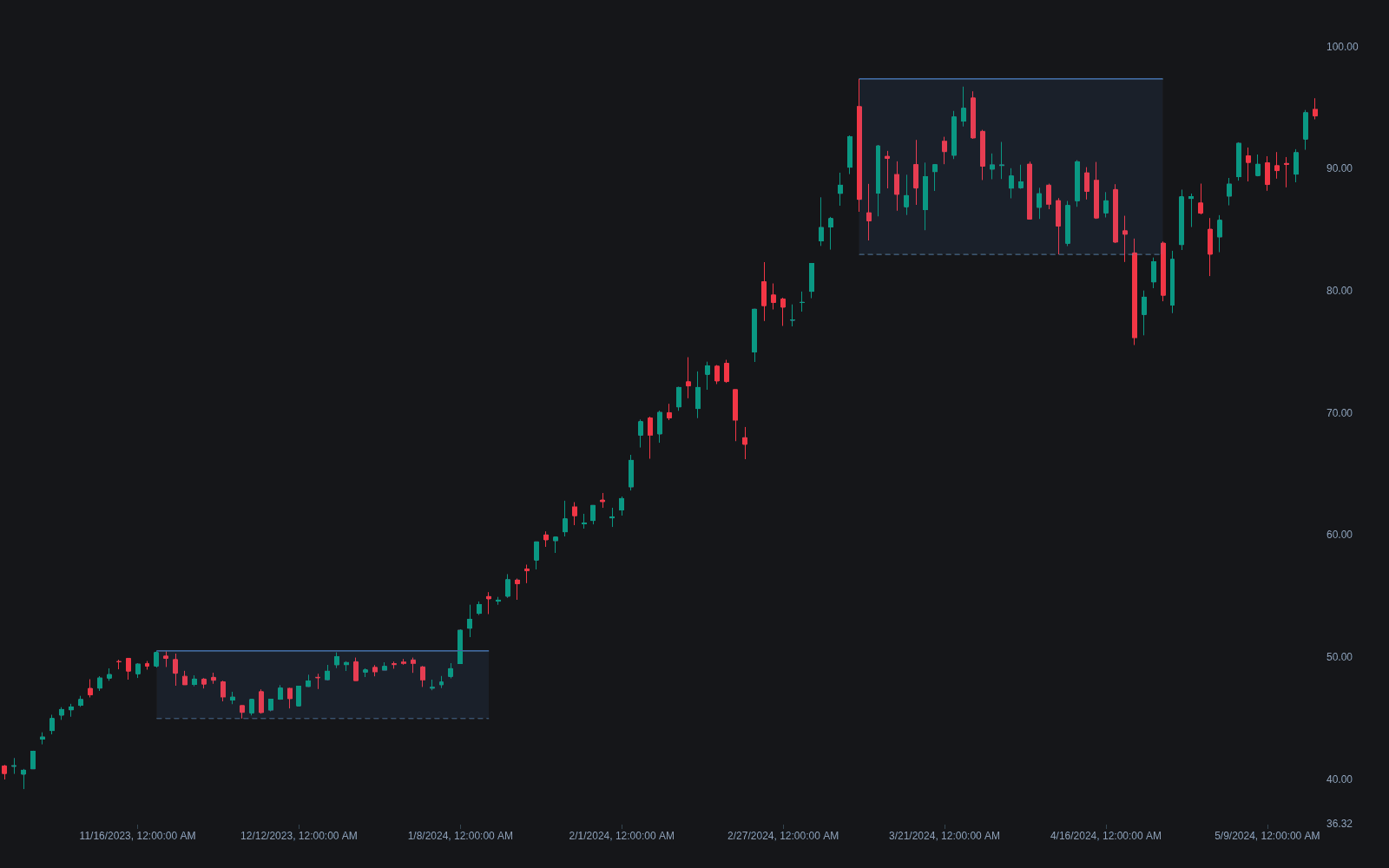
What is an Upthrust?
An upthrust is the bearish mirror of the spring: price pushes above the resistance of a trading range, finds no real demand, and falls back inside. The pop above the highs fills resting buy stops and attracts breakout buyers, and its swift failure shows that higher prices could not be sustained; in Wyckoff terms, larger sellers use the excursion to distribute inventory. In the Wyckoff Distribution Schematic, ordinary upthrusts (UT) appear through phase B, and the decisive one, the upthrust after distribution (UTAD), is the phase C test of demand that precedes markdown.
Other frameworks describe the same footprint as a sweep of buy-side liquidity or a false breakout of the range highs. As with springs, the label is conditional: a push above resistance that holds and builds acceptance is a breakout, not an upthrust, and the difference is often clear only from the close and the behavior on the retest.
The term comes from the Wyckoff Method, the tape-reading and campaign-analysis technique developed by Richard D. Wyckoff in the early twentieth century and carried forward in course form after his death. Wyckoff read markets through the intentions of large operators, and the upthrust expresses that lens clearly: the move above resistance tests whether demand is real and, when it is not, sells inventory to the very buyers it attracted. Later teachers refined the vocabulary and fixed the UTAD's place in the standard schematics.
Analytically, an upthrust is an effort vs result statement: volume expands into new highs yet the bar closes back inside the range, effort with no upward result. It is also absorption seen from the seller's side, resting supply consuming the breakout buying. Its bullish mirror, the spring under support in the Wyckoff Accumulation Schematic, tests supply exactly as the upthrust tests demand.
How to identify an Upthrust
Like the spring, an upthrust is defined by its context: a mature trading range following an uptrend.
- 1Frame the range: mark the resistance defined by the buying climax and later tests, where breakout buy stops are likely resting above the highs.
- 2Watch the poke above: price trades above resistance but cannot hold there, closing back inside the range, often with a long upper wick.
- 3Read the effort: heavy volume with a weak close signals supply meeting the breakout; a very light poke signals demand never showed up at all.
- 4Confirm with weakness: a failing rally that stays below the upthrust high, followed by expanding volume to the downside, supports the distribution read.
- 5Track the retest: a later rally stalling beneath the upthrust high on shrinking volume confirms the failure, while acceptance back above the range invalidates the upthrust read.
How traders use it
- As a short-entry model inside distribution: the classic sequence is a UTAD, then a weak rally that fails below the upthrust high, then a short with the stop above that high, anticipating a sign of weakness.
- As a trap detector on breakouts: a wide push above resistance that closes back inside the range on elevated volume warns that breakout longs are trapped, with downside follow-through in the next bars as the usual confirmation.
- As a phase marker: repeated upthrusts across a range's upper boundary, each showing effort with no upward result, are among the behaviors that distinguish distribution from re-accumulation.
- For managing the trade: acceptance back above the upthrust high contradicts the distribution thesis, so conventional practice treats that reclaim as the exit signal, not a level to argue with.
- For grading the rallies that follow: Wyckoff wave and volume studies assess the bounces after an upthrust, shortening up-waves on shrinking volume arguing that supply now controls the range.
Upthrust vs adjacent Wyckoff concepts
Spring: The spring is the same event reflected through support: a probe below the range lows that fails and returns, testing supply where the upthrust tests demand. Springs are the terminal shakeout of accumulation ranges; the UTAD plays the same role in distribution.
Absorption: Absorption is the process; the upthrust is one footprint of it, sellers absorbing the breakout buying above resistance. It can also appear as flat, heavy-volume trade inside the range with no terminal poke at all.
Effort vs Result: Effort vs result is the analytic principle, comparing volume spent with progress made. The upthrust is a specific application: large effort above resistance yielding a close back inside the range is precisely the disagreement that defines the event.
Concept family
Wyckoff
17 concepts mapped · 17 in the Library
Upthrust FAQ
Turn Upthrust into a trading strategy.
Take the implementation from this page into Quant, then build on it, backtest it on real data, and keep refining it in conversation.