Concept
Spring
Spring, also known as terminal shakeout, is a Wyckoff concept. The Library holds 1 implementation, a working definition you can pull into Quant.
Top Spring indicator
The top custom implementation, built on the original standard Spring formula.
1 total
This Spring implementation is strategy-ready: open it in Quant, set your rules, and it backtests automatically.
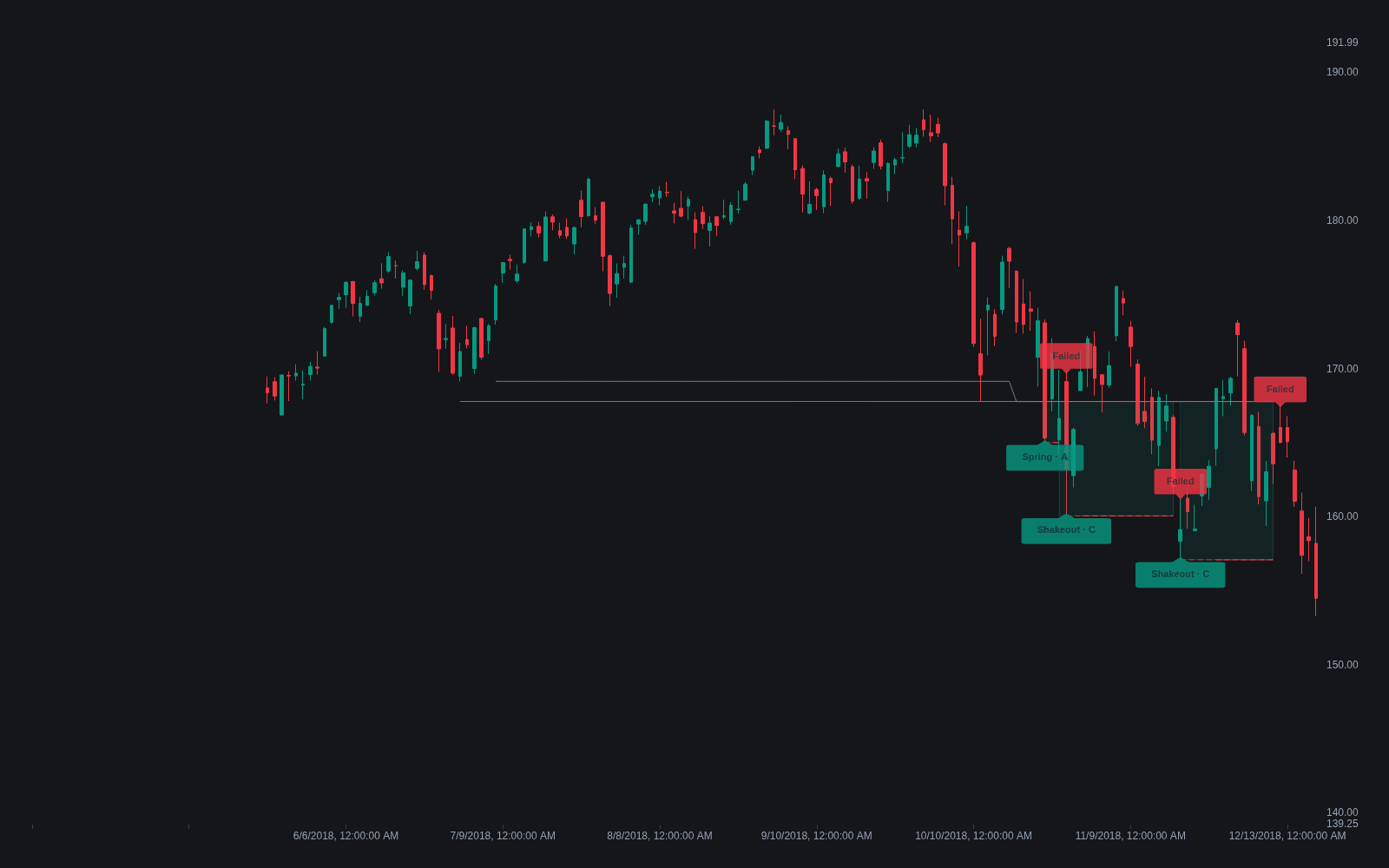
What is a Spring?
A spring is a Wyckoff event at the bottom of an accumulation trading range: price breaks below the range's support, finds little further selling, and quickly reverses back inside. The dip triggers stops below the lows and invites breakdown shorts, but the lack of follow-through shows supply is nearly exhausted, and larger buyers use the flush to complete their positions. In the classic Wyckoff Accumulation Schematic it is the phase C test that precedes markup.
Wyckoff-tradition sources grade springs by the volume on the undercut and on the test that follows; the deeper, higher-volume version is often called a terminal shakeout, though many modern sources use the two terms interchangeably. Other frameworks describe the same footprint as a liquidity sweep or false breakout of the range lows. The label is earned in hindsight: an undercut that keeps falling was simply a breakdown.
The spring is effort versus result staged as a single experiment: the break below support is the effort to sell, and the absence of result, no downside follow-through, light volume, a prompt recovery, is the verdict that supply is spent. The schematic gives it a place in a sequence: the selling climax and automatic rally establish the range, secondary tests probe it through phase B, and the spring is phase C's final question, deliberately asked below the lows where every remaining seller and resting stop must answer. What follows, in the textbook progression, is the sign of strength rally, the last point of support pullback, and markup.
Trading practice keeps the sequence's discipline. The confirmation is the test, a quiet pullback holding above the spring low, and the entry convention places stops just below that low, where the accumulation read is objectively wrong; targets classically project from the range's cause, the preparation Wyckoff held proportional to the move it funds. The mirror event guards the other boundary, the upthrust playing the identical trap at distribution tops, and the cross-framework translation is now standard: spring, sweep of sell-side liquidity, and turtle soup at range lows name one footprint in three vocabularies, which detection tools tag mechanically whatever the trader calls it.
How to identify a Spring
A spring only exists in context: an established accumulation-style trading range has to come first.
- 1Frame the range: mark the support defined by the selling climax and later tests, with price ranging above it long enough that stops have accumulated below the lows.
- 2Watch the undercut: price breaks under support, ideally without volume expanding with the break, and re-enters the range within a few bars rather than accepting below it.
- 3Demand the test: a quiet pullback that holds above the spring low is the confirmation most Wyckoff texts require; a close back below the spring low cancels the read.
- 4Compare the volumes: the undercut's volume grades the event, light for a classic spring, heavy for a shakeout, and the test's volume must be quieter than the spring's, showing supply genuinely dried up.
- 5Wait for the sign of strength: a rally on expanding volume and spread out of the range area is the sequence's confirmation that markup, not more ranging, follows.
How traders use it
- As an entry model inside accumulation: the classic sequence is spring, then a low-volume test that holds above the spring low, then a long entry with the stop below the spring. The test is the confirmation step most Wyckoff texts require before acting.
- As a supply gauge: the volume on the undercut matters. Modest volume that dries up as price re-enters the range supports the accumulation read, while heavy, persistent selling that keeps the market below support argues for a genuine breakdown instead.
- As a cross-methodology translation: structure traders treat springs, sweeps of sell-side liquidity, and swing failure patterns at range lows as versions of the same trap, which helps when reading material from either tradition.
- With the mirror in view: the upthrust runs the identical experiment at range highs, so range traders watch both boundaries with one grammar, springs arguing accumulation below, upthrusts arguing distribution above.
- For target framing: the classical objective projects from the range's cause, the extent of the preparation, so the spring is sized not just as an entry but as the launch point of a move the schematic expects to be proportional to the base that built it.
Spring vs related range events
Upthrust: The mirror at the other boundary: a push above range resistance that fails and falls back inside, distribution's version of the same trap. One grammar covers both, effort beyond the range answered by no result, with the direction of the failure deciding which campaign is running.
Liquidity Sweep: The modern structural vocabulary for the same footprint: stops below the lows taken, price restored into the range. Wyckoff adds the campaign narrative, phase C of accumulation, and the volume grammar; the sweep framing adds pool mapping. Traders increasingly read both as one event.
Wyckoff Accumulation Schematic: The map the spring lives on: selling climax, automatic rally, secondary tests, then the phase C spring, sign of strength, and markup. Out of that context an undercut is just an undercut; the schematic is what makes the spring a named, tradeable question.
Concept family
Wyckoff
17 concepts mapped · 17 in the Library
Spring FAQ
Turn Spring into a trading strategy.
Take the implementation from this page into Quant, then build on it, backtest it on real data, and keep refining it in conversation.