Concept
Effort vs Result
Effort vs Result is a Wyckoff concept. The Library holds 1 implementation, a working definition you can pull into Quant.
Top Effort vs Result indicator
The top custom implementation, built on the original standard Effort vs Result formula.
1 total
The Effort vs Result implementation below can become a backtested trading strategy — describe your rules and Quant writes the code.
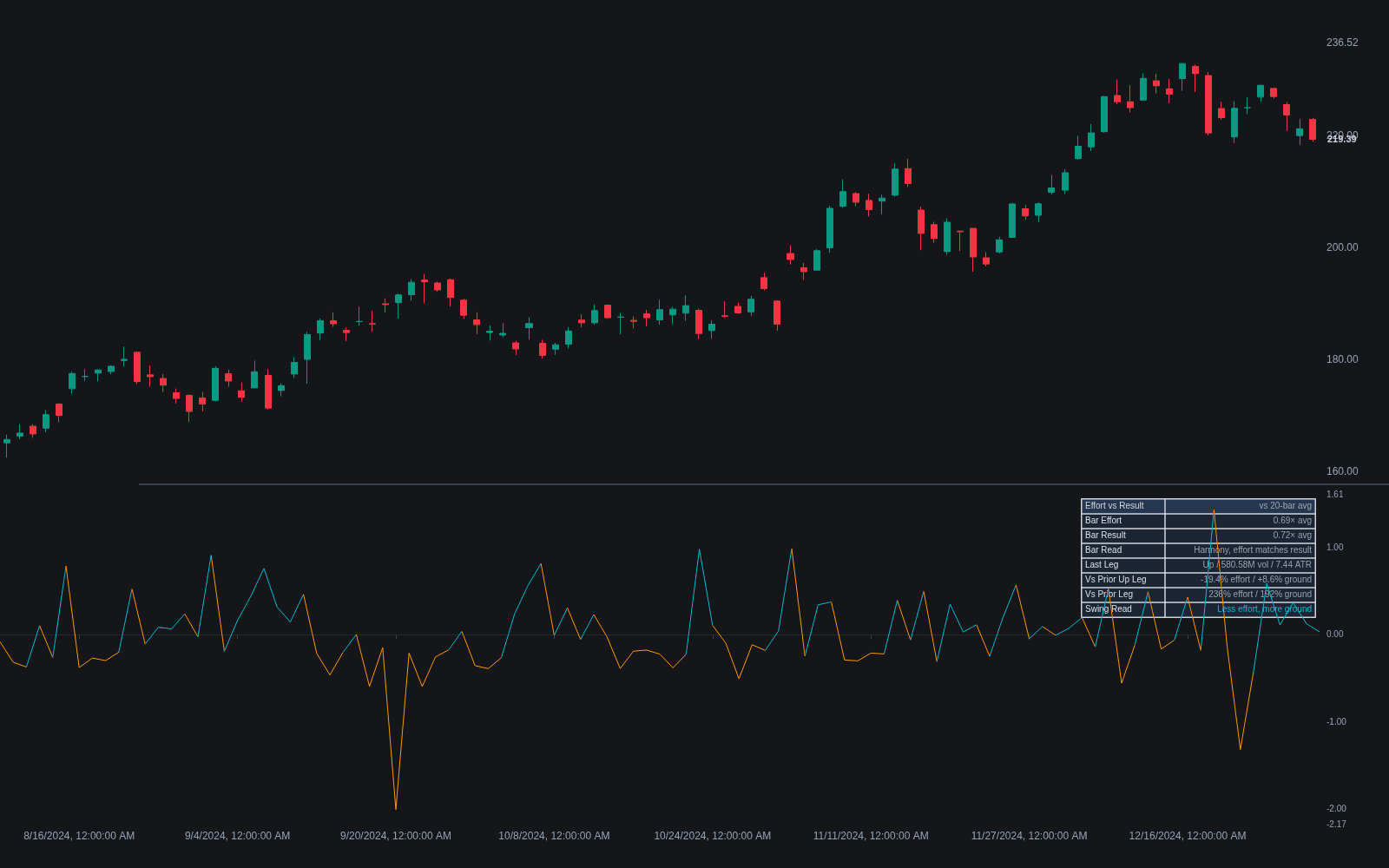
What is Effort vs Result?
Effort vs result is the third of Wyckoff's three laws. Volume is the effort; the price movement it produces is the result. When the two agree, a move is considered sound: expanding volume drives wide-range bars that make real progress. When they diverge, something is opposing the move: heavy volume that yields only a narrow spread or little net progress means the effort is being met by orders of similar size, often through absorption.
The law applies at any scale, from a single bar to a full swing or campaign. Rising volume with shrinking upward progress into resistance reads very differently from an easy, low-effort drift higher. Wyckoff traders treat effort/result divergence as an early warning that a trend is meeting opposition, not as a standalone signal: divergences can persist, and a move can pause and then continue once the opposing orders are consumed.
Within the Wyckoff method the law works alongside supply-and-demand and cause-and-effect, and it is the one that powers the schematics' key tests. A spring is an effort-result reading at a range low: the break below support on light volume with a quick recovery says the effort to sell found no supply, the bullish verdict. An upthrust is the mirror at range highs, effort above resistance producing no upside result. Reading each schematic event as an effort-result experiment, rather than a shape, is what separates Wyckoff analysis from pattern matching.
The law's descendants and instruments are everywhere. Volume spread analysis, the bar-level taxonomy in the Tom Williams tradition, systematizes effort-result verdicts per candle; wave-level instrumentation in the Wyckoff wave and volume studies tradition compares the volume behind each swing with the ground covered; and Library tools operationalize the read, absorption-bubble visualizations flagging heavy volume with no travel at levels, and volatility-impact studies quantifying how much result each unit of effort has been buying. The standing caveats: the law needs trustworthy volume data, and its verdicts always need location, since effort without result matters at a level and means little in the middle of nowhere.
How to identify effort vs result divergence
The comparison is always the same pair: what was spent, what was bought.
- 1Measure the effort: the bar's or swing's volume, judged against its own recent baseline rather than in absolute terms.
- 2Measure the result: the spread of the bar and its net progress, or the ground a whole leg covered.
- 3Compare at bar level: heavy volume with a narrow spread and little net movement is effort without result, the absorption signature.
- 4Aggregate to swing level: legs needing ever more volume to cover ever less ground mark a trend meeting opposition; easy travel on modest volume marks an unopposed one.
- 5Demand location before acting: the divergence means most at support, resistance, or a schematic test point, and needs confirming behavior, a failed test or structure break, to become a trade.
How traders use it
- As a bar-level read: a high-volume bar with a narrow spread and little net progress shows effort without result, a classic sign that aggressive orders were being absorbed at that level.
- As a swing-level trend check: comparing the volume behind each leg with the ground it covers. Legs that need ever more volume to cover ever less ground warn of trend exhaustion, while low-volume pullbacks that give back little are consistent with continuation.
- Around key levels: climactic action, a surge of effort that produces no further progress at support or resistance, is often the first event Wyckoff analysis looks for when judging whether a trend is ending.
- As the engine of schematic tests: springs, upthrusts and secondary tests are read as effort-result experiments at the range's edges, with the accumulation schematic essentially a sequence of such experiments resolving one way.
- Instrumented: absorption visualizations, volatility-per-volume studies and volume-graded price action tools convert the law into per-bar and per-wave measurements, so the divergence is detected mechanically and the trader's judgment is spent on location and response.
Effort vs result vs related Wyckoff reads
Absorption: Absorption is the mechanism behind the divergence: passive orders consuming aggressive flow, effort disappearing into a wall. Effort-vs-result is the observable evidence of it on bars and swings; when the law flags effort without result, absorption is usually the explanation on offer.
Wyckoff Wave & Volume Studies: The wave studies are the law instrumented: cumulative volume per swing, compared against the distance each swing traveled. Where the bar-level read is a snapshot, the wave version audits entire legs, which is the scale campaign analysis actually cares about.
Spring: The spring is the law applied at one specific location: a probe below range support whose light volume and quick recovery certify that selling effort found no supply. It is effort-vs-result packaged as a single, tradeable event with defined invalidation.
Concept family
Wyckoff
17 concepts mapped · 17 in the Library
Effort vs Result FAQ
Turn Effort vs Result into a trading strategy.
Take the implementation from this page into Quant, then build on it, backtest it on real data, and keep refining it in conversation.