Concept
Trading-range Position
Trading-range Position is a Wyckoff concept. The Library holds 1 implementation, a working definition you can pull into Quant.
Top Trading-range Position indicator
The top custom implementation, built on the original standard Trading-range Position formula.
1 total
This Trading-range Position implementation is strategy-ready: open it in Quant, set your rules, and it backtests automatically.
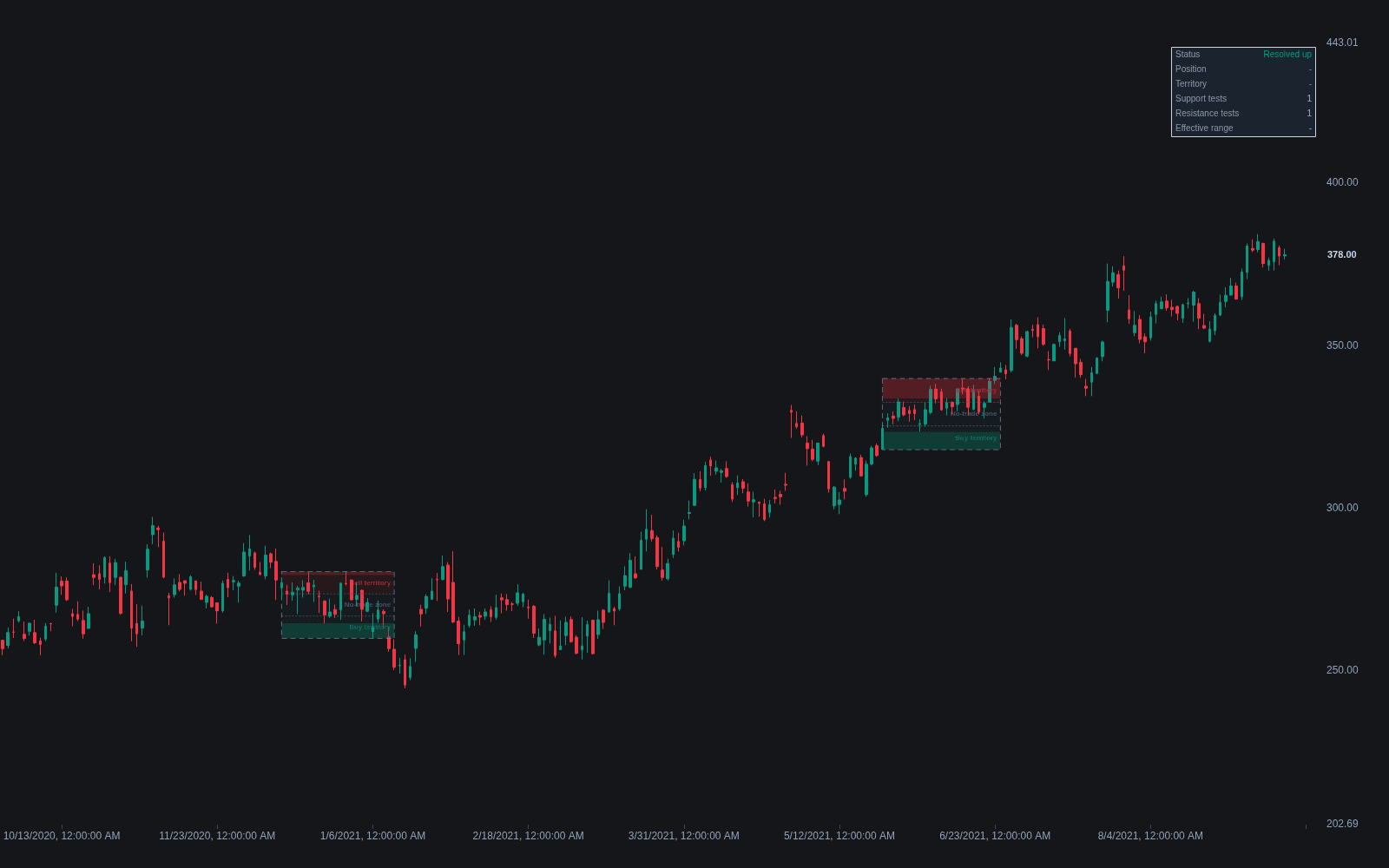
What is trading-range position?
Trading-range position is the discipline of locating where price currently sits inside a trading range, near support, near resistance, or in the middle, and letting that location govern what trades are even eligible. In Wyckoff practice the range's edges are where information and favorable prices concentrate: tests, springs, and upthrusts happen at the extremes, while the middle of the range is where neither side has an advantage and where stop placement is worst relative to the structure.
The concept exists because most range-trading losses come not from misreading the range but from taking trades at bad locations within it. A long entered at range support risks a small, structurally defined amount to reach resistance; the same long entered mid-range risks roughly half the range's height for half the reward, with no nearby level to lean on. Wyckoff-style traders therefore treat range position as a filter that precedes any signal: first establish where price is in the structure, then ask what the behavior there means.
Position within the range also shapes interpretation, not just execution. Heavy volume at the lows can be absorption or stopping action; the same volume mid-range is usually noise. A stall just under resistance sets up either a breakout or an upthrust, readings that simply do not exist elsewhere in the structure. In that sense range position is the coordinate system the rest of the Wyckoff range toolkit operates in.
How to establish range position on a chart
Range position is only meaningful once the range itself is defined honestly, from the levels that trading actually respected.
- 1Define the range from its first reversal extremes: in an accumulation structure, the selling climax low and the automatic rally high commonly set the initial support and resistance.
- 2Refine the edges as tests accumulate: use the zones price repeatedly reverses from, not single wicks, and accept that the working boundaries may be bands rather than lines.
- 3Divide the range into thirds or quarters: lower third is buy territory in a suspected accumulation, upper third is sell or short territory in a suspected distribution, and the middle is the no-trade zone for range-based entries.
- 4Note where the most recent action sits before reading any bar: identical price and volume behavior means different things at support, at resistance, and in the middle.
- 5Re-check after structural events: a spring or shakeout can reset the effective low of the range, shifting every subsequent position reading.
How traders use it
- As an entry filter: range traders restrict longs to the lower portion of the range and shorts to the upper portion, passing on mid-range signals no matter how attractive the individual bar looks.
- For stop logic: entries taken at an edge place stops just beyond the structure (under the spring low, above the upthrust high), keeping risk small relative to the traverse across the range.
- To time patience: mid-range position is used as an instruction to wait, since price in the middle of a range offers neither information nor location, and forcing trades there degrades expectancy.
- In breakout preparation: sustained acceptance in the upper third after repeated support tests often precedes upward resolution, so range position feeds the continuation-versus-failure read at the boundary.
- With a caveat: ranges redraw themselves. Springs, shakeouts, and expansions move the working edges, so position must be recomputed rather than anchored to the first boundaries drawn.
Range position vs neighboring location concepts
Premium and discount: Premium/discount divides a dealing range at its midpoint and labels the halves for buy-low, sell-high logic. Trading-range position is the Wyckoff equivalent, but it is read against tested support and resistance zones and their behavioral evidence rather than a mechanical 50 percent line.
Value area: The value area locates price relative to where volume concentrated, a distributional definition of the middle. Range position uses the reversal extremes instead; the two often agree but diverge when volume builds off-center in the range.
Concept family
Wyckoff
17 concepts mapped · 17 in the Library
Trading-range Position FAQ
Turn Trading-range Position into a trading strategy.
Take the implementation from this page into Quant, then build on it, backtest it on real data, and keep refining it in conversation.