Concept
Upthrust After Distribution
Upthrust After Distribution is a Wyckoff concept. The Library holds 1 implementation, a working definition you can pull into Quant.
UTAD
Top Upthrust After Distribution indicator
The top custom implementation, built on the original standard Upthrust After Distribution formula.
1 total
From studying Upthrust After Distribution to trading it: take the implementation below into Quant and backtest it instantly.
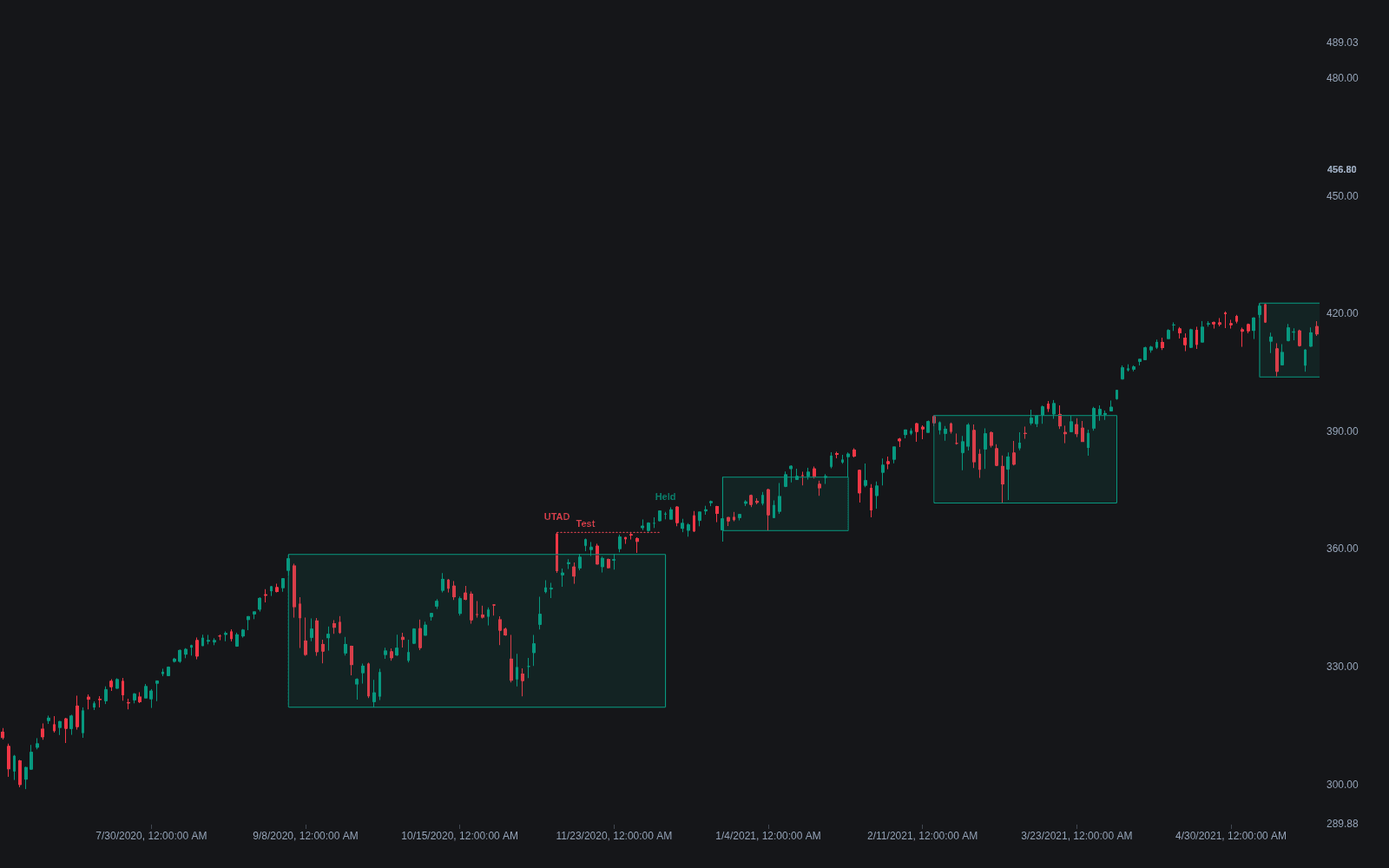
What is an upthrust after distribution?
An upthrust after distribution, usually abbreviated UTAD, is the terminal false breakout in the Wyckoff distribution model: a push above the resistance of a distribution range, late in the structure, that fails to hold and reverses back inside, after which markdown typically begins. In the labeled distribution schematic it is the Phase C event, the definitive test of remaining demand, playing the same structural role at tops that the spring plays at accumulation lows.
The logic is a demand test. By the time a range has absorbed months of rallying attempts, the question is whether any real buying power remains above resistance. A UTAD answers it: the breakout attracts breakout buyers and squeezes shorts, and if that is all the demand the market can produce, price cannot stay above the level. Large sellers get both a final round of higher prices to sell into and confirmation that demand is exhausted. The subsequent failure back into the range, especially on a weak, low-volume test of the UTAD high, is the evidence Wyckoff readers act on.
Traders care because the UTAD is among the most actionable moments in a top: it provides a nearby invalidation level (the UTAD high), a defined structure below it, and it frequently precedes the fastest part of the decline. It is also honest to say that not every distribution produces one; some tops break down without a terminal upthrust, so the UTAD is an event to recognize when it occurs, not a prerequisite to wait for indefinitely.
How to identify a UTAD on a chart
A UTAD is defined by its position late in an established range and by the failure that follows the breakout, not by the breakout bar alone.
- 1Require the context: an extended trading range after a significant advance, showing distributional behavior such as heavy failing rallies and hard tests of support.
- 2Watch the break above range resistance: the move commonly comes on expanded volume as breakout orders and short covering are triggered.
- 3Demand the failure: price cannot sustain above the broken level and closes back inside the range, often within a few bars, leaving trapped buyers above.
- 4Look for the secondary test: many UTADs are followed by a weaker rally toward the UTAD high on shrinking volume and narrowing spread; its failure is the classic entry evidence.
- 5Confirm with downside character: after the failure, a break of range support or a wide, heavy down-leg (sign of weakness) corroborates that markdown has begun.
How traders use it
- As a shorting setup: traders short the failure back into the range or the low-volume secondary test of the UTAD high, with stops just above that high, giving a structurally defined and usually modest risk.
- As an exit signal for longs: holders treating the range as possible re-accumulation often use a confirmed UTAD as the evidence that flips the diagnosis toward distribution.
- As trap awareness: the UTAD is the reason experienced range traders distrust late breakouts from mature ranges without follow-through, since the same print is either breakout or terminal failure depending on what happens next.
- With realistic expectations: real charts produce ambiguous cases, multiple upthrusts, or tops with no UTAD at all, and a breakout that holds above the range refutes the reading, so the pattern requires confirmation and accepts being wrong quickly.
UTAD vs neighboring failure patterns
Upthrust: An ordinary upthrust is any failed poke above range resistance and can occur early or repeatedly (Phase B events). The UTAD is specifically the late, terminal version in Phase C that tests remaining demand and typically precedes markdown.
Spring: The spring is the exact mirror at accumulation lows: a failed break below support that tests remaining supply before markup. Same logic, opposite direction and opposite implication.
Swing failure pattern: The swing failure pattern generalizes the same mechanic, a sweep of a prior extreme that fails, to any swing high or low without requiring a distribution range or phase context. Every UTAD is SFP-shaped; few SFPs are UTADs.
Liquidity sweep: Modern liquidity vocabulary describes the UTAD's mechanics, stops and breakout orders above resistance being taken, without Wyckoff's campaign framing. The UTAD adds the claim about why: a final demand test late in a distribution.
Concept family
Wyckoff
17 concepts mapped · 17 in the Library
Upthrust After Distribution FAQ
Turn Upthrust After Distribution into a trading strategy.
Take the implementation from this page into Quant, then build on it, backtest it on real data, and keep refining it in conversation.