Bollinger Band Tag Reversion
 By LuxAlgoFeb 15, 2026
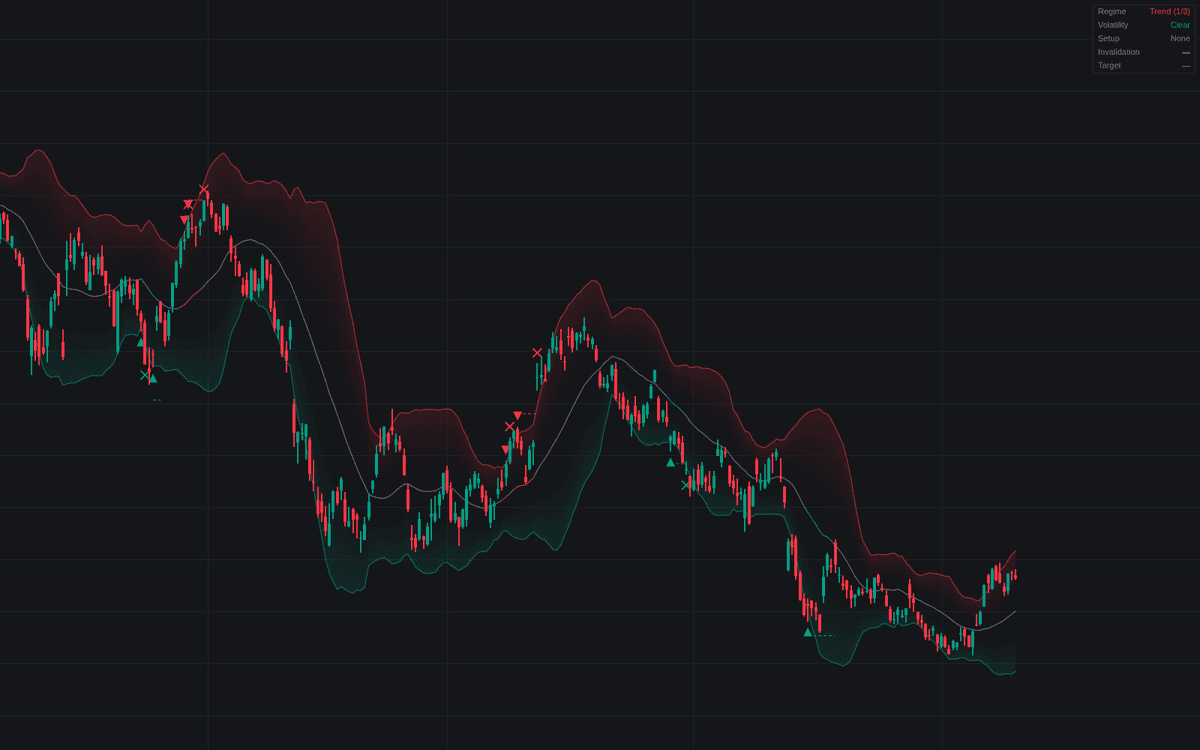

Bollinger Band Tag Reversion is the definitive clean build of the Bollinger Band tag reversion setup, and the tag alone is never the trade. A tag only arms a watch; the setup prints at the first close back inside the bands, and only when the backdrop cooperates: enough basis rotation to read as a range, and no expansion out of a tight base. Qualified setups print a triangle and a dashed invalidation line, then resolve as a circle at the target or a cross on failure.
How to Trade the Bollinger Band Tag Reversion?
- Long Setup: a lower-band tag closes back inside with the filters passing. Rotation toward the middle band, invalidation below the tag extreme less the ATR cushion.
- Short Setup: the upper-band mirror. Alerts cover setups, completions, failures.
- Band-walk standby: price closing outside through the whole confirmation window is strength, not stretch. The tag is refused until a close back inside.
Bollinger Band Tag Reversion Settings
- Length (default 20), Source (default close), Multiplier (default 2): the band construction; the basis is also the default target.
- Tag Trigger (default Touch or Pierce): intrabar touches count; Close Beyond demands a full close outside.
- Confirmation Window (default 5): bars allowed from tag to confirming close before the tag is ruled a band walk.
- Stretch Target (Opposite Band) (default off): target the opposite band instead of the basis.
- Stop ATR Fraction (default 0.5) with ATR Length (default 14): cushion past the tag extreme.
- Range Regime Filter (default on) with Regime Lookback (default 20) and Minimum Rotations (default 3): basis crossings needed to call the backdrop a range.
- Expansion Veto (default on) with Reference Lookback (default 125) and Tight Base Window (default 10): vetoes tags as width turns up off a fresh base low.
Frequently Asked Questions

Original indicatorBuilt in-house by LuxAlgo
The Library is free. Quant makes it yours.
Pull any concept or indicator into Quant: rebuild it, retune it, or turn it into a backtested strategy of your own.