Diagonals
 By LuxAlgoJun 19, 2026
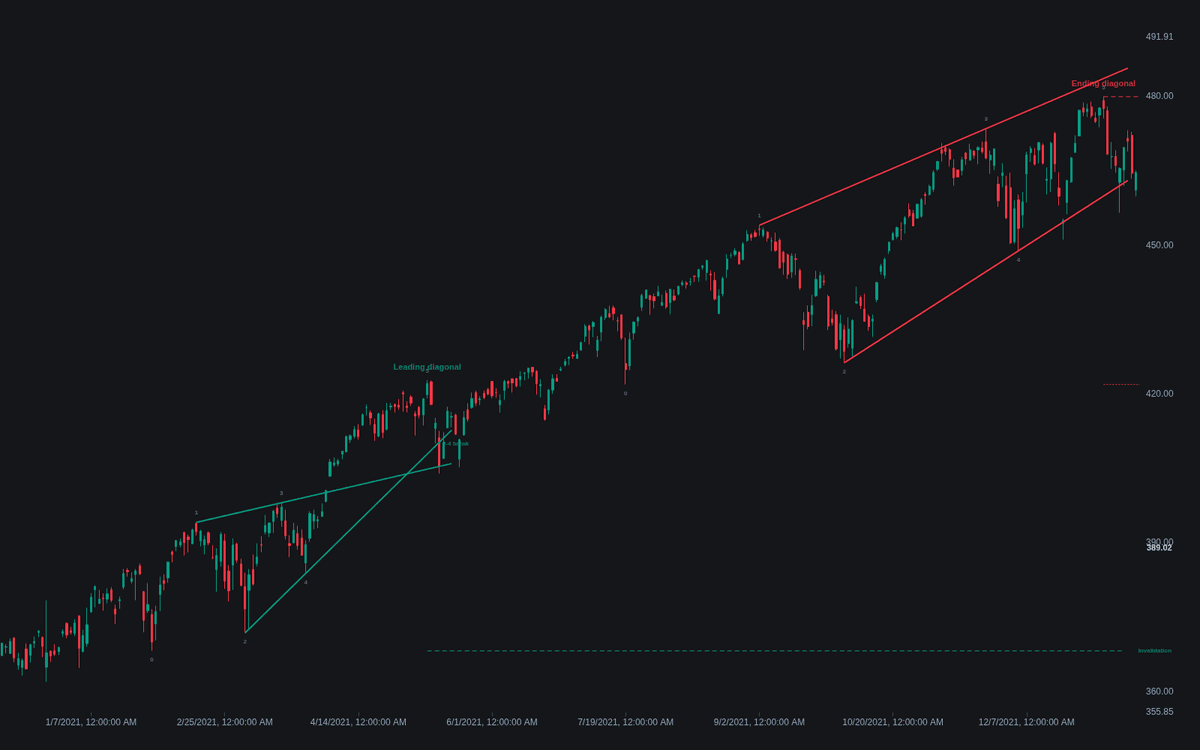

Diagonals scans confirmed swing pivots for the five-wave wedge geometry that defines a diagonal, checking motive order, wave 4/wave 1 overlap and boundary convergence. Position decides the meaning: swings falling into the origin mark a leading diagonal opening a move, swings rising into it an ending diagonal closing one. Each detection's tooltip reports wedge type, throw-over, momentum divergence and invalidation.
How to Trade the Diagonals?
- Ending diagonal: wave 5 or C position. The origin target line marks the full-retrace tendency, with an alert when reached.
- Leading diagonal: wave 1 or A position. Expect a deep second-wave pullback; the origin is the invalidation.
- Throw-over: a push through the wave 1-3 boundary is classic terminal behavior, marked on the chart.
- 2-4 break: a close back through the wave 2-4 boundary is the reversal trigger.
Diagonals are among the most specific structures in the Elliott and harmonics family, so this first dedicated build errs toward strict geometry over frequent detections.
Diagonals Settings
- Pivot Length (default 6): swing confirmation span, setting the wedge scale.
- Minimum Bars Per Wave (default 3): filters degenerate one-bar legs.
- Require Wave 4 / Wave 1 Overlap (default enabled): the trait separating diagonals from impulses.
- Detect Expanding Diagonals (default disabled): also finds the rare diverging variant.
- Convergence Ratio (default 0.9): maximum wedge-width ratio at wave 4 versus wave 2.
- Wave 5 Completion % (default 60): how far wave 5 must travel across the wedge.
- Momentum Length (default 14): RSI length for the divergence check.
- Pattern Expiry (Bars) (default 200): the monitoring window after confirmation.
- Style toggles: wave labels, invalidation and target levels, and throw-over/2-4 break markers.
Frequently Asked Questions

Original indicatorBuilt in-house by LuxAlgo
The Library is free. Quant makes it yours.
Pull any concept or indicator into Quant: rebuild it, retune it, or turn it into a backtested strategy of your own.