Concept
Diagonals
Diagonals, also known as leading, ending, are Elliott & Harmonics concepts. The Library holds 1 implementation, a working definition you can pull into Quant.
Top Diagonals indicator
The top custom implementation, built on the original standard Diagonals formula.
1 total
Want to trade Diagonals? The implementation below is one prompt away from a backtested strategy in Quant.
What are diagonals?
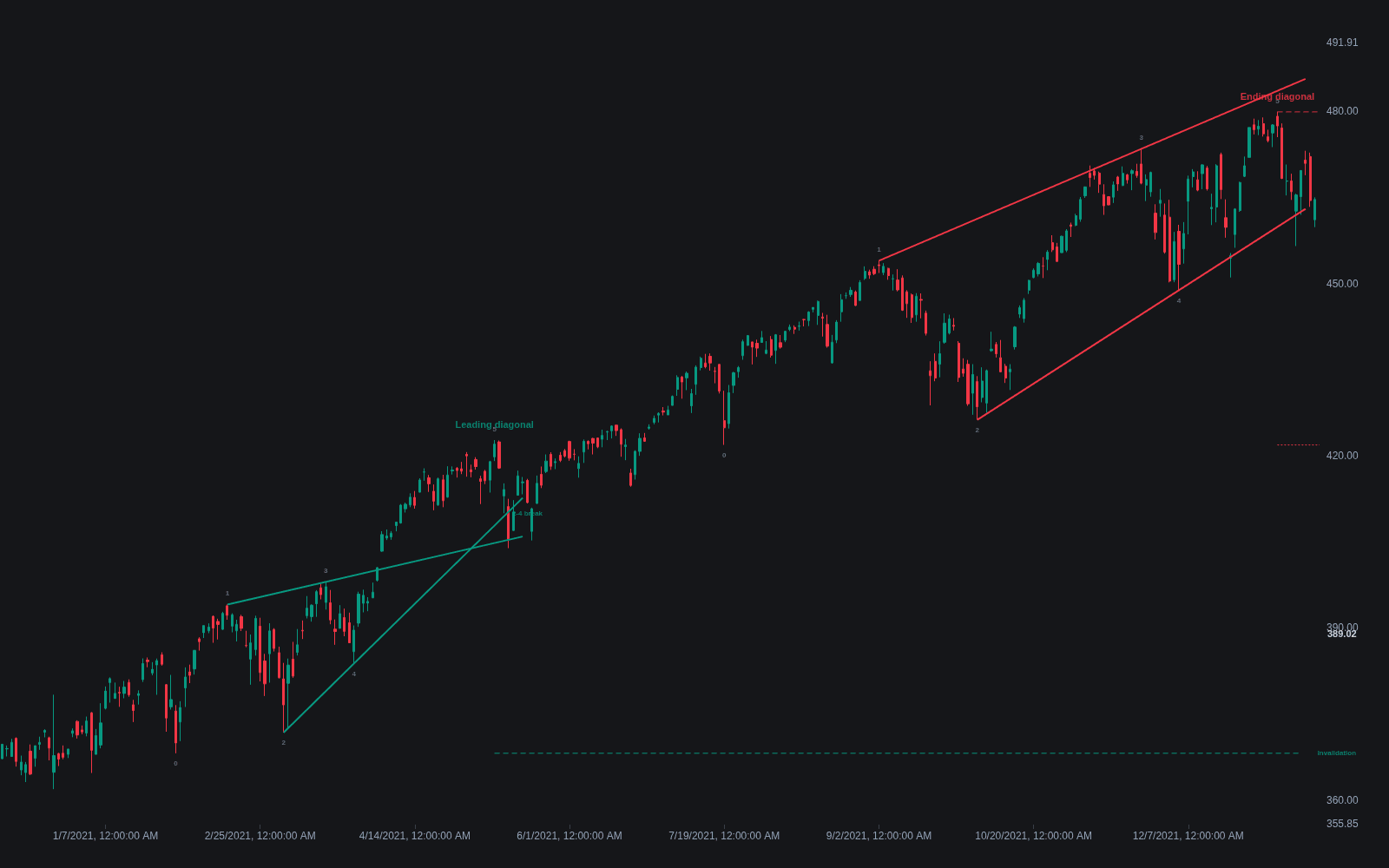
Diagonals are the wedge-shaped members of the motive family in Elliott wave analysis: five-wave structures that move in the direction of the one-larger trend but violate the normal impulse rule against overlap, with wave 4 typically entering the territory of wave 1. They come in two positional types. A leading diagonal appears at the start of a move, in the wave 1 position of an impulse or the wave A position of a zigzag. An ending diagonal appears at the end, in the wave 5 position or the C-wave position, and signals exhaustion of the larger move.
Their internal structure is the key diagnostic. In the classic ending diagonal, each of the five waves subdivides into three (a 3-3-3-3-3 structure), and the boundary lines drawn across waves 1-3 and 2-4 converge into a wedge. Leading diagonals may subdivide 5-3-5-3-5 or 3-3-3-3-3 depending on the source. Expanding variants, where the boundary lines diverge, are described in the literature but are rare and viewed skeptically by many practitioners.
Traders care because diagonals carry unusually specific implications. An ending diagonal is one of the few Elliott structures with a strong terminal message: when it completes, the move it ends is often retraced swiftly, frequently back to where the diagonal began. A leading diagonal warns that the new trend is starting hesitantly, so the following wave 2 correction tends to be deep. Both are easy to confuse with the classical rising or falling wedge, which encodes similar exhaustion logic without the wave-count machinery.
How to identify a diagonal
Diagonals are identified by position, converging boundaries, and internal three-wave subdivisions.
- 1Check the position first: wave 1 or A for a leading diagonal, wave 5 or C for an ending diagonal. A wedge in any other wave position is not a diagonal under standard rules.
- 2Draw boundary lines across the extremes of waves 1 and 3 and of waves 2 and 4; in the common contracting form they should converge.
- 3Confirm overlap: wave 4 typically enters wave 1 territory, which would invalidate an ordinary impulse but is characteristic here.
- 4Inspect subdivisions: threes throughout for an ending diagonal; momentum usually diverges as the pattern grinds toward its apex.
- 5Watch for the throw-over: a brief push through the outer boundary near completion, often on fading momentum, frequently precedes the reversal.
How traders use it
- As reversal setups: a completed ending diagonal, especially after a throw-over and a break back inside the wedge, is traded as a reversal signal with a stop beyond the pattern extreme.
- To set retracement expectations: because ending diagonals are often retraced fully and quickly, targets near the diagonal's origin are common, though nothing about the pattern makes that outcome certain.
- To anticipate deep wave 2 pullbacks: after a leading diagonal in wave 1, analysts expect a deep second-wave correction and avoid chasing the initial move.
- As count protection: recognizing legitimate overlap in a diagonal prevents discarding a valid motive count for violating the hard rules that apply to ordinary impulses.
- With honest limits: wedges are common and most are not diagonals. Requiring correct position, subdivisions, and converging boundaries filters out many candidates, and even qualified diagonals fail.
Diagonals vs confusable structures
Rising / Falling Wedge: The classical wedge is defined purely by converging trendlines and volume behavior, with no wave-count requirements. A diagonal is a wedge that additionally satisfies Elliott position and subdivision rules.
Impulse: An impulse forbids wave 4 overlapping wave 1 and subdivides 5-3-5-3-5. A diagonal permits the overlap, converges, and in its ending form subdivides entirely into threes.
Truncation: Both signal terminal weakness in a fifth wave, but truncation is a fifth wave that fails to exceed the third wave's extreme, while an ending diagonal is a full wedge-shaped structure that usually does make new price extremes before reversing.
Concept family
Elliott & Harmonics
33 concepts mapped · 33 in the Library
Diagonals FAQ
Turn Diagonals into a trading strategy.
Take the implementation from this page into Quant, then build on it, backtest it on real data, and keep refining it in conversation.