Wave Degree Hierarchy
 By LuxAlgoJul 4, 2026
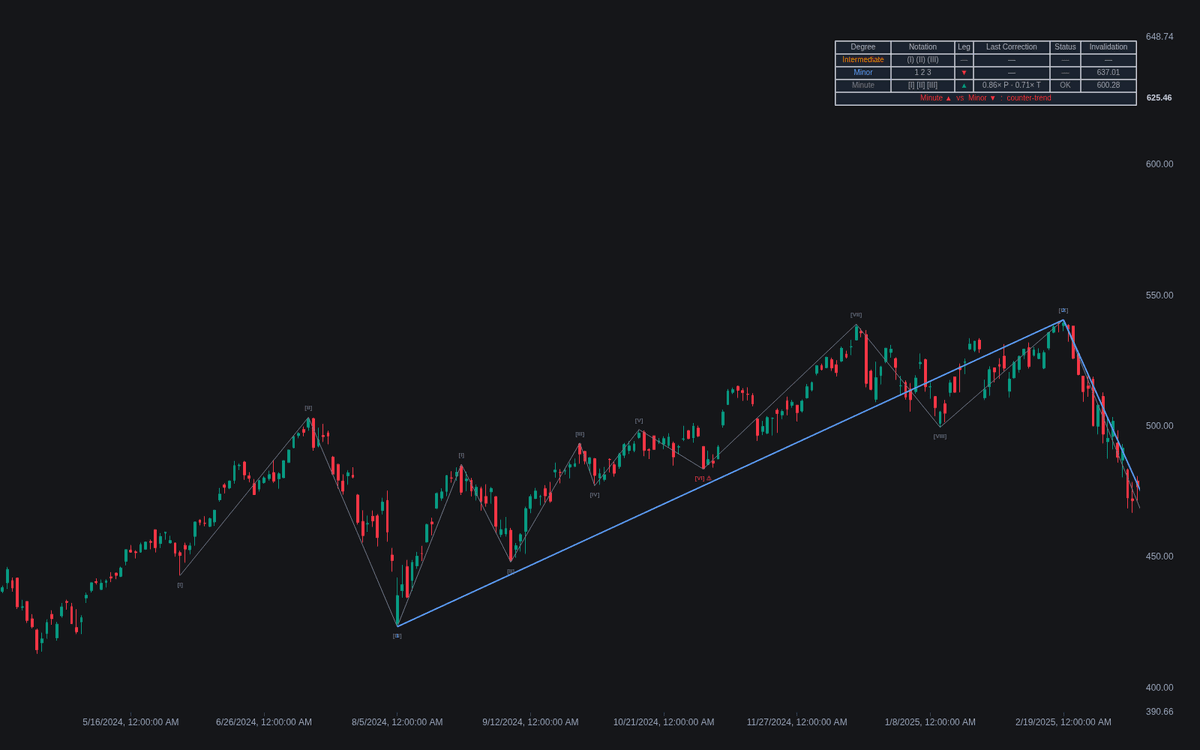

Wave Degree Hierarchy draws the nesting Elliott analysis rests on: a base zigzag and up to three degrees derived recursively above it, each pivot surviving upward only when it dominates its same-type neighbors one degree below, the wave degree hierarchy made a chart object for the first time. Each degree gets its ladder name, notation pivot labels, a dotted developing leg and a dashed invalidation level at its prior extreme.
How to Trade the Wave Degree Hierarchy?
- Trade with the reference degree: the dashboard's context row compares the execution-degree leg with the leg one or more degrees above, tinting the background on request while they oppose.
- Invalidation breaks: each degree's dashed level is the prior pivot extreme whose break kills that degree's current-leg count, each with its own alert.
- Disproportion flags: corrections retracing under the minimum proportion get an ellipsis; those traveling further or lasting longer than the wave they correct get a warning mark.
Notation is positional bookkeeping inside the parent leg, not an impulse count.
Wave Degree Hierarchy Settings
- Base Pivot Length (default 8): pivot half-length of the lowest degree, from which all others derive.
- Degrees Displayed (default 3): 2 to 4 nested degrees; higher ones confirm later by construction.
- Lowest Degree Name (default Minute): ladder name of the base; the rest walk upward, clamped at Grand Supercycle.
- Min Correction Proportion (Price) (default 0.236), Max Correction Proportion (Price) (default 1) and Max Correction Proportion (Time) (default 1): the proportion discipline.
- Trend Reference (Degrees Above) (default 1) and Tint Counter-Trend Background (off): the context read.
- Display: Show Dashboard (on), Pivot Labels (Notation), Flag Disproportion On Labels, Developing Legs and Invalidation Levels (all on), Drawn Swings Per Degree (default 50).
Frequently Asked Questions

Original indicatorBuilt in-house by LuxAlgo
The Library is free. Quant makes it yours.
Pull any concept or indicator into Quant: rebuild it, retune it, or turn it into a backtested strategy of your own.