NeoWave Logic
 By LuxAlgoMay 29, 2026
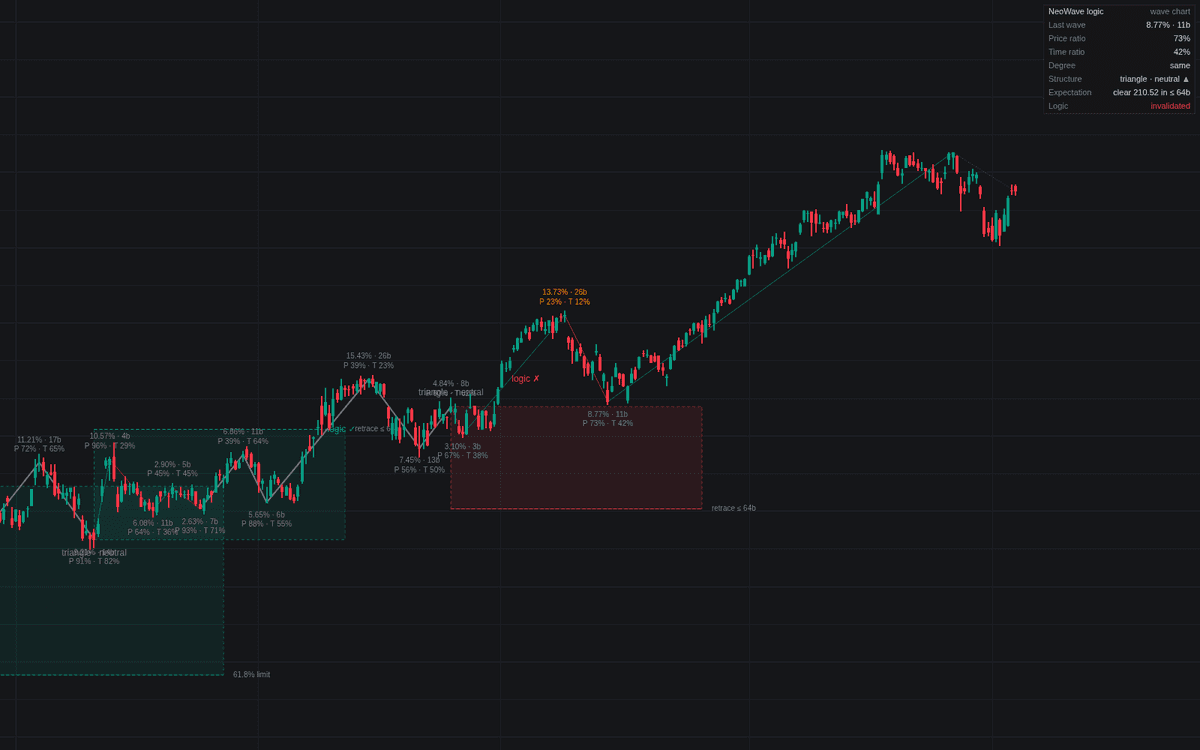

NeoWave Logic treats a wave count as a claim that must survive testing, not a drawing. Built on the stricter charting and proportion rules of NeoWave, it builds monowaves from the selected data points, measures adjacent waves in price and time, and labels only structures passing explicit shape rules: :5 impulsive groups, :3 corrective reactions, triangles including Neely's neutral variant, and the seven-legged diametric. Each label carries a drawn post-pattern expectation (a level to hold or clear within a time allowance) and the follow-through grades it.
How to Trade the NeoWave Logic?
- Degree break flagged: a wave below the similarity threshold versus its neighbor in BOTH price and time cannot belong to the same degree: the comparison is discarded rather than rationalized, and an alert fires.
- Structure labeled: the expectation zone shows what must happen next: a :5's reaction must hold the retracement limit; corrective structures must be fully retraced within the time allowance.
- logic ✓ / logic ✗: confirmation validates the label; invalidation means the count is wrong and is abandoned rather than relabeled. Both resolutions carry alerts.
NeoWave Logic Settings
- Data Points (default Close (wave chart)): Neely's closing-price wave chart, or High/Low for a conventional swing chart.
- Wave Pivot Length (default 8): bars each side confirming a turn; higher values read the logic at a higher degree.
- Similarity & Balance Threshold % (default 33): Neely's one-third guideline for waves of the same degree.
- Impulsive Retracement Limit % (default 61.8): the post-pattern extent test for :5 structures.
- Time Allowance (x pattern time) (default 1.0): the speed-test window for corrective structures.
- Detect Triangles (incl. Neutral) and Detect Diametric Formations (both on), plus display toggles.
Frequently Asked Questions

Original indicatorBuilt in-house by LuxAlgo
The Library is free. Quant makes it yours.
Pull any concept or indicator into Quant: rebuild it, retune it, or turn it into a backtested strategy of your own.