Elliott Hard Rules
 By LuxAlgoJun 2, 2026
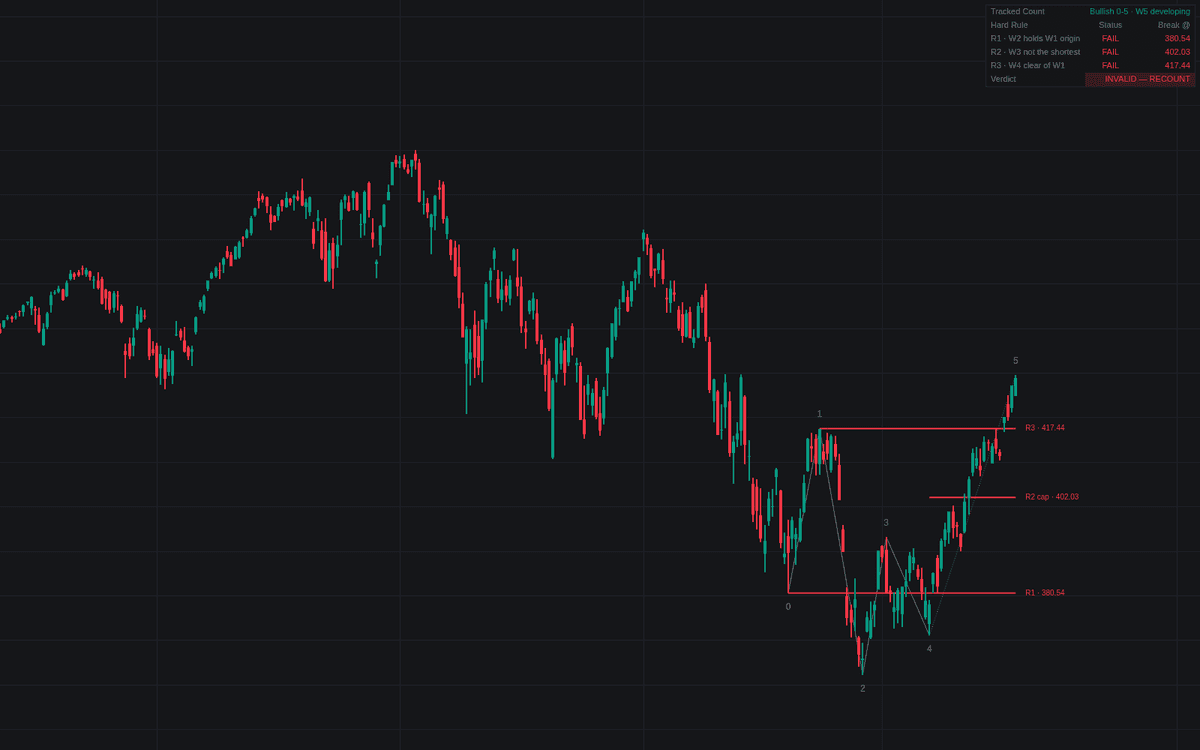

Elliott Hard Rules is the gate of the wave framework: it validates the six most recent swing points as a candidate five-wave count against the three constraints every impulse must satisfy and, more usefully, draws the exact price where each would break. The Elliott hard rules are binary by design: wave 2 holding the wave-1 origin, wave 3 never the shortest, wave 4 staying clear of wave-1 territory. A breach makes the labeling wrong rather than weak, and the build latches it the moment price prints there, even intrabar.
How to Trade the Elliott Hard Rules?
- VALID IMPULSE verdict: the tracked candidate currently satisfies all three rules; the validation itself is alertable.
- Invalidation levels as stops: R1 (the wave-1 origin) is the structural stop for wave-2 and wave-3 positions, R3 (the wave-1 extreme) for wave-4 positions.
- R2 cap: while wave 3 measures shorter than wave 1, wave 5 wears a hard cap at the wave-3 length; the cap line exists only while that condition is live.
- Solid line = broken rule: a dashed level turning solid is the record of a breach, the instruction to relabel rather than rationalize.
Alerts fire per rule, on any rule break, and when a candidate first passes all three.
Elliott Hard Rules Settings
- Pivot Length (default 10): swing confirmation width anchoring the count.
- Count Selection (default Auto): Auto re-anchors on every new swing; Bullish or Bearish locks onto counts ending on a high or a low.
- Diagonal Count (tolerate W1-W4 overlap) (default disabled): reports wave-4 overlap as tolerated instead of a failure; rules 1 and 2 still apply in full.
- Invalidation Levels (default enabled): the R1, R2 cap and R3 lines with their prices.
- Display toggles: Candidate Wave Structure and Wave Numbers default on; Show Dashboard defaults on with Position and Size options.
Frequently Asked Questions

Original indicatorBuilt in-house by LuxAlgo
The Library is free. Quant makes it yours.
Pull any concept or indicator into Quant: rebuild it, retune it, or turn it into a backtested strategy of your own.