Elliott Guidelines
 By LuxAlgoJun 2, 2026
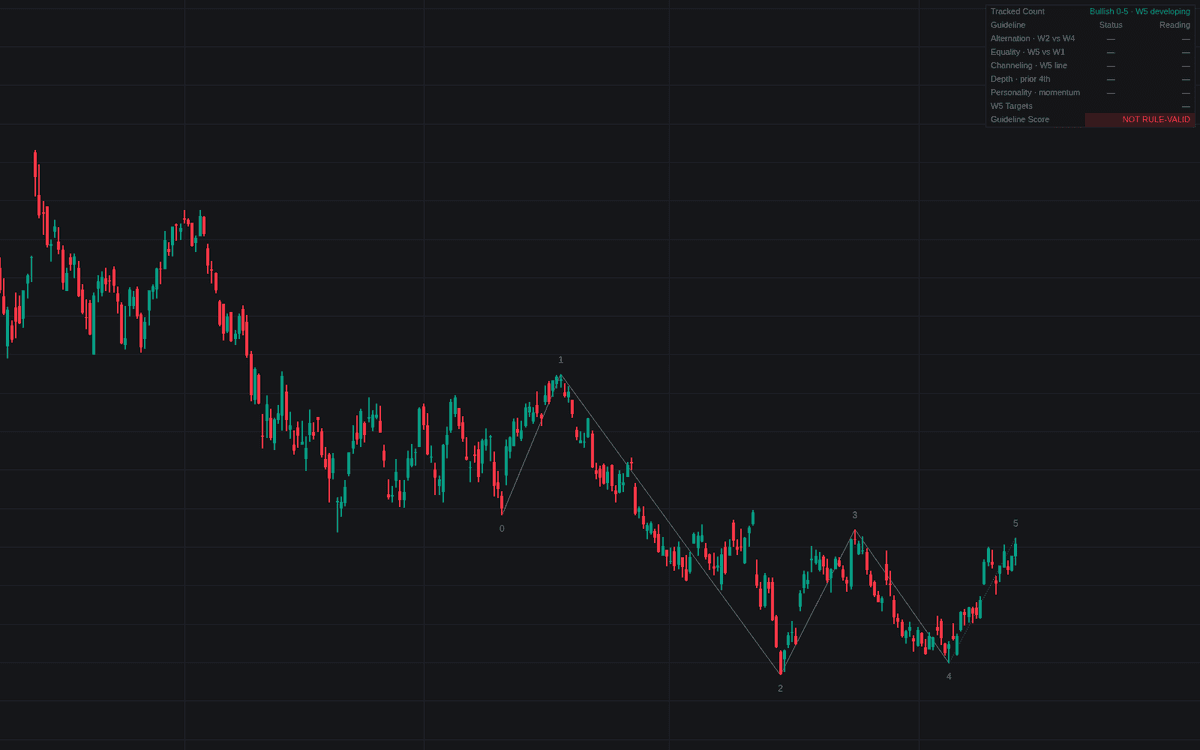

Elliott Guidelines grades a candidate five-wave count against the tendencies that separate a preferred labeling from a merely legal one. The six most recent swing points form the candidate; once it clears the hard-rule gate, five checks (alternation, equality, channeling, depth and personality) each return PASS or MISS with the measured reading behind the grade. The build applies Elliott guidelines exactly as the doctrine intends: a broken rule discards a count, a missed guideline only demotes it.
How to Trade the Elliott Guidelines?
- Guideline Score: the STRONG / MODERATE / WEAK COUNT verdict is evidence for arbitrating competing rule-valid counts, not a trade signal.
- W5 targets: the equality zone (wave 1's length and 0.618 of it, projected from the wave-4 extreme) and the channel parallel each estimate where wave 5 may end; CONFLUENCE flags the parallel landing inside the zone.
- Fifth-wave divergence: a developing wave 5 pushing past the wave-3 extreme on fading RSI is the classic maturity cue.
Each event carries an alert, including full guideline conformance.
Elliott Guidelines Settings
- Pivot Length (default 10): swing confirmation width of the count.
- Lesser-Degree Length (default 3): pivot length of the lesser-degree zigzag behind the depth and complexity checks.
- Count Selection (default Auto): Auto re-anchors on every new swing; Bullish or Bearish locks the count's ending side.
- Ratio Tolerance (default 0.1): how close counts as close for the equality and channeling grades.
- Sharp / Sideways Split % (default 50): the retracement depth separating sharp corrections from sideways ones.
- Momentum Length (default 14): RSI length behind the personality grade.
- Display toggles: Candidate Wave Structure, Wave Numbers, Elliott Channel (W2-W4), Equality Targets, Prior Fourth-Wave Zone and Show Dashboard default on; Provisional Channel (W1-W3) off.
Frequently Asked Questions

Original indicatorBuilt in-house by LuxAlgo
The Library is free. Quant makes it yours.
Pull any concept or indicator into Quant: rebuild it, retune it, or turn it into a backtested strategy of your own.