Concept
Elliott Guidelines
Elliott Guidelines, also known as alternation, equality, channeling, wave personality, are Elliott & Harmonics concepts. The Library holds 1 implementation, a working definition you can pull into Quant.
Top Elliott Guidelines indicator
The top custom implementation, built on the original standard Elliott Guidelines formula.
1 total
This Elliott Guidelines implementation is strategy-ready: open it in Quant, set your rules, and it backtests automatically.
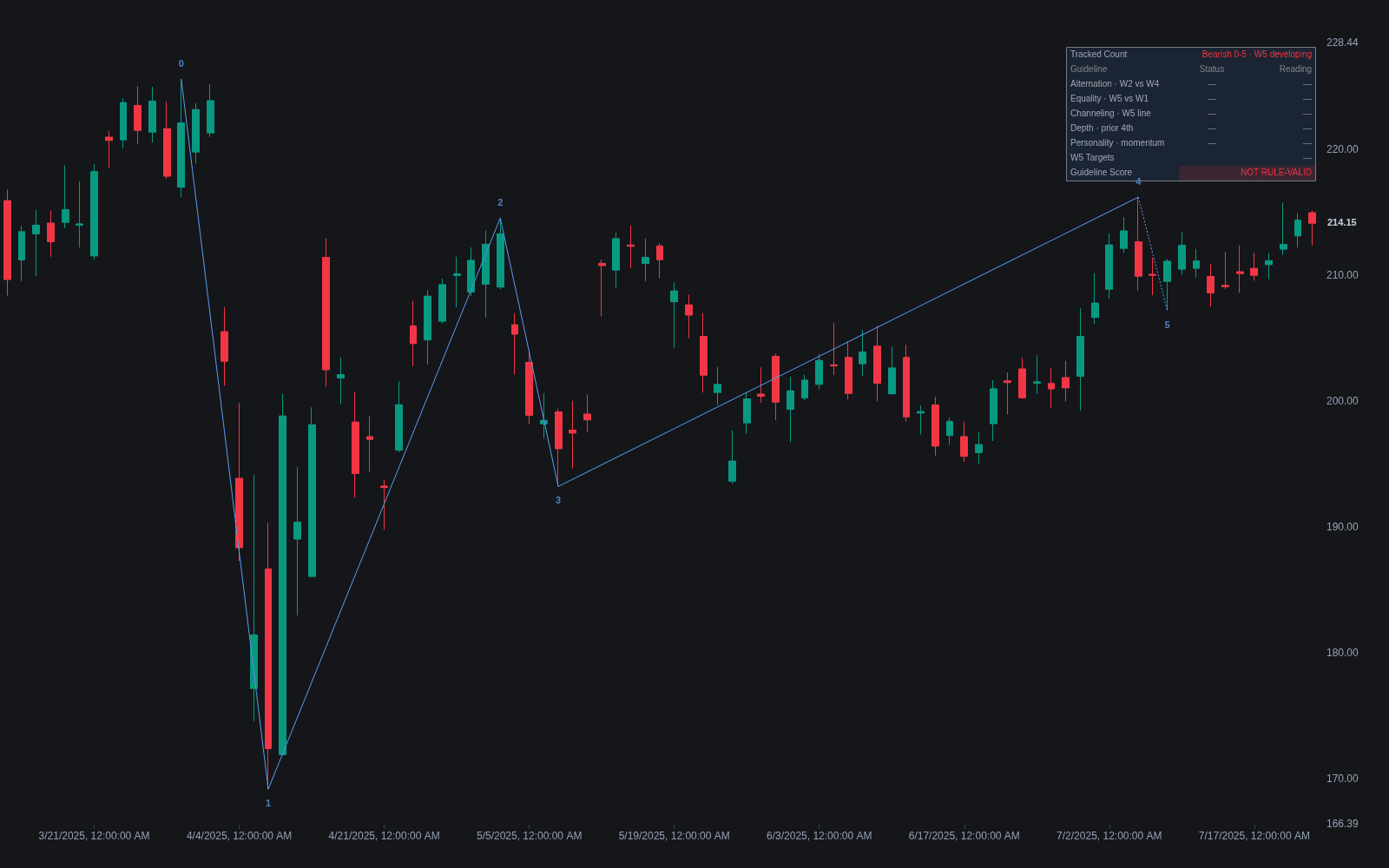
What are Elliott Guidelines?
Elliott guidelines are the tendencies of Elliott Wave Theory, distinct from its three hard rules. Rules are binding; guidelines describe what waves usually do. The best known are alternation (waves 2 and 4 of an impulse tend to differ in form and depth, one sharp, one sideways) and equality (when wave 3 extends, waves 1 and 5 tend toward equal length or a 0.618 relationship).
Channeling and depth extend the set: a channel drawn through the ends of waves 2 and 4, with a parallel line touching the end of wave 3, projects where wave 5 may end, and fourth waves often terminate within the span of the previous fourth wave of one lesser degree. Wave personality rounds it out: each position has a typical character, with wave 3 usually the strongest, broadest move, wave 5 often narrower with fading momentum, and B waves within corrections prone to unconvincing rallies.
The distinction matters because rules eliminate counts while guidelines rank the survivors. A labeling that satisfies every rule but shows no alternation and a poor channel is still valid, just less preferred, so practitioners treat guidelines as accumulating evidence for one count over another.
The observations trace to Ralph Nelson Elliott's work in the 1930s and 1940s, and the rules-versus-guidelines framing was systematized by A.J. Frost and Robert Prechter in Elliott Wave Principle (1978), still the standard reference. The core set of alternation, equality, channeling, depth, and personality has been stable for decades, one reason wave software can encode and score it.
How to check the guidelines against a chart count
Guidelines are applied to a count that already satisfies the hard rules; each check either strengthens or weakens the labeling.
- 1Start from a rule-valid impulse count with clearly marked swing pivots for waves 1 through 5.
- 2Compare waves 2 and 4 for alternation: one sharp and deep, the other sideways and shallow, ideally differing in duration and internal structure too.
- 3Draw the channel through the ends of waves 2 and 4 and project the parallel from the end of wave 3; wave 5 ending near that line fits the channeling guideline.
- 4Test equality: if wave 3 is extended, project wave 1's full length and 0.618 of it from the wave 4 extreme as the wave 5 target zone.
- 5Check depth: locate the fourth wave of one lesser degree inside wave 3 and see whether wave 4 ended within its span.
- 6Grade personality: momentum typically peaks in wave 3, while wave 5 often advances on fading momentum with oscillator divergence.
How traders use it
- To arbitrate between counts: several labelings can satisfy the hard rules at once, and analysts prefer the one that also shows alternation, a clean channel, and wave personalities that match their positions.
- To project fifth-wave targets: when wave 3 is extended, equality suggests wave 5 near the length of wave 1 (or 0.618 of it) measured from the wave 4 extreme, refined with channel lines and Fib wave relationships.
- To set expectations for the next correction: if wave 2 was sharp and deep, alternation argues for a shallower, sideways wave 4, often ending near the prior fourth wave of one lesser degree. These are tendencies; a guideline failing does not invalidate the count.
- To grade corrections in progress: alternation operates inside corrective structures too, so a simple first leg warns that a later leg may turn complex, shaping expectations for how a corrective wave may evolve.
- To build target confluence: a channel line, an equality projection, and the prior fourth-wave span all pointing to one area define a zone treated much like a potential reversal zone in harmonic work: a place to watch for terminal behavior, not a promise of reversal.
Elliott Guidelines vs neighboring concepts
Elliott Hard Rules: The three rules are absolute and falsifying: break one and the count dies. Guidelines are graded evidence: a count missing alternation or a clean channel survives, it just ranks below one that has them.
Fib Wave Relationships: Ratio tendencies such as wave 3 reaching 1.618 of wave 1 are effectively the quantitative wing of the guidelines. The broader guideline set also covers form and behavior (alternation, channeling, personality) that ratios alone cannot express.
Elliott Wave Theory: The theory is the full framework: wave forms, degrees, rules, and guidelines together. The guidelines are its probabilistic layer, the part that ranks competing rule-valid counts rather than defining what a wave is.
Concept family
Elliott & Harmonics
33 concepts mapped · 33 in the Library
Elliott Guidelines FAQ
Turn Elliott Guidelines into a trading strategy.
Take the implementation from this page into Quant, then build on it, backtest it on real data, and keep refining it in conversation.