Concept
Elliott Hard Rules
Elliott Hard Rules are Elliott & Harmonics concepts. The Library holds 1 implementation, a working definition you can pull into Quant.
wave 2/3/4 constraints
Top Elliott Hard Rules indicator
The top custom implementation, built on the original standard Elliott Hard Rules formula.
1 total
From studying Elliott Hard Rules to trading it: take the implementation below into Quant and backtest it instantly.
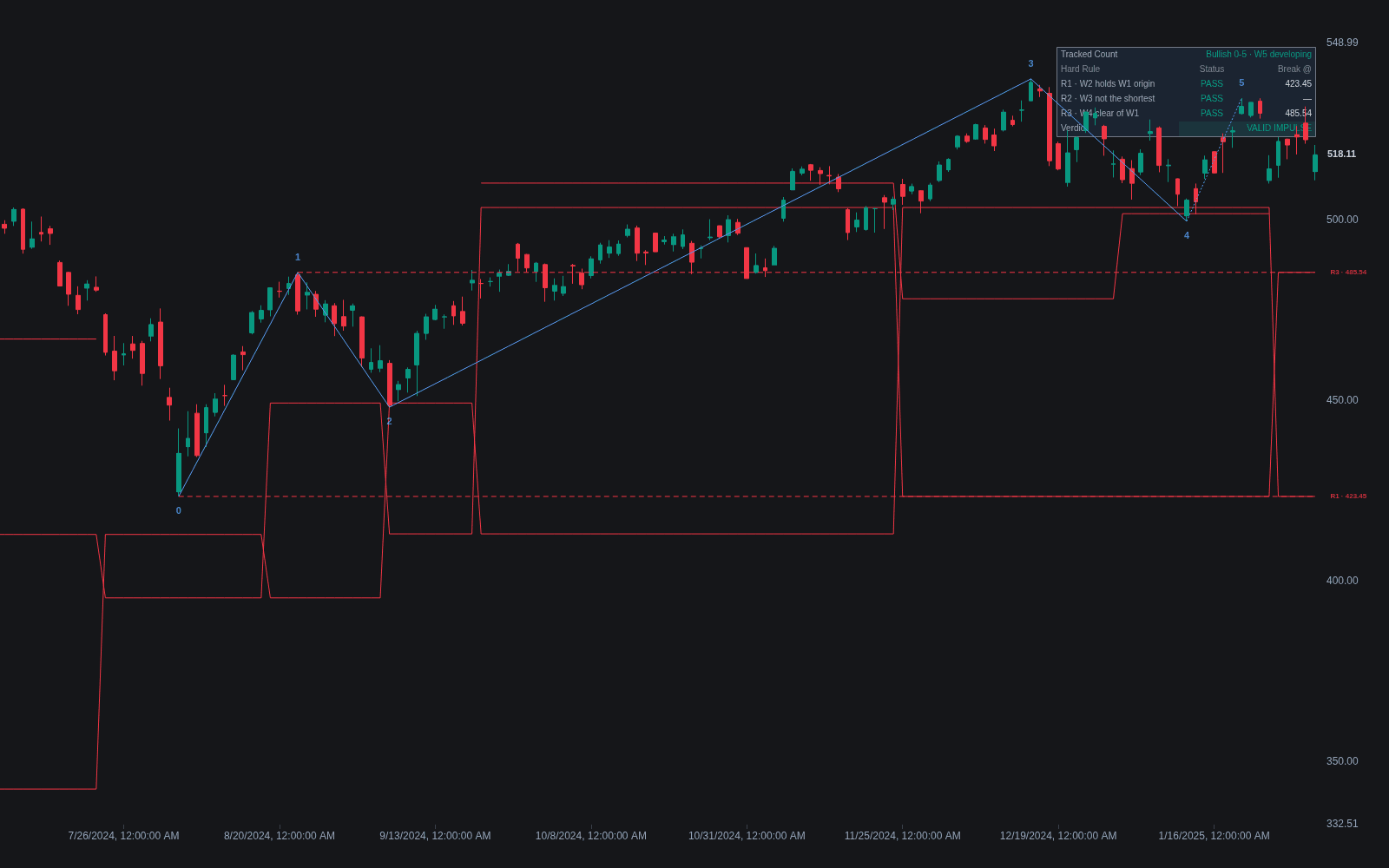
What are the Elliott Hard Rules?
The Elliott hard rules are the three constraints an impulse count must satisfy, as codified in Frost and Prechter's Elliott Wave Principle: wave 2 never retraces more than 100% of wave 1, wave 3 is never the shortest of waves 1, 3, and 5, and wave 4 never enters the price territory of wave 1. Breaking any one invalidates the count outright rather than making it unlikely; the overlap rule is relaxed only in diagonals, the wedge-shaped motive wave variant.
The rules matter because they make an interpretive framework falsifiable: each one doubles as a price level at which a labeling is demonstrably wrong. Rule-based wave tools therefore anchor invalidation lines at the start of wave 1 and at the wave-1 extreme. Everything else in the framework, alternation, channeling, and ratio tendencies included, is a guideline: a probability statement, not a requirement.
The constraints originate in R.N. Elliott's own writings from the 1930s and 1940s, but their crisp modern statement comes from A.J. Frost and Robert Prechter's 1978 book, which deliberately separated the framework's few absolutes from its many tendencies. That separation is what makes the rules hard: a structure that breaks one is not a weak impulse but something else entirely, usually a corrective wave or a diagonal demanding a different label.
In practice the rules serve as the risk-management layer of Elliott Wave Theory. Because each rule maps to a price, a wave count carries its own stop: the start of wave 1 for a wave-2 entry, the wave-1 extreme for a wave-4 position. Rule-checking is also fully mechanical, which is why rule-based wave scripts, including the impulse detectors and rule engines in this library, can validate candidate pivot sequences against the three constraints and discard any labeling that fails.
How to apply the hard rules to a chart
Checking a candidate impulse against the rules takes three measurements, each anchored to marked swing pivots (described here for an uptrend; invert for a downtrend).
- 1Label the candidate impulse's five waves on clear pivots: lows for waves 2 and 4, highs for waves 1, 3, and 5.
- 2Rule 1: confirm the wave 2 low sits above the start of wave 1; a print below it, even briefly, invalidates the count.
- 3Rule 2: measure the price lengths of waves 1, 3, and 5 and confirm wave 3 is not the shortest of the three.
- 4Rule 3: confirm the wave 4 low stays above the wave 1 high, with overlap tolerated only when the structure is counted as a diagonal.
- 5Mark the levels from rules 1 and 3 as invalidation lines and treat any breach as the cue to recount, not to argue with the chart.
How traders use it
- As objective invalidation: a trader positioned on a wave-3 count knows the idea is wrong if price crosses the start of wave 1, which turns a subjective count into a concrete stop level.
- To prune candidate counts: manual and automated analysts generate multiple labelings, discard every one that breaks a rule, and rank the survivors by how well they fit the guidelines.
- To classify structure: persistent overlap between waves rules out an impulse, pushing the analyst toward a corrective or diagonal interpretation instead of a trend count.
- To place stops with structural meaning: a wave-2 pullback entry uses the start of wave 1 as its invalidation, so the stop sits at the exact price where the premise fails rather than at an arbitrary distance.
- To anchor projections: once a count passes the rules, Fib wave relationships and channel guidelines project wave-3 and wave-5 targets, with the rule levels defining the boundaries those projections must respect.
Elliott Hard Rules vs related concepts
Elliott Guidelines: Guidelines (alternation, equality, channeling) describe what usually happens, and breaking one merely weakens a count. Rules describe what must happen, and breaking one kills the count.
Fib Wave Relationships: Ratio tendencies such as wave 3 reaching 1.618 of wave 1 help rank competing counts, but none of them is binding; a count that satisfies the three rules stands even when every ratio preference is missed.
Elliott Wave Theory: The theory is the complete framework of wave forms, degrees, rules, and guidelines. The hard rules are its falsification core, the minimal subset that makes any particular count testable against price.
Concept family
Elliott & Harmonics
33 concepts mapped · 33 in the Library
Elliott Hard Rules FAQ
Turn Elliott Hard Rules into a trading strategy.
Take the implementation from this page into Quant, then build on it, backtest it on real data, and keep refining it in conversation.