Concept
NeoWave Logic
NeoWave Logic is a Elliott & Harmonics concept. The Library holds 1 implementation, a working definition you can pull into Quant.
Neely
Top NeoWave Logic indicator
The top custom implementation, built on the original standard NeoWave Logic formula.
1 total
Want to trade NeoWave Logic? The implementation below is one prompt away from a backtested strategy in Quant.
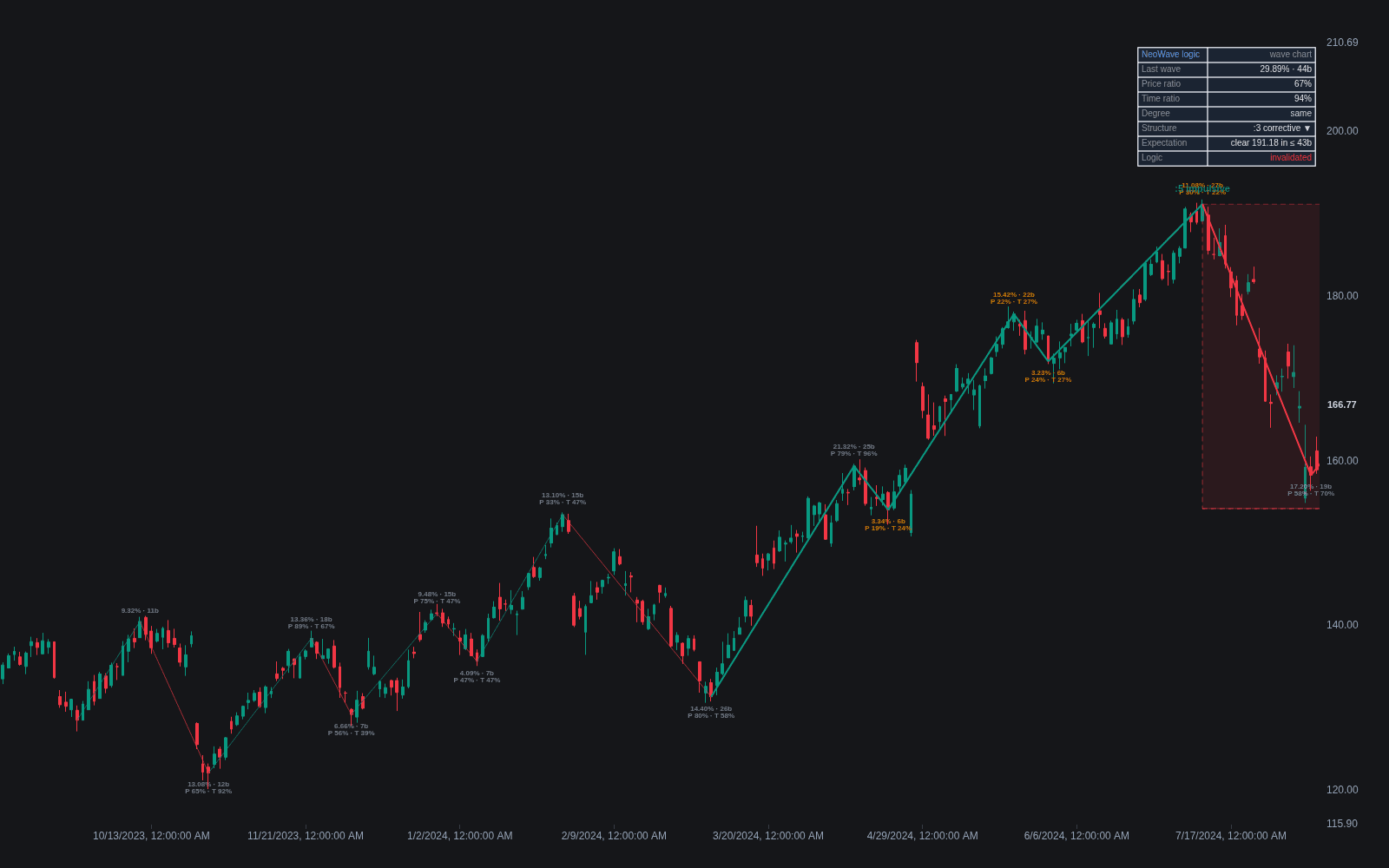
What is NeoWave logic?
NeoWave is Glenn Neely's reformulation of Elliott wave analysis, presented in his book Mastering Elliott Wave (1990). Neely's complaint was that orthodox Elliott wave theory leans heavily on the analyst's eye, letting two competent practitioners produce contradictory counts from the same chart. NeoWave answers with a stricter, more rule-bound system: quantified requirements for how waves relate in price and time, additional pattern categories, and logic tests that a count must pass before it is accepted.
Several ideas distinguish the approach. Charts are built from specific data points plotted against true elapsed time rather than casually eyeballed bar charts, on the argument that consistent inputs are a precondition for consistent counts. Waves are compared through explicit price and time ratios, and a structure that breaks the expected proportions is discarded rather than rationalized. Neely also added structures not in the orthodox catalog, including the neutral triangle and the diametric formation, a seven-legged structure, to cover price action he argued the classic patterns could not honestly describe.
The core contribution most practitioners take from NeoWave is post-pattern logic: every completed structure carries implications for what must follow, and the follow-through is a test of the count. If a correction was truly a fourth wave, the subsequent move should behave a specific way in both extent and speed; if it does not, the count is wrong and must be abandoned. This turns wave analysis from a labeling exercise into a sequence of falsifiable claims, which is why NeoWave attracts traders frustrated by the flexibility of conventional counting.
How traders use it
- As a discipline layer over standard counting: analysts adopt NeoWave's logic checks, especially the requirement that post-pattern behavior confirm the label, without necessarily adopting the full system.
- For count elimination: quantified price and time relationships between waves let a practitioner discard candidate counts mechanically, narrowing the field faster than visual judgment alone.
- For self-invalidation: because each accepted count carries specific expectations for the next move, failure of those expectations is a clear exit or re-analysis trigger rather than an invitation to relabel.
- In sideways markets: the added corrective categories give analysts vocabulary for extended congestion that orthodox counting often forces into strained combination labels.
- With honest limits: NeoWave is demanding to learn, its extra patterns are not universally accepted, and stricter rules reduce but do not eliminate subjectivity. Independent evidence that it outperforms orthodox counting is thin.
NeoWave vs orthodox Elliott practice
Elliott Wave Theory: Orthodox theory supplies the wave taxonomy and a small set of rules, leaving much to judgment. NeoWave keeps the wave premise but adds quantified relationships, extra structures, and mandatory confirmation logic.
Elliott Guidelines: Guidelines like alternation and channeling are soft tendencies an orthodox analyst may weigh loosely. NeoWave hardens many comparable observations into requirements whose violation kills the count.
Elliott Hard Rules: The orthodox hard rules are three brief prohibitions. NeoWave expands the rule set substantially, governing time, proportion, and post-pattern behavior in addition to price overlap and retracement limits.
Concept family
Elliott & Harmonics
33 concepts mapped · 33 in the Library
NeoWave Logic FAQ
Turn NeoWave Logic into a trading strategy.
Take the implementation from this page into Quant, then build on it, backtest it on real data, and keep refining it in conversation.