Concept
Wave Degree Hierarchy
Wave Degree Hierarchy is a Elliott & Harmonics concept. The Library holds 1 implementation, a working definition you can pull into Quant.
Top Wave Degree Hierarchy indicator
The top custom implementation, built on the original standard Wave Degree Hierarchy formula.
1 total
The Wave Degree Hierarchy implementation below can become a backtested trading strategy — describe your rules and Quant writes the code.
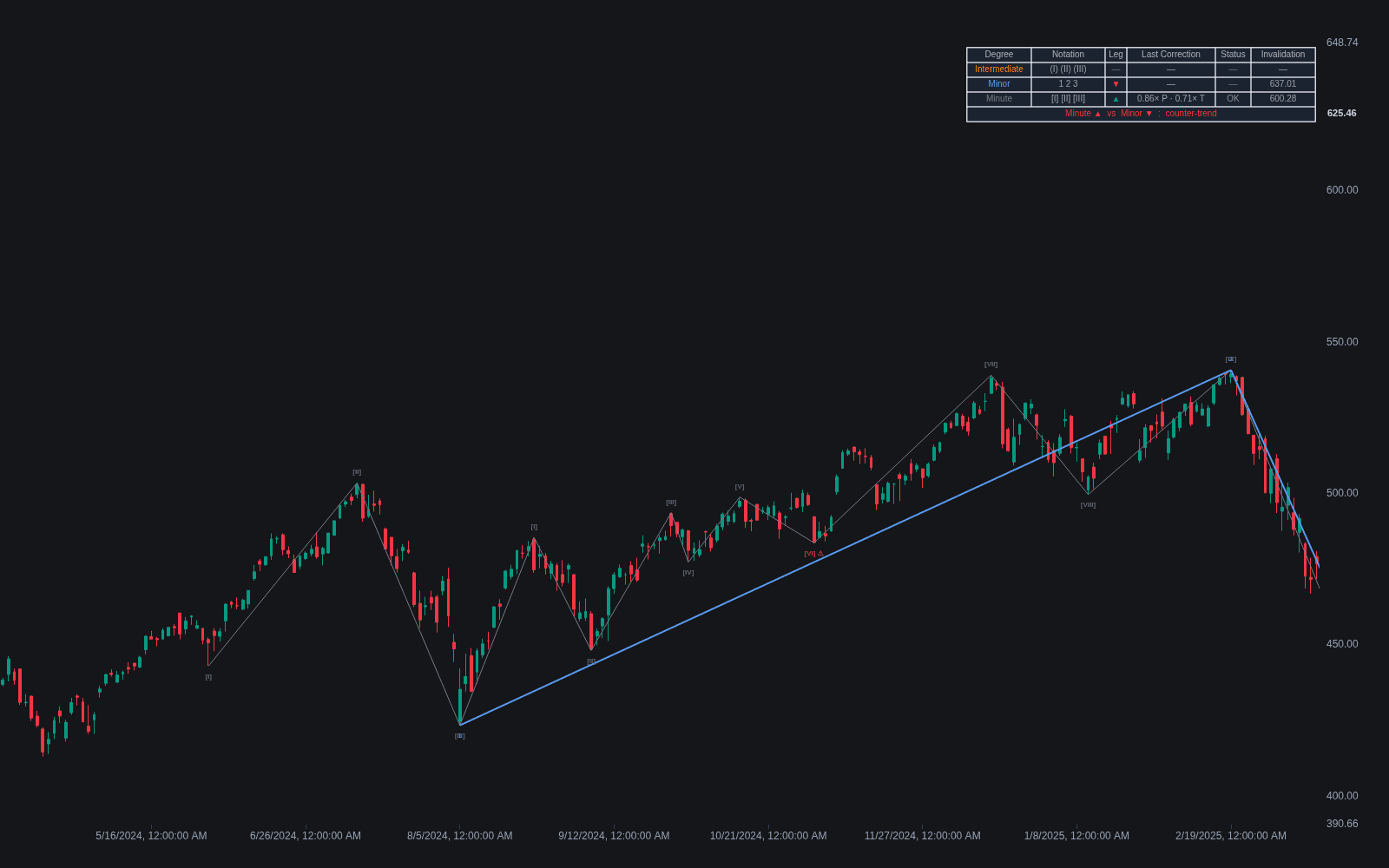
What is the wave degree hierarchy?
The wave degree hierarchy is the system of nested scales in Elliott wave theory: every wave is simultaneously a complete structure at its own degree and a component of a larger wave one degree higher. R.N. Elliott named a ladder of degrees running from Grand Supercycle, spanning decades or longer, down through Supercycle, Cycle, Primary, Intermediate, Minor, Minute, Minuette, and Subminuette, each with its own labeling convention (circled numerals, Roman numerals, letters, and so on) so an analyst can state exactly which scale a given label refers to.
The hierarchy exists because the wave model is recursive. A five-wave motive wave at Minor degree is built from five Minute-degree waves, and itself forms one leg of an Intermediate structure. This is the same self-similarity described more generally as fractal nesting: the grammar of impulses and corrections repeats at every scale, and degree is how the analyst keeps track of which level of the recursion any statement is about. Degree names are anchored to structural relationships rather than fixed clock time; a Minor wave in a fast market can take less time than a Minute wave in a slow one.
Traders care because most wave-count errors are degree errors. Mixing degrees, for instance counting a small pullback as complete when the larger degree demands a deeper correction, produces counts that look valid locally but are incoherent globally. Degree discipline also produces the practical payoff: knowing that a correction at Intermediate degree is due tells a trader to expect something proportionally larger and longer than the Minor-degree dips that preceded it, which shapes both position sizing and patience.
How traders use it
- For top-down counting: analysts establish the count at a high degree on weekly or monthly charts first, then work downward so that lower-degree labels must fit inside the higher-degree frame rather than contradict it.
- To set proportion expectations: a correction should be roughly proportional in price and time to the wave it corrects at the same degree, so degree awareness flags corrections that are too small or too large for their assigned label.
- For trade selection: many practitioners trade in the direction of the motive wave one or two degrees above their execution timeframe, using the hierarchy to define with-trend and counter-trend rather than a moving average.
- For invalidation logic: the hard rules apply within a single degree, so identifying the degree of a wave determines exactly which prior extreme, if broken, kills the count.
- With honest limits: degree assignment is judgment, especially in real time. Two analysts can agree on structure yet disagree on degree, and the hierarchy compounds errors upward: one wrong degree call distorts every level above it.
Degree hierarchy vs related framing concepts
Fractal Nesting: Fractal nesting is the general observation that market structure repeats across scales. The degree hierarchy is Elliott's formalization of it, with named levels, labeling conventions, and rules about how components must relate to their parent wave.
Dow Theory: Dow theory layers primary, secondary, and minor trends by duration and importance. Elliott degrees are finer-grained, explicitly recursive, and tied to wave structure rather than to trend duration alone.
Corrective Wave: Corrective wave describes what a structure is; degree describes where it sits in the nesting. The same ABC form can be a Minute-degree pause or a Cycle-degree bear market, with very different implications.
Concept family
Elliott & Harmonics
33 concepts mapped · 33 in the Library
Wave Degree Hierarchy FAQ
Turn Wave Degree Hierarchy into a trading strategy.
Take the implementation from this page into Quant, then build on it, backtest it on real data, and keep refining it in conversation.