Day-type Taxonomy
 By LuxAlgoJun 4, 2026
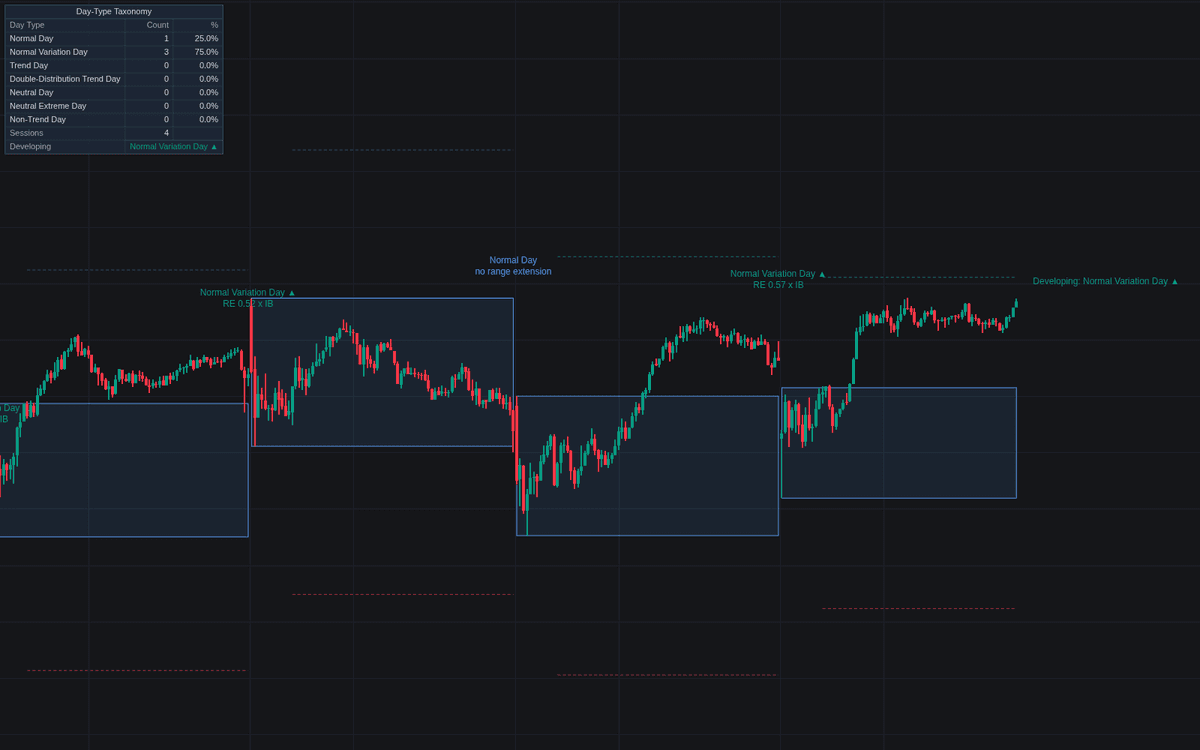

Day-type Taxonomy turns the Market Profile day-type taxonomy into a live session classifier, the first of its kind in the Library. Each day the initial balance is boxed and carried across the session, dashed levels mark the trend threshold beyond each extreme, and a developing-type label updates live; the close stamps the final classification with its extension in IB widths, and a statistics table counts each type.
How to Trade the Day-type Taxonomy?
- Trend Day Developing: one-sided extension reached the trend threshold with price holding near the extreme. Joining strength beats fading.
- Both-side extension: extension beyond both IB extremes defines neutral conditions; the close separates neutral from neutral extreme.
- No extension: the initial balance contains the session. Rotational tactics dominate.
On most markets trend days are a minority, the case for rotation as the default. Early reads are revised often, so let a session mature. Alerts cover extensions, a developing trend day, and every final classification.
Day-type Taxonomy Settings
- Initial Balance Length (minutes) (default 60): the canonical first hour.
- Min Range Extension (% of IB width) (default 15) and Trend Threshold (x IB width) (default 1): the smallest extension that counts, and the multiple reaching trend-day magnitude.
- Close-at-Extreme Zone (%) (default 25): range share counting as an extreme close.
- Detect Non-Trend Days (default on), Non-Trend Range (x average) (default 0.6), Average Range Lookback (sessions) (default 10): the narrow-day add-on.
- Detect Double-Distribution Trend Days (default on): splits two-distribution trend days.
- Display: Developing Day Type Label, Final Day Type Labels, Initial Balance Zone, Trend Extension Levels, Day-Type Statistics (all default on), Shade Initial Balance Period (default off), plus table position, size, colors.
Frequently Asked Questions

The Library is free. Quant makes it yours.
Pull any concept or indicator into Quant: rebuild it, retune it, or turn it into a backtested strategy of your own.