Auction Market Theory
Auction Market Theory, also known as AMT, Auction theory, is a Volume & Order Flow concept. The Library holds 12 implementations, each one a working definition you can pull into Quant.
Top Auction Market Theory indicators
The top custom implementations, built on the original standard Auction Market Theory formula.
12 total
Any of the 12 Auction Market Theory implementations below can become a backtested trading strategy — describe your rules and Quant writes the code.
What is Auction Market Theory?
Auction market theory (AMT) is the framework that reads every market as a continuous two-way auction searching for value. Its premise is that a market exists to facilitate trade: price rises until it shuts off buying and draws in sellers, falls until it shuts off selling and draws in buyers, and settles where both sides keep doing business. Every move is a probe that advertises a new price, and the market's verdict on it is read through time and volume. The framework grew out of J. Peter Steidlmayer's Market Profile work at the Chicago Board of Trade, released as a CBOT data product in 1985 and set out in Markets and Market Logic (1986). James Dalton, Eric Jones and Robert Dalton turned it into a trading discipline in Mind Over Markets (1990, updated 2013) and Markets in Profile (2007).
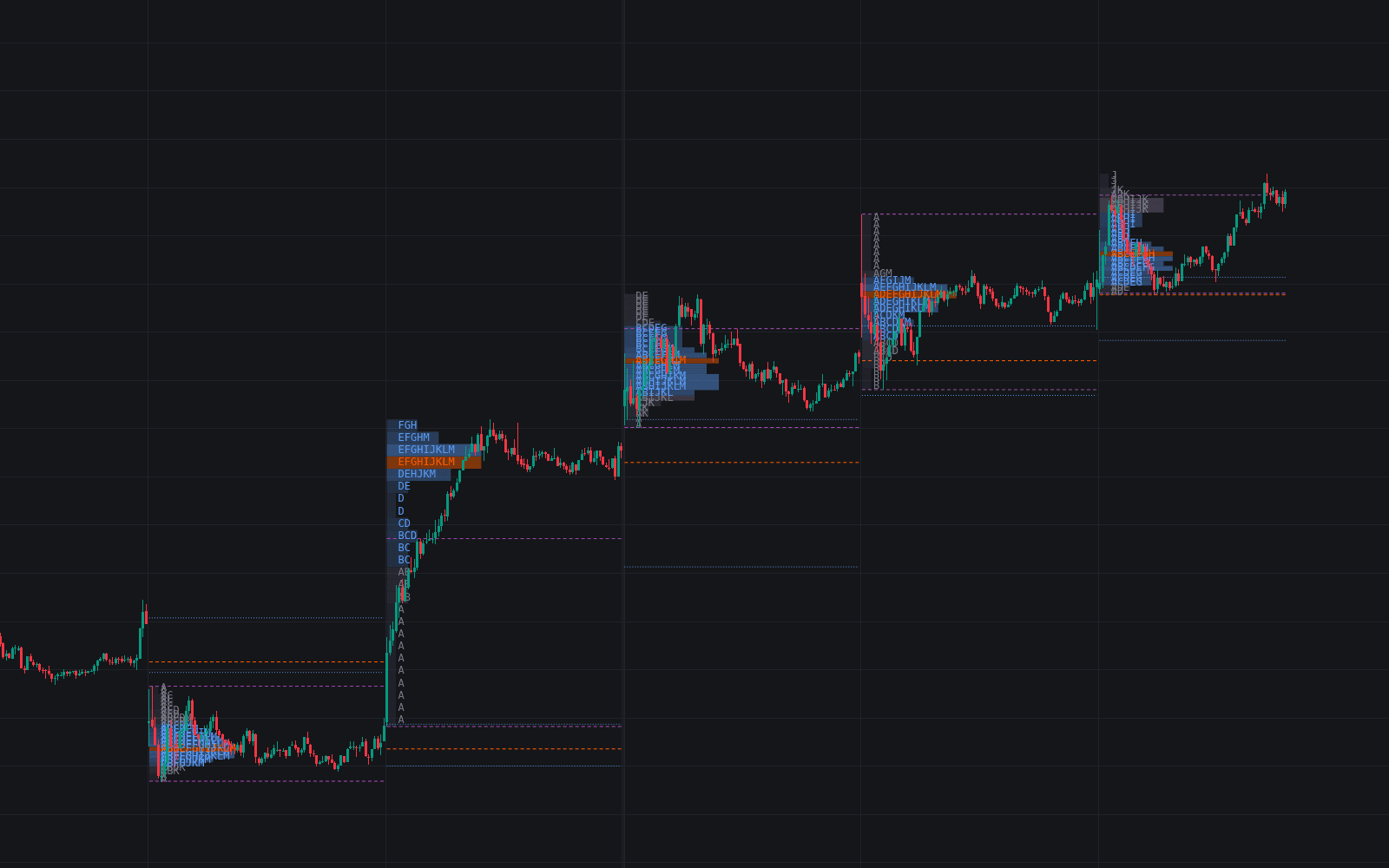
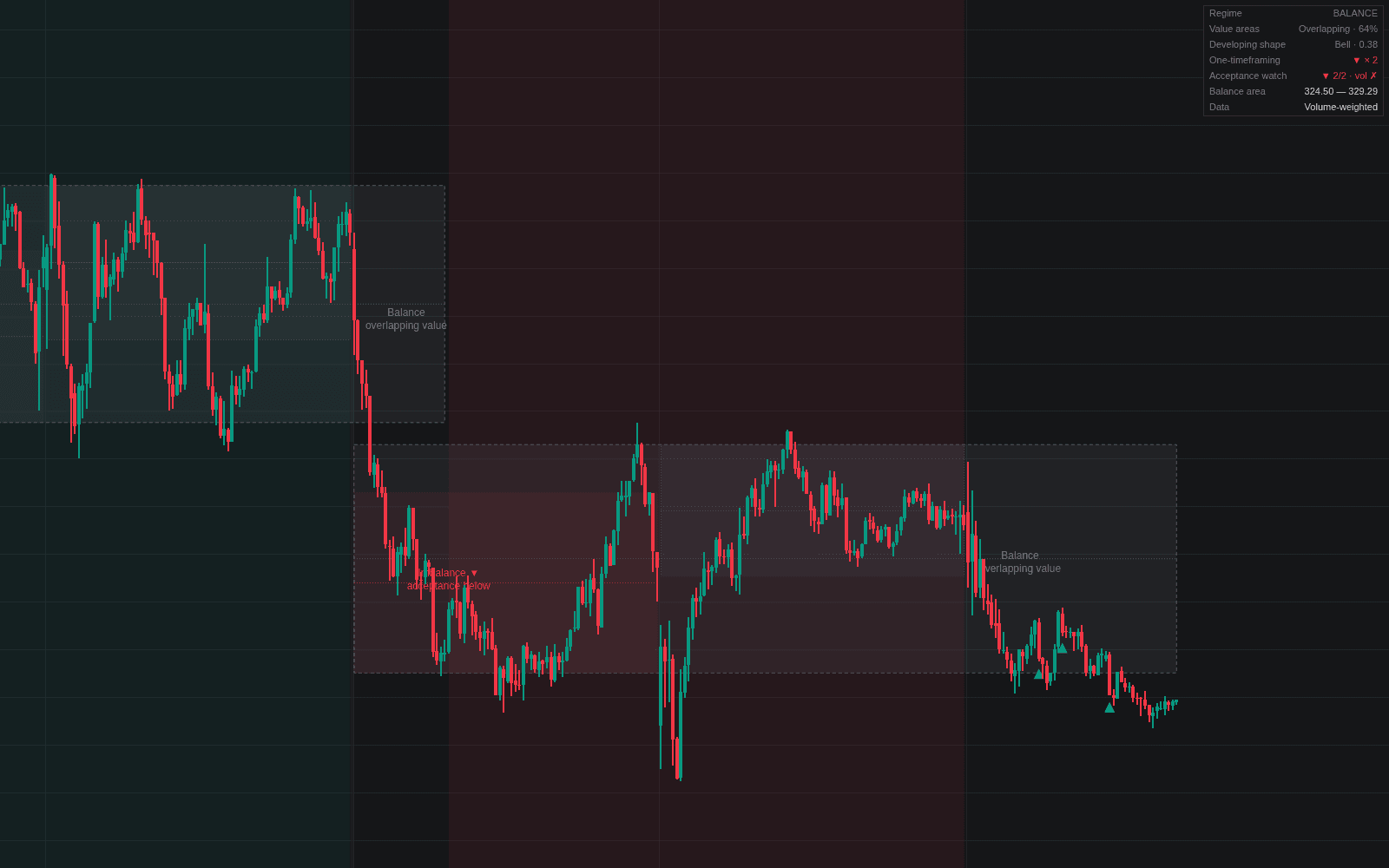
Value is where the most business gets done. A TPO profile or volume profile displays it as a distribution, with the point of control at its busiest price and the value area around it. The theory's central claim is that markets alternate between two states: balance, where both sides accept value and price rotates inside a range, and imbalance, where one side is aggressive enough to move the auction in search of new value. Deciding which state is in force, the subject of balance vs imbalance, comes before any setup, because the right behavior in each is nearly opposite.
The theory also says how an auction should end. A move that travels too far, attracts the other side and is driven away leaves excess, the tail of a completed auction; an extreme that ends flat and heavily traded is a poor high or poor low, an unfinished auction the market often returns to repair. Single prints record fast one-sided travel. Participants are sorted by horizon and motive: day-timeframe traders keep price rotating, other-timeframe participants drive the directional moves, and responsive vs initiative activity classifies whether trade is answering a move away from value or starting one.
Each linked concept has its own page with the detailed mechanics. AMT is a way of reasoning about price, not a signal system: profile readings depend on session definitions and value-area conventions, labels such as acceptance and excess involve judgment, and there is no rigorous public evidence that the framework predicts on its own.
How to read a market with auction market theory
AMT analysis works from the larger auction down to the current session, and each step uses one of the framework's tools:
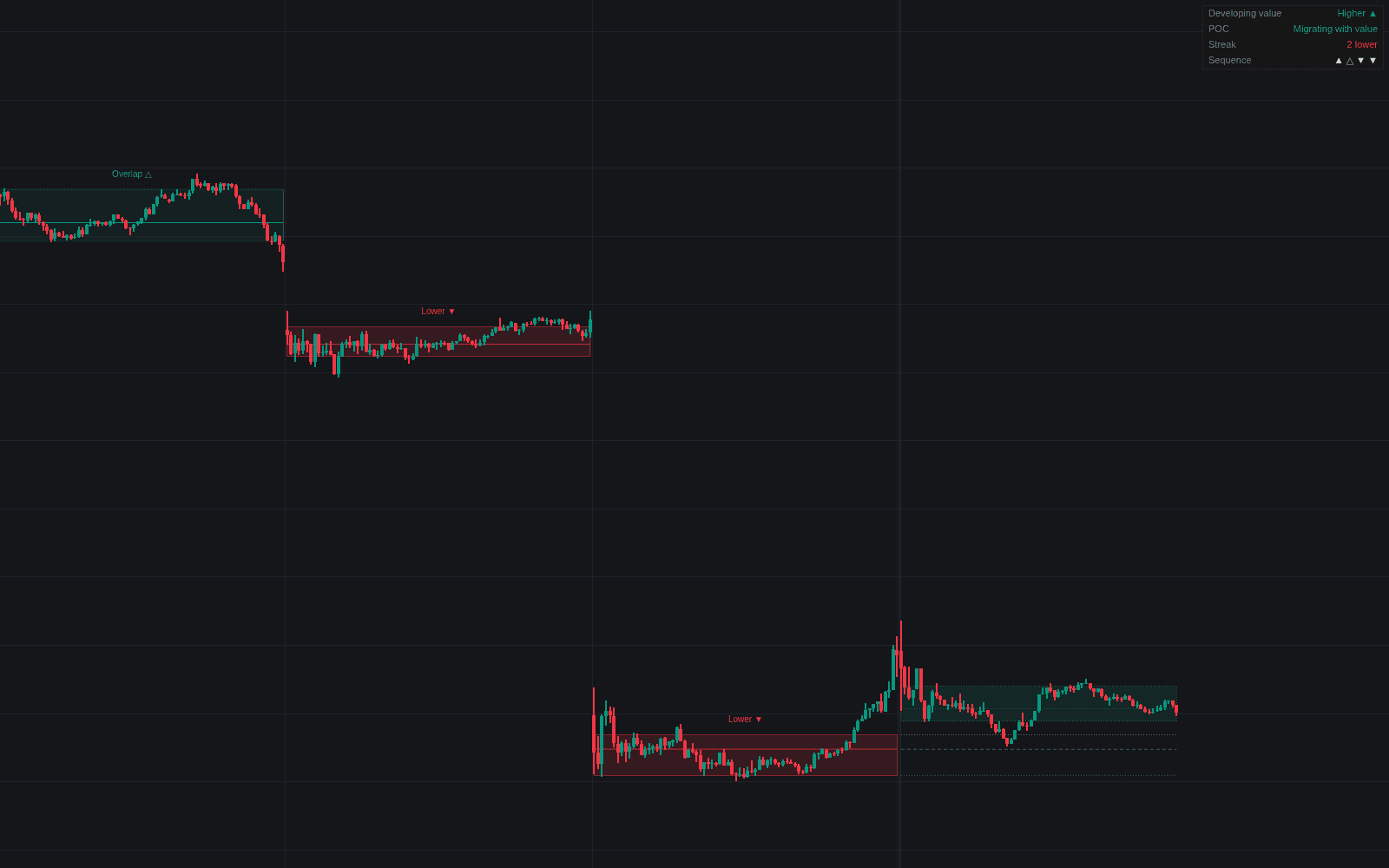
- 1Set the larger context by comparing recent sessions' value areas: overlapping value describes a balance bracket, while value migration higher or lower describes imbalance.
- 2Map the references carried forward: prior value edges and POC, naked POCs, excess tails, poor highs and lows, and single prints.
- 3Read the open against that map. Where the session opens relative to prior value, and how it trades from there (open types), frames the first hypothesis; the 80% rule handles one specific case, an open outside value that re-enters.
- 4Track the developing session: range extension beyond the initial balance sorts the day by day type, while one-timeframing and the rotation factor measure how directional the trade is.
- 5Judge every probe by acceptance or rejection: time and volume building beyond a reference is acceptance, and a quick return is rejection, the auction failure case.
- 6Grade the extremes as the session closes, apply the spike rules to any late breakout, and carry the unfinished references into the next day.
How traders use it
- Regime-dependent tactics: fading the edges back toward value while the market balances, following range extension while it is imbalanced, and switching playbooks when acceptance or rejection says the state has changed.
- Location before pattern: entries are framed by where price sits relative to value, for example responsive buying below value inside a bracket versus initiative buying above value when the market is trying to trend.
- A reference map for targets and stops: poor highs and lows, naked POCs and single prints are watched as levels the market may revisit, while excess tails are treated as walls with stops placed beyond them.
- Reading who controlled the session: profile shapes such as P, b and double distributions summarize which side was active and how the auction ended.
- Alongside flow data: session VWAP as the running average of the day's business, and volume delta to check whether range extension carried genuine aggression. Bar-level reads from volume spread analysis are often taken at the same auction references.
- With automated bookkeeping: the LuxAlgo Library builds the pieces separately, from TPO Profile and Value Migration to Excess, Auction Failure and the 80% Rule, while the auction reading itself stays with the trader.
Auction Market Theory vs related frameworks
Wyckoff Method: Both read supply and demand from price and volume. Wyckoff organizes the chart around trading ranges, schematic events and the campaigns of large operators; AMT organizes it around value distributions, sessions and participant timeframes, and reads acceptance from time and volume at price rather than from bar sequences.
Balance vs Imbalance: Not a rival but the core of the theory: balance vs imbalance is the state judgment every other AMT read depends on, while AMT is the full framework of value, auction completion and participants around it.
TPO Profile: The TPO profile, or Market Profile, is the chart format Steidlmayer built to display the auction; AMT is the theory used to interpret it. The same theory applies to volume profiles, and much of it to ordinary bar charts.
More Auction Market Theory implementations
Concept family
Volume & Order Flow
91 concepts mapped · 91 in the Library
Auction Market Theory FAQ
Turn Auction Market Theory into a trading strategy.
Take any implementation from this page into Quant, then build on it, backtest it on real data, and keep refining it in conversation.