Concept
Day-type Taxonomy
Day-type Taxonomy is a Volume & Order Flow concept. The Library holds 1 implementation, a working definition you can pull into Quant.
trend/normal/normal-variation/neutral/neutral-extreme
Top Day-type Taxonomy indicator
The top custom implementation, built on the original standard Day-type Taxonomy formula.
1 total
From studying Day-type Taxonomy to trading it: take the implementation below into Quant and backtest it instantly.
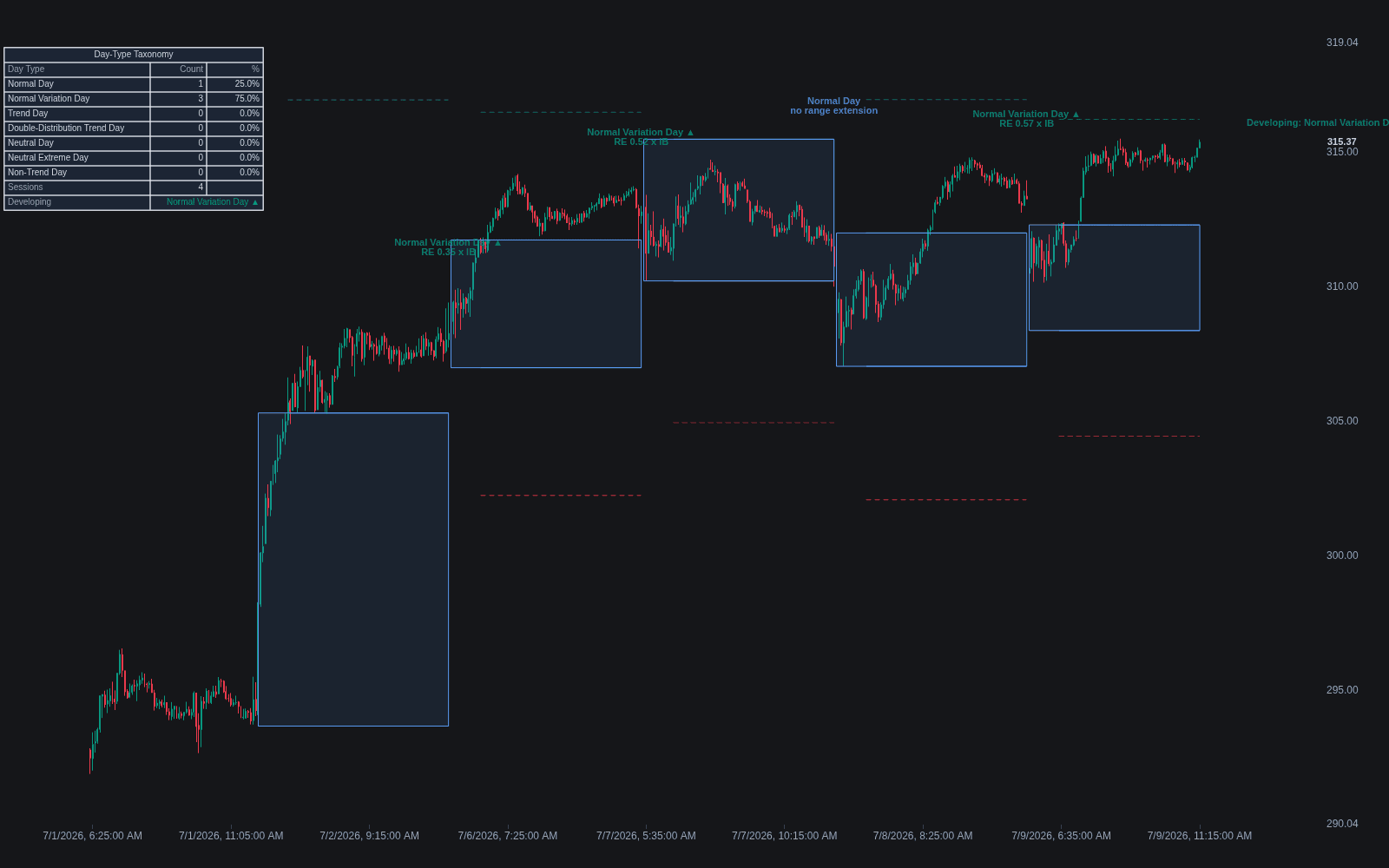
What is the day-type taxonomy?
The day-type taxonomy is the Market Profile classification of trading sessions by how far and how convincingly price extends beyond the initial balance, the range of the first hour. The canonical set, developed from Peter Steidlmayer's profile work at the CBOT and elaborated in James Dalton's teaching material, includes the trend day, the normal day, the normal variation day, the neutral day, and the neutral extreme day, with the non-trend day and the double-distribution trend day as common additions.
Each type encodes a different balance of conviction. A normal day sets a wide initial balance that contains the whole session, with rotational two-sided trade inside it. A normal variation day extends the initial balance meaningfully on one side, roughly doubling it, as one-sided activity takes over mid-session. A trend day opens with a narrow initial balance and extends relentlessly in one direction, closing near the extreme with little rotation. A neutral day extends beyond the initial balance on both sides, signaling genuine two-sided conflict; if it then closes near one extreme it is a neutral extreme day, and if it closes mid-range it reflects unresolved balance.
Traders care because the day type shapes which tactics tend to work. Fading extremes tends to pay on normal and neutral days and to fail badly on trend days; joining strength tends to work on trend days and to bleed on rotational ones. Since the type only becomes certain in hindsight, the practical skill is recognizing the developing type as early as possible from the open, the initial balance width, and the character of range extensions.
How to identify the developing day type
Classification builds through the session; the open and first hour carry most of the early evidence.
- 1Judge the open first: conviction-driven open types such as an open-drive lean toward trend or normal variation days, while quiet in-range opens lean rotational.
- 2Measure the initial balance after the first hour. A wide first hour suggests a normal day whose extremes may hold; a narrow one leaves the session unresolved and raises trend-day odds.
- 3Watch range extension. No extension points to a normal or non-trend day; one-sided extension to normal variation or trend; extension on both sides defines a neutral day.
- 4Grade the extension's character: sustained one-timeframing, with each period holding above the prior period's low (or below its high), marks trend conditions, while extensions that immediately retrace mark rotation.
- 5Use the close to finalize: closes at the extreme confirm trend or neutral extreme days; mid-range closes confirm balance.
How traders use it
- Tactic selection is the core use: rotational day types favor fading the edges of the developing range and the value area, while trend days demand joining pullbacks and forbid counter-trend fades.
- Risk scaling: many intraday traders cut size or stand aside once a trend day is recognized against their preferred mean-reversion style, since trend days account for a large share of fade-strategy losses.
- Next-day context: the type just completed shapes expectations, for example trend days are often followed by balancing sessions, and neutral days flag unresolved two-sided interest likely to continue.
- Statistical framing: traders track the frequency of each type in their market, since trend days are a minority of sessions in most instruments, which justifies rotational tactics as the default until proven otherwise.
- With honest limits: real sessions blur categories, the classification is only certain at the close, and mechanical definitions of extension multiples vary between authors, so the taxonomy is a lens rather than a signal.
Day types vs related classifications
Profile Shape Taxonomy: Profile shapes (P, b, D, B profiles) classify the finished distribution of the session, while day types classify the sequence of how the session traded relative to its initial balance. They usually agree but describe different dimensions.
Open Types: Open types classify only the first minutes of trade. They are the earliest input into the developing day type, not a substitute for it.
Balance vs Imbalance: Balance versus imbalance is the timeframe-agnostic version of the same question. The day-type taxonomy applies it specifically to a single session's structure around the initial balance.
Concept family
Volume & Order Flow
88 concepts mapped · 88 in the Library
Day-type Taxonomy FAQ
Turn Day-type Taxonomy into a trading strategy.
Take the implementation from this page into Quant, then build on it, backtest it on real data, and keep refining it in conversation.