Rotation Factor
 By LuxAlgoMay 31, 2026
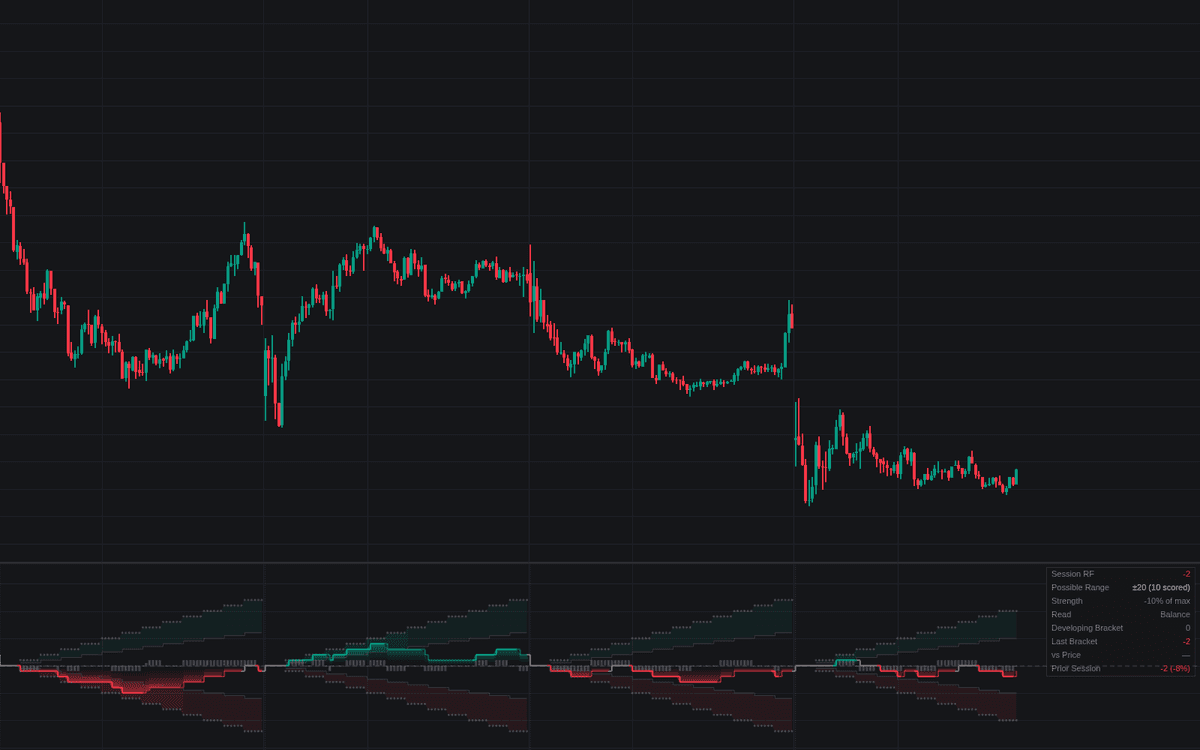

Rotation Factor keeps Market Profile's period-by-period auction score automatically: each finished 30-minute TPO bracket scores against its predecessor (+1 per higher extreme, -1 per lower, 0 for unchanged) and the running total plots as a stepline resetting each session. The definitive build of the rotation factor judges the count against the session's own possible range (±2 per scored bracket) with strong-rotation levels as a share of that range rather than a fixed number.
How to Trade the Rotation Factor?
- One-sided counts: a total holding beyond the strong-rotation levels says one side keeps winning the auctions, an argument for trend-day tactics.
- Balance: totals inside the balance band read as a two-sided auction, favoring responsive trades around the edges.
- Effort versus result: the dashboard compares the count's direction with the session's net price change. Strong rotation without progress warns of absorption, worth checking against the volume and order-flow tools.
Six alerts cover strong rotation, sign flips, the divergence and the session lock-in.
Rotation Factor Settings
- Session Anchor (default D): session the tally runs over and resets on; choose deliberately on 24-hour markets.
- TPO Bracket (default 30): one bracket's duration, the statistic's only real parameter; must not be below the chart timeframe.
- Strong Rotation Threshold % (default 50): share of the possible range that reads as strongly one-sided.
- Balance Band % (default 15): share of the range that reads as balance.
- Show Dashboard (default enabled) with Position (default Top Right) and Size (default Small).
- Style toggles draw the score columns, gradient fill, range envelope, threshold levels and session breaks (all default enabled).
Frequently Asked Questions

Original indicatorBuilt in-house by LuxAlgo
The Library is free. Quant makes it yours.
Pull any concept or indicator into Quant: rebuild it, retune it, or turn it into a backtested strategy of your own.