Concept
Trend Exhaustion
Trend Exhaustion is a Trend concept. The Library holds 2 implementations, each one a working definition you can pull into Quant.
Top Trend Exhaustion indicators
The top custom implementations, built on the original standard Trend Exhaustion formula.
2 total
Want to trade Trend Exhaustion? Any of the 2 implementations below is one prompt away from a backtested strategy in Quant.
.png&w=3840&q=75)
What is Trend Exhaustion?
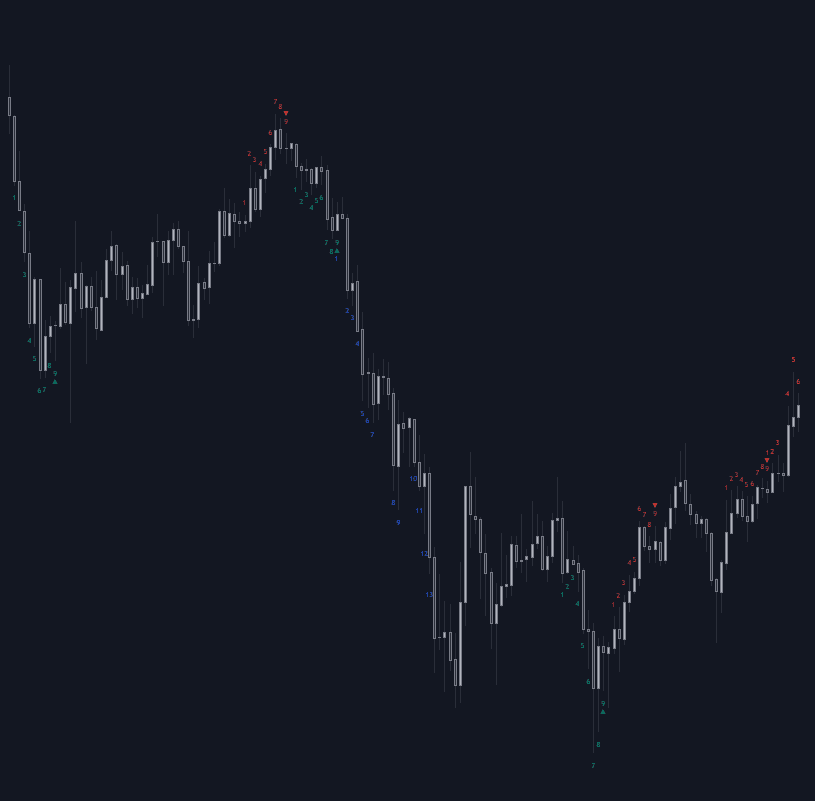
Trend exhaustion is the condition late in a directional move when the buying or selling that drove it stops being replenished: price is still trending, but each push covers less ground, momentum readings diverge from the new extremes, and volume either climaxes or dries up. It is a state to be diagnosed rather than a single formula, and different traditions measure it differently, from momentum divergence to sequential bar counts such as TD Sequential to climactic volume studies.
Exhaustion is a warning, not a verdict. Trends frequently look exhausted, consolidate, and resume; genuine turns usually need structural confirmation (a broken swing, a failed retest) before the exhaustion reading means much. Its practical value is asymmetric: it is generally treated as a reason to stop adding and start protecting rather than as a standalone reason to trade against the trend.
The underlying story is replenishment. A trend persists while pullbacks keep recruiting fresh participants in its direction; exhaustion is the evidence that recruitment is failing. That evidence wears several uniforms: momentum diverging at new extremes, completed sequential counts, a volume climax with no follow-through or volume quietly draining from the pushes, bar ranges contracting in the trend's direction while stretching against it, and price extended far from its baseline EMA with the ribbon behind it splaying at unsustainable width. No single uniform is the diagnosis; the state is declared when several arrive together, ideally at a level that matters.
Tooling packages the diagnosis in layers. LuxAlgo's Sequencer generalizes DeMark-style counting into staged setup and countdown phases, its Reversal Signals implements the classic 9-count and 13-count grammar with graded alerts, and Zeenobit's Momentum Exhaustion study reads the divergence-and-fade side. The playbook around all of them is the same three-act sequence: exhaustion flags the conditions, a structure break supplies the event, and the retest of the break supplies the trade. Strong trends will print exhaustion repeatedly and keep going, which is why the reading defends positions far more reliably than it predicts tops.
How to identify trend exhaustion
The diagnosis is cumulative: one sign is noise, several together at a meaningful location are the state.
- 1Establish that there is a mature trend to exhaust: an extended run, price far from its baseline average, ideally into a higher-timeframe level.
- 2Scan momentum at the new extremes: oscillators printing lower highs against higher price highs, or the mirror at lows, are the classic first flag.
- 3Check the counts: completed sequential setups and countdowns formalize the run-length evidence that a move has aged.
- 4Read the volume character: a climactic spike without follow-through, or pushes proceeding on visibly draining participation, both say replenishment is failing.
- 5Wait for structure before acting on the diagnosis: a broken swing, a failed breakout, or a lost retest converts exhaustion from context into a trade.
How traders use it
- As an exit or tightening trigger for trend followers: exhaustion readings prompt partial profit-taking or closer stops without requiring a top or bottom call.
- As a timing layer for reversal traders, who wait for exhaustion plus a structure break rather than fading strength on exhaustion alone.
- As a filter against chasing: fresh entries in the trend direction are skipped while exhaustion flags are active, then reconsidered once the trend digests and resets.
- As the sensor layer of reversal-signal indicators: counts, divergences and climax detection are fused into staged alerts, a warning tier when conditions accumulate and a confirmation tier when structure finally gives.
- As hygiene inside trailing systems: an active exhaustion state forbids new pyramids while a Supertrend-style trail keeps the existing position working, letting the trend prove itself dead rather than guessing.
Trend exhaustion vs related trend states
Reversal: Exhaustion is the precondition, reversal is the event, and the funnel between them is wide: many exhausted trends consolidate and resume instead of turning. Trading the state as if it were the event is the classic way to fight a strong trend and lose.
Trend Regime Label: Regime classifiers answer whether the market is trending now; exhaustion asks how much fuel the current trend has left. A market can be unambiguously trending and deeply exhausted at once, which is exactly the state where the two tools disagree productively.
MA Slope Filter: A fading slope is one mechanical symptom of exhaustion, cheap to compute and always on. The full diagnosis is broader, adding divergence, counts and volume character, which is why slope alone flags exhaustion late in fast trends and early in grinding ones.
Concept family
Trend
100 concepts mapped · 100 in the Library
Trend Exhaustion FAQ
Turn Trend Exhaustion into a trading strategy.
Take any implementation from this page into Quant, then build on it, backtest it on real data, and keep refining it in conversation.