Concept
Order Types
Order Types, also known as market, limit, stop, stop-limit, are Risk, Sizing & Exits concepts. The Library holds 1 implementation — a working definition you can pull into Quant.
Top Order Types indicator
The top custom implementation, built on the original standard Order Types formula.
1 total
Want to trade Order Types? The implementation below is one prompt away from a backtested strategy in Quant.
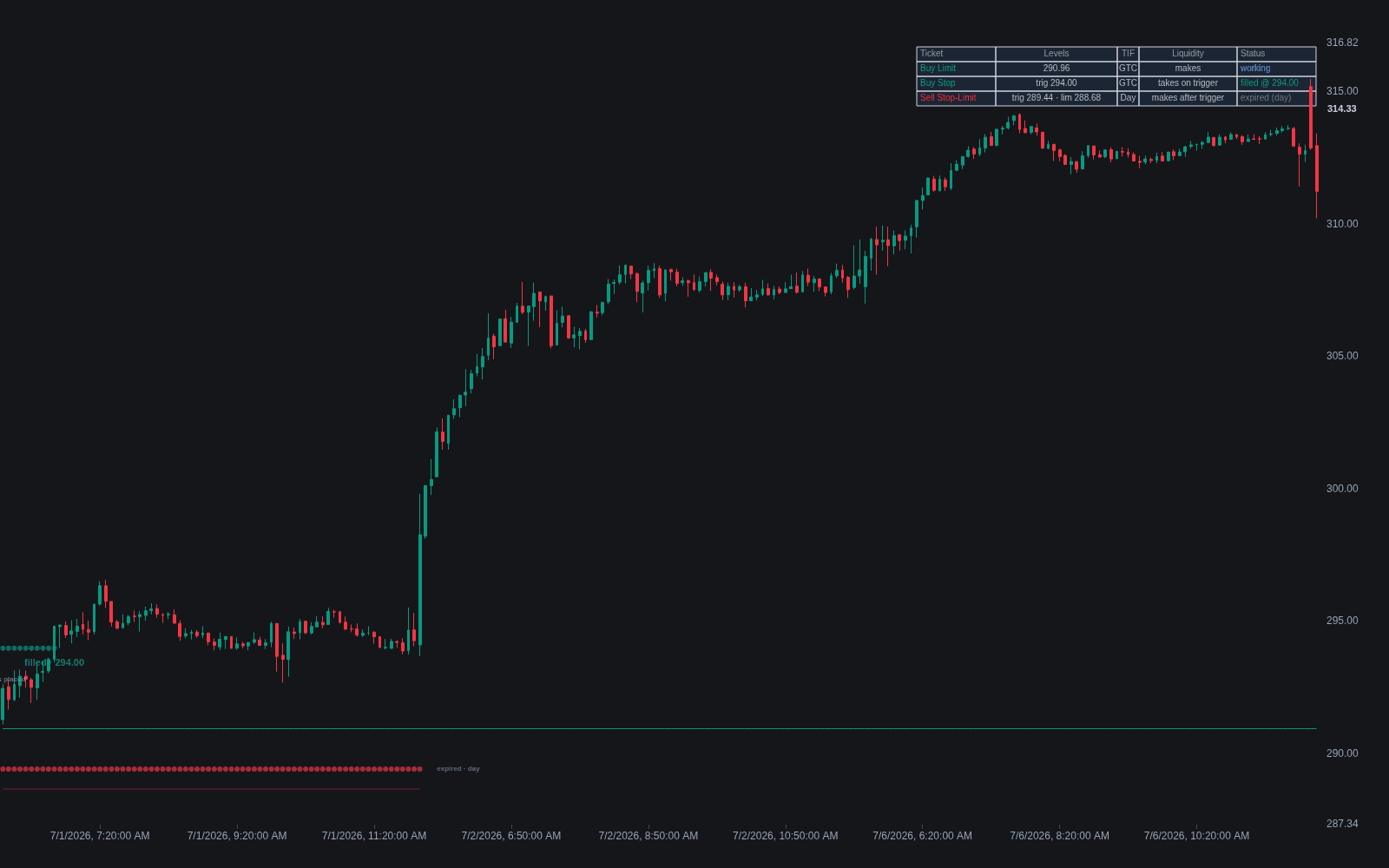
What are Order Types?
Order types are the basic execution instructions a venue accepts. A market order executes immediately at the best available price: the fill is all but certain, the price is not. A limit order rests at a chosen price and executes only there or better: the price is protected, the fill is not. A stop order becomes a market order once its trigger is reached, and a stop-limit becomes a limit order instead, adding price control at the risk of never filling on a gap. Time-in-force settings (day, good-till-canceled, immediate-or-cancel) govern how long each instruction lives.
The core split is between taking and making liquidity. A market order takes: it consumes resting orders on the other side, pays the spread, and on many venues incurs the higher taker fee. A limit order priced away from the market makes: it joins the book, earns the spread when hit, and often pays a lower fee or a rebate. Stops are dormant until triggered, and venues differ on what wakes them: some fire on the last traded price, others when the bid or ask touches the level, which decides whether a quote spike with no trade behind it can set off your stop.
Every type is a trade-off between fill certainty and price certainty, and setups map onto that trade-off naturally: breakout entries use stop orders to join only if price proves it, pullback entries use limit orders to be paid the spread rather than pay it, and exits that must happen use market or stop-market rather than anything that can miss. Combined with linkage logic, the basic types become order constructs such as brackets and OCO pairs.
Execution choices compound. A strategy that trades often can see its edge consumed by spreads and slippage, so order-type selection belongs in the plan alongside sizing bases and loss-control rules rather than being an afterthought.
How to choose an order type
There is nothing to spot on a chart; the skill is mapping each part of a trade plan onto the instruction whose failure mode you can live with.
- 1Decide what must not fail: a missed entry is usually survivable, so price-protecting types are affordable there, while a missed protective exit is the disaster, which argues for stop-market.
- 2Match the entry to the setup: a stop order beyond the level for momentum entries that want confirmation, a limit order at the level for entries that want position and price.
- 3Place the protective exit as a stop-market by default, at the level chosen by your stop method, whether a fixed level, a structure stop, or a volatility-based distance.
- 4Rest profit targets as limit orders so they can fill while you are away; the profit target taxonomy covers how those prices are chosen, and pick each order's time-in-force deliberately so nothing expires or lingers unnoticed.
How traders use it
- Matching entry style to type: stop orders above resistance for breakout entries, limit orders at support or a retracement level for pullback entries, market orders when immediacy matters more than the spread.
- Protecting positions: stop-market for the hard stop, since a fill with slippage beats no fill in a runaway move, with stop-limit reserved for thin instruments where a momentary wick would otherwise eject the position at a distorted price.
- Controlling costs in automation: alert-driven systems often choose limit entries to avoid paying the spread on every signal, accepting missed trades as the price of execution quality and tracking the miss rate as a statistic of its own.
- Working scale-ins: DCA plans and deliberate averaging down rest a ladder of limit orders at staged prices, while pyramiding adds with stop orders so each addition requires the move to keep proving itself.
- Structuring exits: scaling out rests limit targets at several levels against a single protective stop, usually OCO-linked so the stop quantity shrinks as targets fill, while trailing exits amend the stop along the chosen trailing method.
Order Types vs exit and placement frameworks
Order Constructs: Order types are single instructions; constructs are packages of them wired together with cancel logic, such as brackets and OCO pairs. Mastering the types comes first, because a construct inherits every quirk of the legs it is built from.
Fixed Stops: A fixed stop is a placement policy: where the exit price belongs and that it stays put. The stop order is the instruction that expresses it in the market, converting to a market order for exit certainty or to a limit order for price certainty.
Concept family
Risk, Sizing & Exits
37 concepts mapped · 37 in the Library
Order Types FAQ
Should a stop loss be a stop-market or a stop-limit order?
Stop-market is the usual default for protection: it accepts slippage to make sure the position actually closes. A stop-limit can fail exactly when it matters most, because a gap through both the trigger and the limit leaves the position open in a runaway market. Stop-limits earn their place in thin instruments where wick-driven slippage is routinely worse than the occasional uncapped loss. Neither choice removes gap risk.
Why did my limit order not fill even though price touched it?
A touch is not a guarantee. At the limit price you are in a queue: orders ahead of you at the same price fill first, and if price only touches the level and reverses, the queue may never reach you. A fill is only assured when price trades through the level, which is why careful backtests of limit entries assume through-price fills.
What is slippage and which order types suffer it?
Slippage is the difference between the price you expected and the price you received. Market orders and triggered stop-markets bear it, since they take whatever liquidity is available; limit orders cannot slip on price but can fail to fill. It grows with size, volatility, and thin books, so fast markets punish market orders exactly when they are most tempting.
What do time-in-force settings like GTC, IOC, and FOK mean?
They set an order's lifespan. Day orders die at the session close, good-till-canceled (GTC) orders persist until filled or removed, immediate-or-cancel (IOC) fills what it can instantly and cancels the rest, and fill-or-kill (FOK) executes in full immediately or not at all. Automated systems lean on IOC and FOK to avoid leaving unintended resting orders behind.
Can other traders see my stop orders?
Resting limit orders appear in the order book aggregated at their price, not attributed to you. Stop orders are generally not displayed: they wait in the exchange's trigger logic or on the broker's servers until activated. Others can still infer where stops plausibly sit, beneath obvious swing lows and round numbers, but that is inference, not visibility of your ticket.
Turn Order Types into a trading strategy.
Take the implementation from this page into Quant, then build on it, backtest it on real data, and keep refining it with AI.