Concept
Portfolio-aware Sizing
Portfolio-aware Sizing, also known as correlation-adjusted, risk parity, Kelly-capped ensembles, is a Risk, Sizing & Exits concept. The Library holds 1 implementation, a working definition you can pull into Quant.
Top Portfolio-aware Sizing indicator
The top custom implementation, built on the original standard Portfolio-aware Sizing formula.
1 total
Want to trade Portfolio-aware Sizing? The implementation below is one prompt away from a backtested strategy in Quant.
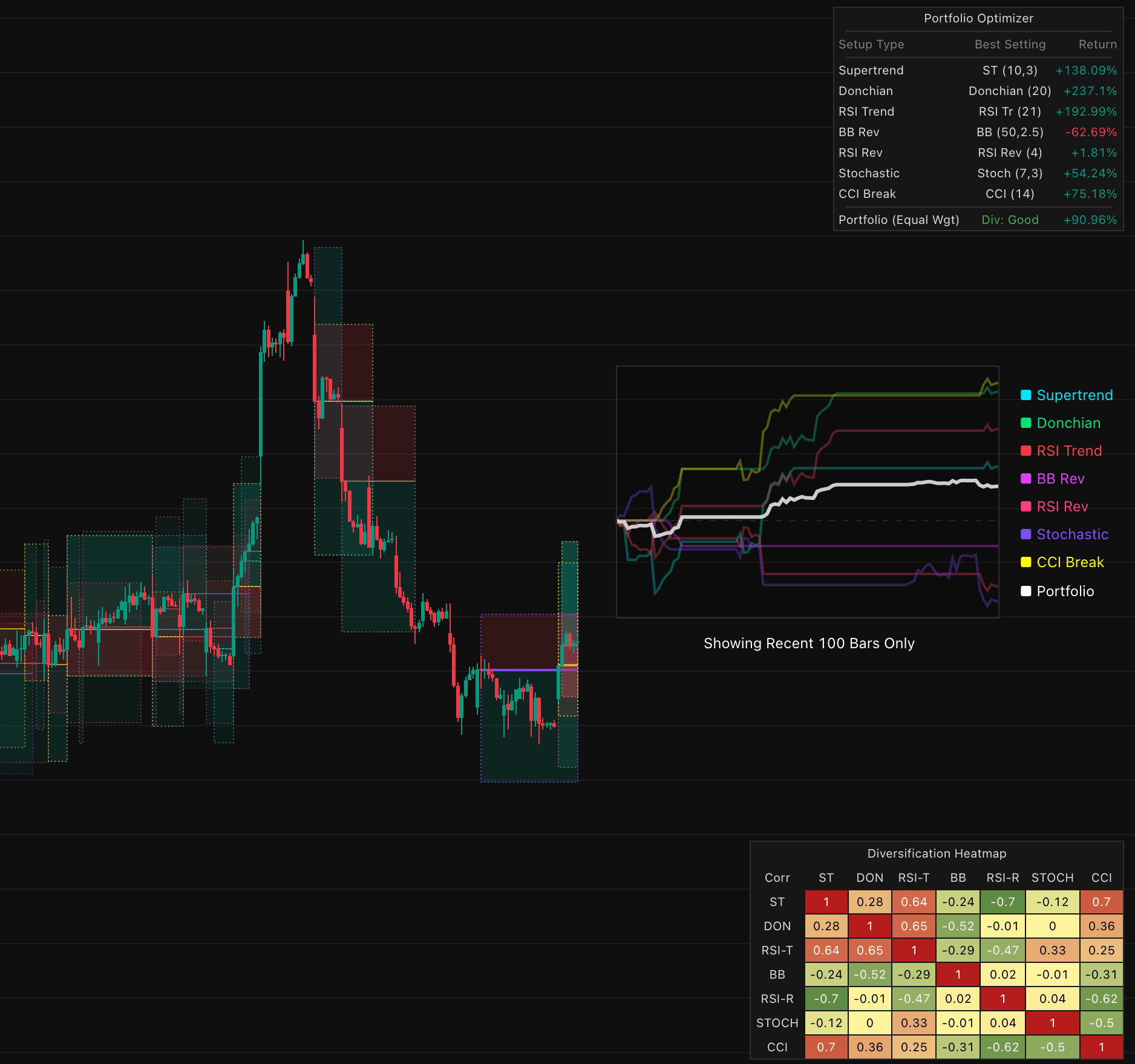
What is Portfolio-aware Sizing?
Portfolio-aware sizing sets each position's size with reference to everything else the account already holds, rather than treating every trade as an island. Per-trade schemes like fixed fractional answer one question: how much to risk on this stop distance. Portfolio-aware schemes add the questions that follow: how correlated is the new trade to the open book, how much total risk is already deployed, and how concentrated the book is in one direction or factor.
Common implementations include correlation haircuts (shrink size when the new trade moves with existing positions, since correlated positions behave as one larger position), risk parity (allocate so each position contributes a similar share of portfolio volatility, extending volatility-targeted sizing to the book level), and capped ensembles, where several strategies each request size and an aggregate limiter scales the requests down so combined exposure stays inside a fixed budget. The shared premise is that risk lives at the portfolio level, and correlation is the thing per-trade math cannot see.
The machinery scales with ambition. Heat accounting is arithmetic: sum stop-distance-times-size across the book and compare against a ceiling. Correlation haircuts need a rolling estimate, commonly twenty to ninety days of returns, applied as a discount that grows with the new trade's correlation to the existing book. Risk parity in its simple form weights positions by inverse volatility, and in its full form solves for equal risk contributions using the whole covariance structure. Kelly-capped ensembles work top-down: sub-strategies request sizes, the requests sum to more than the account should carry, and a governor rescales everything so the aggregate risked fraction respects a hard cap.
The failure modes are as established as the methods. Correlation estimates are unstable and converge toward one in stress, precisely when the haircut mattered; covariance matrices estimated on short windows are noise wearing a suit, which is why practical implementations shrink estimates and keep caps conservative; and small books can over-engineer, since two or three blunt rules, a heat cap, a same-direction limit, a correlated-pair haircut, capture most of the benefit that full optimization promises. The portfolio layer also composes with the time dimension: loss-control rules brake losing sequences while portfolio sizing governs cross-sectional stacking, and complete plans run both.
How to apply portfolio-aware sizing
Per-trade size first, then three book-level checks before the order goes out.
- 1Compute the per-trade base size from your sizing rule, the island answer the portfolio layer will adjust.
- 2Measure the candidate's relationship to the open book: rolling correlation to existing positions, and its direction and factor alignment.
- 3Apply the adjustment: a correlation haircut, a parity weight, or an ensemble rescaling, whichever the plan specifies.
- 4Check the aggregate: total heat against its ceiling, and concentration against direction or factor caps, refusing or shrinking the trade when either binds.
- 5Log the book-level exposures with the trade, since the portfolio layer only works if its state is visible when the next candidate arrives.
How it's calculated
Sizing rules that set each position from portfolio-level risk, using volatilities, correlations, and total open risk rather than the single trade alone.
These are complementary rules rather than one formula: weights feed the portfolio volatility check, and the Kelly output is capped before the heat limit is enforced.
Full risk parity equalizes each position's contribution to sigma_p and needs a numeric solver; the inverse-volatility form is the closed-form shortcut and matches it when all pairwise correlations are equal.
The Kelly formula assumes independent repeated bets, so correlated positions argue for a smaller c.
How traders use it
- As total-heat caps: sum the open risk of all positions (distance to stop times size) and refuse or shrink new entries once the sum reaches a preset ceiling, regardless of how good the next signal looks.
- As correlation-adjusted allocation: before adding a position, measure its correlation to the current book over a recent window and scale size down as correlation rises, so five correlated trades cannot quietly become one five-times-size trade.
- As an ensemble governor in multi-strategy systems: each sub-strategy proposes a size, and a portfolio layer rescales the set (risk-parity weights, or a Kelly-style cap on the aggregate fraction) so the combined book, not any single signal, defines the account's risk.
- As concentration limits: separate caps on net directional exposure and on single-factor exposure, so a book can be under its heat ceiling and still get refused for being one bet wearing five tickers.
- As drawdown-responsive scaling: the whole book's risk budget contracts as account drawdown deepens and restores with recovery, applying the fixed-fractional instinct at portfolio scale.
Portfolio-aware sizing vs related risk layers
Fixed Fractional: The island rule: each trade risks a fraction of equity against its own stop, blind to what else is open. Portfolio-aware sizing is the layer above, adjusting the island answers for correlation, heat, and concentration. The two compose; neither replaces the other.
Volatility-targeted Sizing: Volatility targeting equalizes each position's standalone risk contribution; the portfolio layer extends the same instinct to the book, where correlations decide whether ten equal contributions are ten bets or one. Risk parity is literally this extension formalized.
Loss-control Rules: Loss-control brakes the time dimension, capping what a losing sequence may spend; portfolio sizing governs the cross-section, capping what simultaneous positions may stack. A book can fail either audit while passing the other, which is why mature plans run both.
Concept family
Risk, Sizing & Exits
37 concepts mapped · 37 in the Library
Portfolio-aware Sizing FAQ
Turn Portfolio-aware Sizing into a trading strategy.
Take the implementation from this page into Quant, then build on it, backtest it on real data, and keep refining it in conversation.