Concept
Breakeven Move Rules
Breakeven Move Rules are Risk, Sizing & Exits concepts. The Library holds 1 implementation, a working definition you can pull into Quant.
BE at +1R
Top Breakeven Move Rules indicator
The top custom implementation, built on the original standard Breakeven Move Rules formula.
1 total
From studying Breakeven Move Rules to trading it: take the implementation below into Quant and backtest it instantly.
What are Breakeven Move Rules?
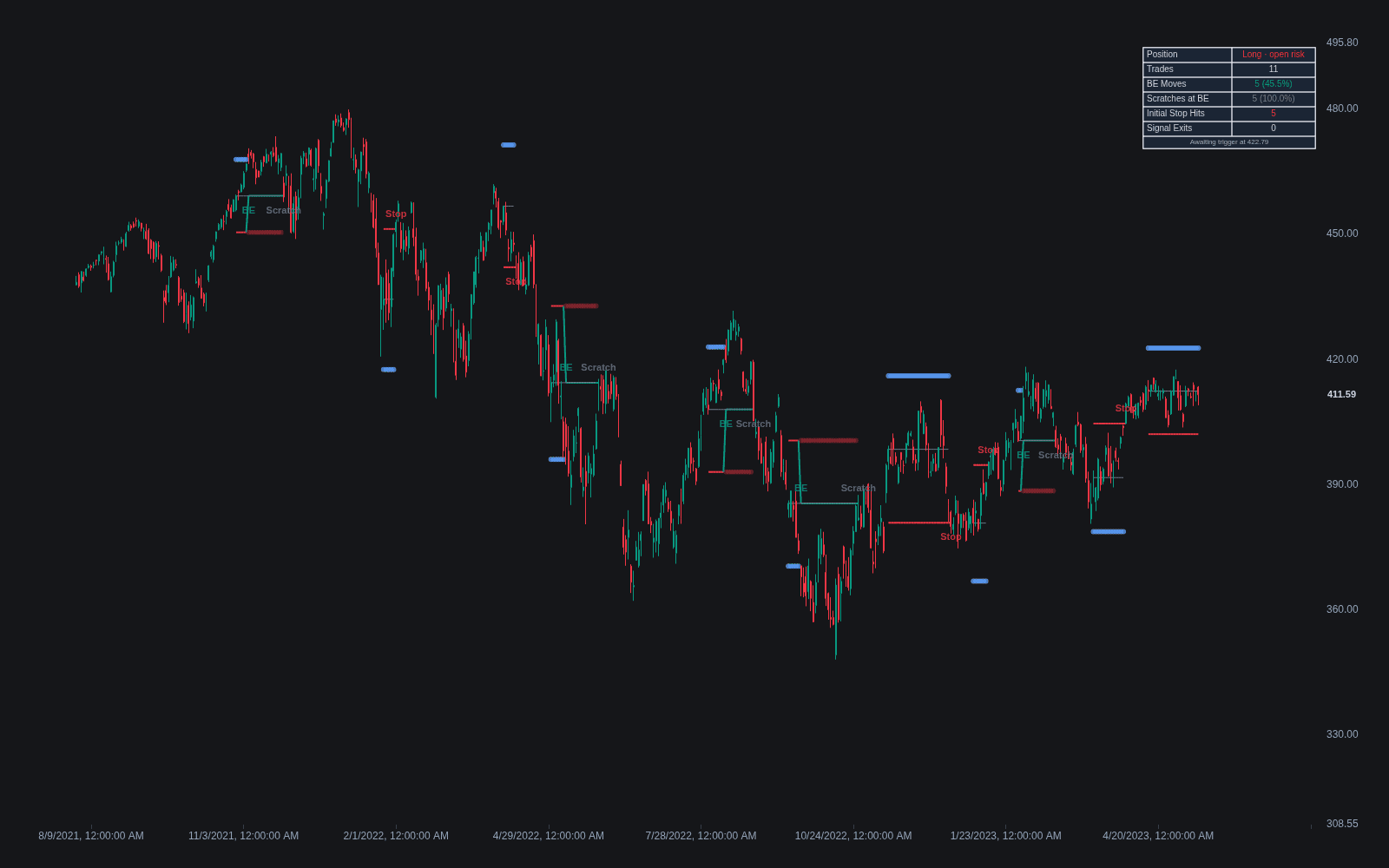
Breakeven move rules are trade-management rules that move the stop loss to the entry price once the trade has moved a predefined distance in favor, most commonly one initial risk unit, that is, at +1R in the R-multiple framework. From that point the trade can no longer produce a loss beyond costs; the worst case becomes a scratch. Variants trigger at other multiples, at a fixed price or ATR distance, or after a structural event such as a new swing forming in the trade's direction.
The rule exists for two reasons, one financial and one psychological. Financially it converts open risk to roughly zero, freeing risk budget under portfolio constraints like max heat. Psychologically it removes the specific pain of watching a winner turn into a loser, which is one of the most tilt-inducing experiences in trading, and that comfort is why the rule is so widely taught.
The honest trade-off is that the comfort has a price. Entry-area prices are revisited often; normal pullbacks tag a breakeven stop and eject the trade before the move it was designed to capture. Studies of MAE and MFE distributions for a given strategy often show that mechanical breakeven moves at +1R reduce average profit per trade, because the scratches they create cost more expectancy than the avoided losers save. Whether the rule helps is an empirical question per strategy, not a principle.
How it's calculated
The common form, stated for a long trade:
There is no single canonical k; +1R is a convention, not a derived optimum, and variants trigger on ATR multiples or structure instead of R.
For shorts, mirror the arithmetic: trigger = entry - k * R and new_stop = entry - c.
How traders use it
- As a mechanical rule inside systematic strategies: the trigger and buffer are fixed parameters, and their value is verified in backtests rather than assumed, since the rule measurably changes the trade outcome distribution.
- As the first step of a trailing plan: many traders move to breakeven at +1R and then hand management over to a trailing method or partial scaling out, so the breakeven move is a transition, not the whole exit.
- Structure-conditioned versions wait for the market to build a new swing low (for longs) beyond entry, then place the stop under that structure instead of exactly at entry, which avoids parking the stop at the most revisited price on the chart.
- In funded and prop accounts, breakeven moves are used aggressively to protect daily loss limits, accepting the expectancy cost in exchange for rule survival.
- With honest limits: breakeven is an emotionally derived level, not a market-derived one. The market does not know your entry price, and MAE/MFE-informed management often finds better stop-advance points than the entry itself.
Breakeven moves vs adjacent management rules
Trailing Method Taxonomy: Trailing methods keep advancing the stop with price by some rule; a breakeven move is a single discrete jump to entry. Many plans use the breakeven move as the handoff point into a trail.
Structure Stop: Places and advances stops at market-derived swing levels rather than the trader's entry price. A structure stop that happens to sit near entry is coincidence; a breakeven stop is entry by definition.
Scaling Out: Banks part of the position at a target instead of (or alongside) moving the stop. Both reduce the chance of a round trip to red; scaling out pays for it with capped upside, breakeven with more scratches.
Concept family
Risk, Sizing & Exits
37 concepts mapped · 37 in the Library
Breakeven Move Rules FAQ
Turn Breakeven Move Rules into a trading strategy.
Take the implementation from this page into Quant, then build on it, backtest it on real data, and keep refining it in conversation.