Concept
Loss-control Rules
Loss-control Rules, also known as daily loss limits, consecutive-loss breakers, cooldowns, are Risk, Sizing & Exits concepts. The Library holds 1 implementation, a working definition you can pull into Quant.
Top Loss-control Rules indicator
The top custom implementation, built on the original standard Loss-control Rules formula.
1 total
This Loss-control Rules implementation is strategy-ready: open it in Quant, set your rules, and it backtests automatically.
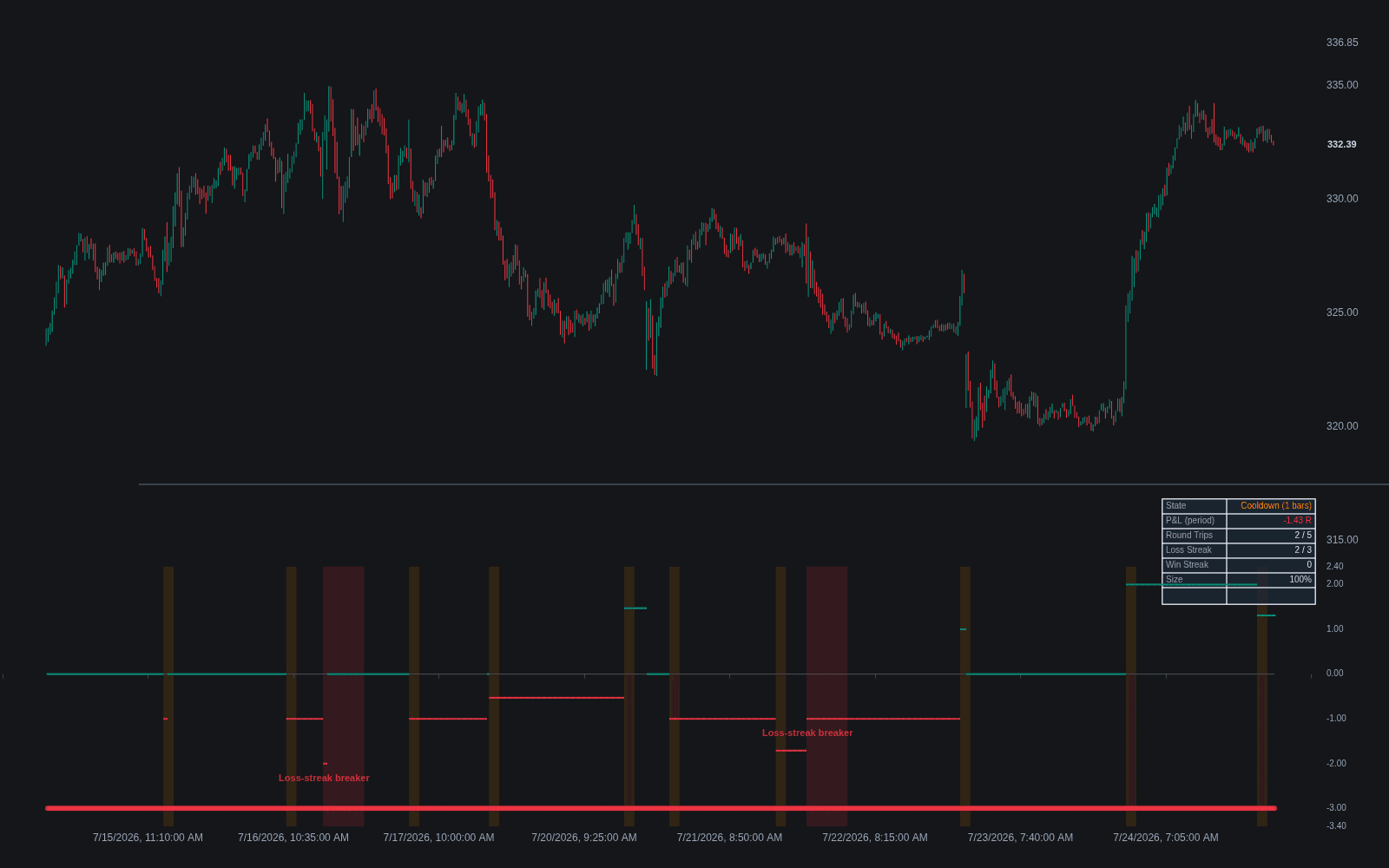
What are Loss-control Rules?
Loss-control rules are account-level circuit breakers: predefined conditions under which trading stops or shrinks for the rest of a session, day, or week. Common forms include a daily loss limit (stop after losing a fixed amount or percentage), a consecutive-loss breaker (stop after N losers in a row), cooldown timers between trades, and caps on round trips per day. They operate one level above the stop loss: a stop caps the damage of one trade, while loss-control rules cap the damage of a losing sequence.
The case for them is both mathematical and behavioral. Percentage losses compound, so a rule that halts trading after, say, three full-risk losers bounds the day at a known multiple of the per-trade risk defined in an R-multiple framework. Behaviorally, losing streaks tend to degrade decision quality, and a forced cooldown removes the revenge-trade option entirely. Prop firms hard-code the same idea as daily and maximum drawdown limits, which makes personal loss-control rules a survival requirement on funded accounts rather than a stylistic choice.
The taxonomy extends past the basics. Profit-giveback rules protect a finished day: once up some amount, trading stops if a set fraction of the gain is returned, converting a good session from a peak into a floor. Round-trip caps bound overtrading directly, the constraint the Library's trip-limiter tool automates. Equity-curve throttles apply trend logic to the trader: size drops when the account's own equity curve deteriorates below its average and restores with recovery, a debated technique whose statistical value is regime-dependent but whose behavioral value, forcing smallness during bad stretches, is easier to defend.
Enforcement is the entire game, because the rules exist precisely for moments when judgment is compromised. Pre-commitment beats willpower: automated counters that block entries after thresholds, broker- or platform-level lockouts where available, and alert-driven accountability all outrank a resolution remembered mid-tilt. The other half is the restart protocol, defined in advance: what ends a cooldown, what restores full size after a throttle, and what a rule violation costs. Prop-firm rule sets make the template concrete, a daily loss limit plus a trailing maximum drawdown, and a personal version of the same two-layer structure is the standard recommendation.
How to identify and implement loss-control rules
Define in R, automate the counting, and decide the restart before the stop.
- 1Set the limits in R terms: a daily stop at 2R to 3R, a consecutive-loss breaker at a small N, and any round-trip cap, all written before the week begins.
- 2Automate the counting: an execution layer or alert tool tracks losses and trips, since self-reported counts fail exactly when they matter.
- 3Define the lockout mechanics: what is blocked, for how long, and whether the rule halts trading or throttles size.
- 4Define the restart: the conditions that end a cooldown or restore full size, decided in calm, applied without renegotiation.
- 5Audit compliance separately from performance: a limit that was overridden is a limit that does not exist, whatever the P&L says.
How traders use it
- As a daily loss limit sized in R: for example, stop after losing 2R to 3R in a day, so a normal losing day remains a small, planned fraction of the account instead of cascading into an outsized one.
- As consecutive-loss breakers and cooldowns in automated systems: an execution layer counts round trips and losses, then blocks new entries for a fixed window once a threshold is hit, regardless of what the signal logic says.
- As throttles that de-risk rather than halt: after a trigger, size drops (half the usual fixed-fractional risk, for instance) until a winning sequence restores full size.
- As profit protection: giveback rules end the session once a set fraction of the day's peak gain has been returned, converting good days into secured outcomes rather than round trips.
- As funded-account survival: personal limits set inside the prop firm's own daily and maximum drawdown rules keep normal variance from breaching the account, since the firm's limits are terminal while personal ones are merely uncomfortable.
Loss-control rules vs related risk layers
Fixed Stops: The stop is trade-level: it caps one position's damage. Loss-control rules are sequence-level: they cap what a day or streak of stopped trades can accumulate into. A plan with stops but no sequence rules has bounded every loss except the one that matters.
Sizing Bases: The sizing base budgets each trade's risk; loss-control rules govern how many such budgets a bad stretch may spend. They compose top-down: the base defines R, the daily limit is quoted in R, and together they make the worst normal day a designed number.
Pyramiding: Both are sequence policies, pointed opposite ways: pyramiding schedules how winners earn additional risk, loss-control schedules how losers forfeit it. Mature plans specify both, since discretion under euphoria fails about as reliably as discretion under tilt.
Concept family
Risk, Sizing & Exits
37 concepts mapped · 37 in the Library
Loss-control Rules FAQ
Turn Loss-control Rules into a trading strategy.
Take the implementation from this page into Quant, then build on it, backtest it on real data, and keep refining it in conversation.