Concept
Averaging Down
Averaging Down is a Risk, Sizing & Exits concept. The Library holds 1 implementation, a working definition you can pull into Quant.
labeled: risk-expanding
Top Averaging Down indicator
The top custom implementation, built on the original standard Averaging Down formula.
1 total
This Averaging Down implementation is strategy-ready: open it in Quant, set your rules, and it backtests automatically.
What is Averaging Down?
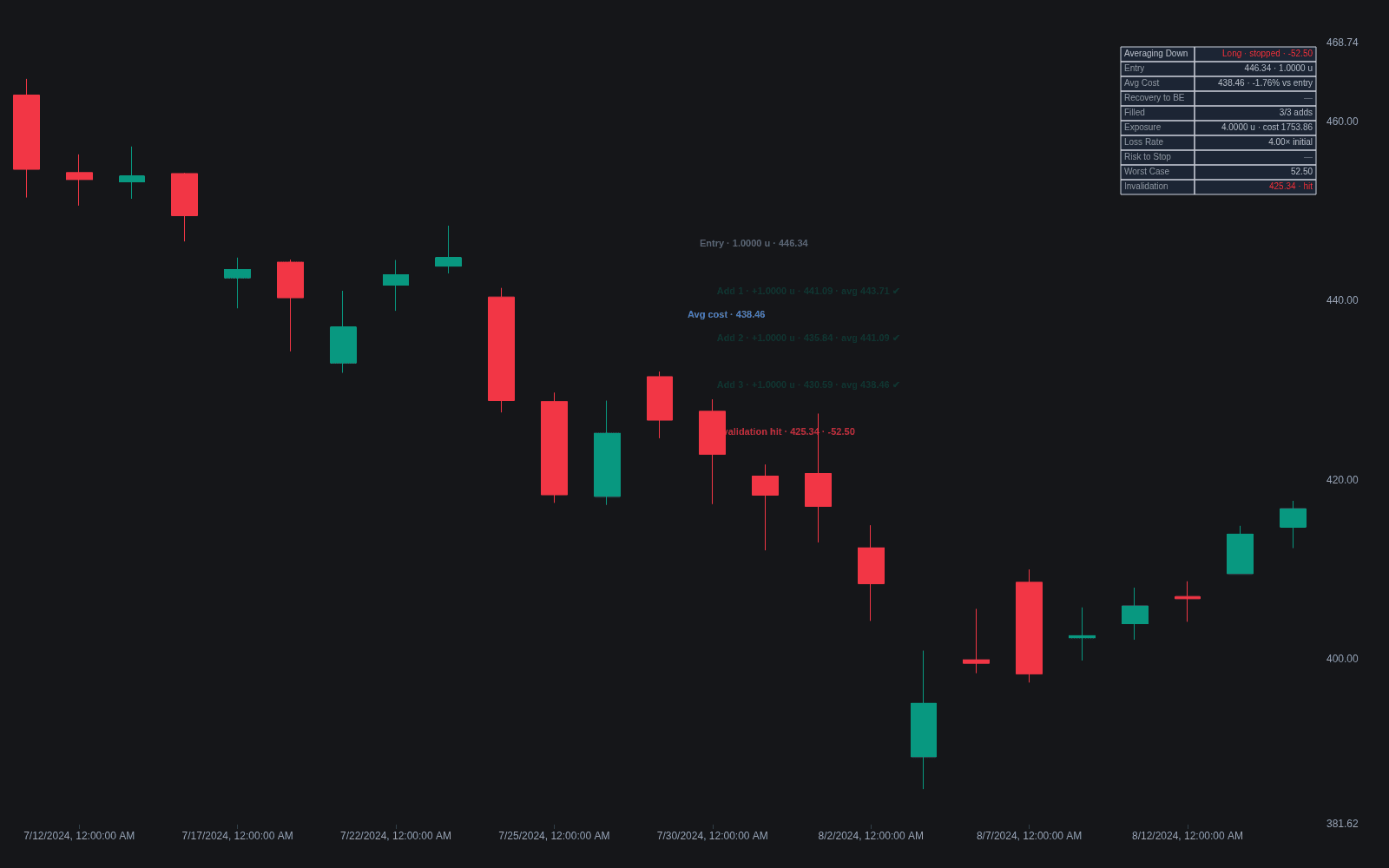
Averaging down is adding to a losing position at better prices: buying more as price falls (or selling more as it rises against a short) so the average entry improves. Each add pulls the break-even price closer to the current market, which is the appeal, since a smaller bounce now recovers the whole position. The cost is larger than the appeal suggests: every add increases size in a trade the market is currently disproving, so if price keeps going, the drawdown deepens at an accelerating rate.
The practice descends from the gambling world's martingale, double the stake after every loss and the first win recovers everything, and it inherits the martingale's ruin arithmetic: the recovery works every time except the time it removes the account. Markets sharpen the danger because prices trend, and the milder trading versions (fixed tranches rather than doubling) soften the curve without changing its direction: size still peaks exactly when the idea is most wrong.
Risk frameworks classify averaging down as risk-expanding, the opposite of a stop: instead of cutting exposure when wrong, it compounds it. That does not make it automatically irrational. Grid systems and DCA plans average into positions by design, with predefined levels, fixed tranche sizes, and a hard cap on total exposure. The failure mode is unplanned averaging, adding ad hoc to avoid realizing a loss, which can turn one bad trade into an account-level event when the market trends.
The arithmetic explains both the seduction and the trap. Averaging a loser halves the required recovery move, a second equal tranche 10% lower moves break-even to 5% below the first entry, while doubling the loss rate per further decline; planned systems accept that exchange knowingly, pricing the worst case with an exposure cap and a combined stop, while improvised averaging accepts it blindly. The planning is the entire difference between a strategy and a coping mechanism.
How to structure a planned averaging schedule
If averaging is to exist at all, every parameter is decided before the first entry.
- 1Fix the thesis and its invalidation first: the price or condition at which the idea is wrong regardless of average entry.
- 2Predefine the ladder: entry levels (structural or volatility-spaced) and the tranche size at each, with sizing bases set so the full ladder is an intended position, not an accident.
- 3Cap total exposure: the maximum combined size, consistent with fixed-fractional risk on the whole ladder rather than per tranche.
- 4Attach one stop to the combined position, at the invalidation from step one, and size the ladder so that stop costs the intended R and no more.
- 5Define the exit ladder symmetrically: targets or scaling-out rules for the recovered position, so the plan is round-trip, not entry-only.
- 6Ban improvisation explicitly: any add outside the predefined ladder is a rule violation to be reviewed, the check that separates systems from rationalizations.
How traders use it
- As the engine of grid trading: a grid places layered limit buys below price across a defined trading range, intentionally averaging down inside the range and taking profit on each rung as price oscillates back.
- As a planned accumulation schedule: fixed tranches at predefined discounts, with the position cap and maximum number of adds decided before entry, so the worst case is known rather than discovered.
- As a diagnostic in trade review: repeated unplanned averaging down flags a process problem. Many risk plans ban it outright, or convert it into rules with fixed-fractional tranche sizing and a single hard stop for the combined position.
- With volatility-spaced rungs: grids and tranche ladders spaced in ATR or volatility-targeted units rather than fixed percentages adapt the schedule to the instrument, so quiet markets do not exhaust the ladder on noise.
- In R-multiple accounting: pricing the whole ladder as one trade, total risk to the combined stop as 1R, keeps averaging systems inside the same R-multiple framework as everything else and exposes the true risk that per-tranche bookkeeping hides.
Averaging Down vs related concepts
DCA: DCA buys fixed amounts on a schedule regardless of direction; the trigger is time. Averaging down triggers specifically on adverse movement, so it concentrates buying in declines. A DCA plan can average down incidentally, but it never adds because price fell.
Pyramiding: Pyramiding adds to winning positions as the market confirms the idea, usually with shrinking size and a trailed stop. Averaging down adds to losing positions. One expands risk with confirmation, the other against it.
Scaling Out: Scaling out is the exit-side ladder: reducing a position in tranches as targets print. It pairs naturally with planned averaging, the entries built the ladder down, the exits dismantle it up, and both replace one all-or-nothing decision with a schedule.
Concept family
Risk, Sizing & Exits
37 concepts mapped · 37 in the Library
Averaging Down FAQ
Turn Averaging Down into a trading strategy.
Take the implementation from this page into Quant, then build on it, backtest it on real data, and keep refining it in conversation.