Concept
Stop Placement vs Liquidity Pools
Stop Placement vs Liquidity Pools are Risk, Sizing & Exits concepts. The Library holds 1 implementation, a working definition you can pull into Quant.
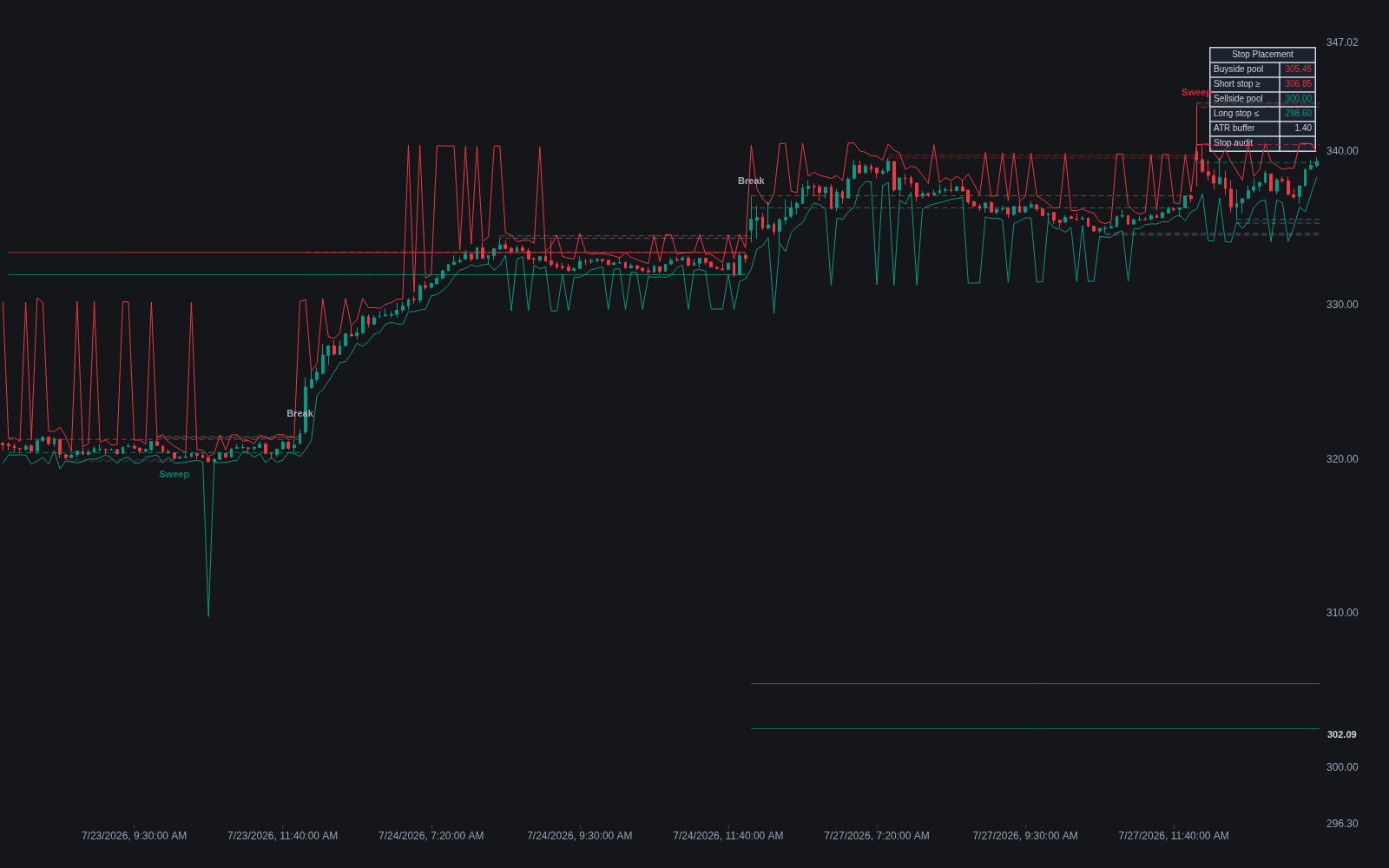
Top Stop Placement vs Liquidity Pools indicator
The top custom implementation, built on the original standard Stop Placement vs Liquidity Pools formula.
1 total
From studying Stop Placement vs Liquidity Pools to trading it: take the implementation below into Quant and backtest it instantly.
What is Stop Placement vs Liquidity Pools?
Stop placement vs liquidity pools is the interaction between where traders park protective stops and where the market finds resting orders to trade against. Stops gather at obvious locations: a few ticks beyond swing highs and lows, behind equal highs and lows, around round numbers. A pocket of buy stops above a high is, functionally, a pool of waiting market buy orders, and sell stops below a low are the mirror image. Those pockets are liquidity pools, and price is often drawn toward them because that is where size can transact.
The idea is older than its modern vocabulary. Floor traders spoke of running the stops long before electronic charts, and market-microstructure research gave the intuition an anchor: Carol Osler's studies of currency orders found stop-losses bunching just beyond round numbers and documented how triggered stops feed self-reinforcing price cascades. Smart Money Concepts material in the 2010s repackaged the same mechanics for retail charts, treating swept highs and lows as the footprint of stop-driven trading.
The practical question is whether your stop sits inside the pool everyone can see. A stop placed one tick behind an obvious level sits inside the pool itself, first in line for a sweep that pierces the level, triggers the resting orders, and reverses. The trade idea can be right while the stop placement makes it a loser. Common responses: place the stop beyond the pool plus a volatility buffer, size down so the wider stop keeps risk constant under your sizing base, or treat the pool as a target rather than a hazard and trade toward it. None of this is certainty. Actual stop locations are invisible on most venues, so the pool is an inference from structure, not a fact.
Cascade mechanics explain why this matters beyond one trade. A triggered stop is a market order, so a dense pocket of stops converts a small push into forced flow that can hand momentum to the next pocket, the logic behind stop-cascade breakout models. Trailing exits are not exempt: a swing-ratcheted trail, as surveyed in the trailing method taxonomy, keeps relocating the stop to exactly where everyone else's swing-based stops sit.
How to identify likely liquidity pools on a chart
Pools cannot be observed directly on most markets, but the locations that attract stops are consistent enough to map in advance.
- 1Mark the obvious swing highs and lows, equal highs and lows, prior session and week extremes, and nearby round numbers: the standard stop-parking spots.
- 2Assume a pocket of stops a few ticks beyond each marked level: buy stops above highs, sell stops below lows.
- 3Classify the break: acceptance beyond the level suggests initiative trade; a fast pierce that snaps back inside suggests a stop-driven sweep.
- 4Audit your own order: a stop inside one of the marked pockets is a placement problem to solve before entry, not after.
How traders use it
- Auditing stop location before entry: if the intended stop sits one tick behind an obvious swing point or equal high/low, either widen it beyond the likely sweep zone (structure plus an ATR-scaled buffer) and resize, or skip the trade when the wider stop no longer fits the risk budget.
- Trading toward pools instead of hiding behind them: liquidity-based frameworks treat the nearest untapped pool as a draw, placing profit targets just in front of it and expecting acceleration into the pocket, then stalls or reversals once it fills, often scaling out into the move.
- Reading sweeps as information: a fast poke through a level that immediately reverses suggests the move was stop-driven rather than initiative, a distinction breakout filters use; stop-cascade models likewise expect one triggered pocket to hand momentum to the next.
- Keeping risk constant across placements: the buffer widens the stop distance, so size is recomputed under the R-multiple framework rather than held fixed, otherwise the safer placement quietly raises dollar risk.
- Containing revenge sequences: levels that sweep once often sweep again, so loss-control rules capping re-entries per level keep one crowded swing point from draining the day.
Stop placement vs related stop logic
Structure Stop: A structure stop is the placement doctrine: exit beyond the level that invalidates the idea. Stop placement vs liquidity pools is the adversarial context around that doctrine: the invalidation levels everyone uses are precisely where stops pool and sweeps hunt. In practice the two combine: structure plus buffer, sized down for the distance.
Fixed Stops: Fixed percent or dollar stops ignore both structure and where other traders' orders likely rest. They are simple to administer, but where obvious levels sit within the fixed distance they routinely expire inside the most crowded pocket on the chart.
Concept family
Risk, Sizing & Exits
37 concepts mapped · 37 in the Library
Stop Placement vs Liquidity Pools FAQ
Turn Stop Placement vs Liquidity Pools into a trading strategy.
Take the implementation from this page into Quant, then build on it, backtest it on real data, and keep refining it in conversation.