Concept
DCA
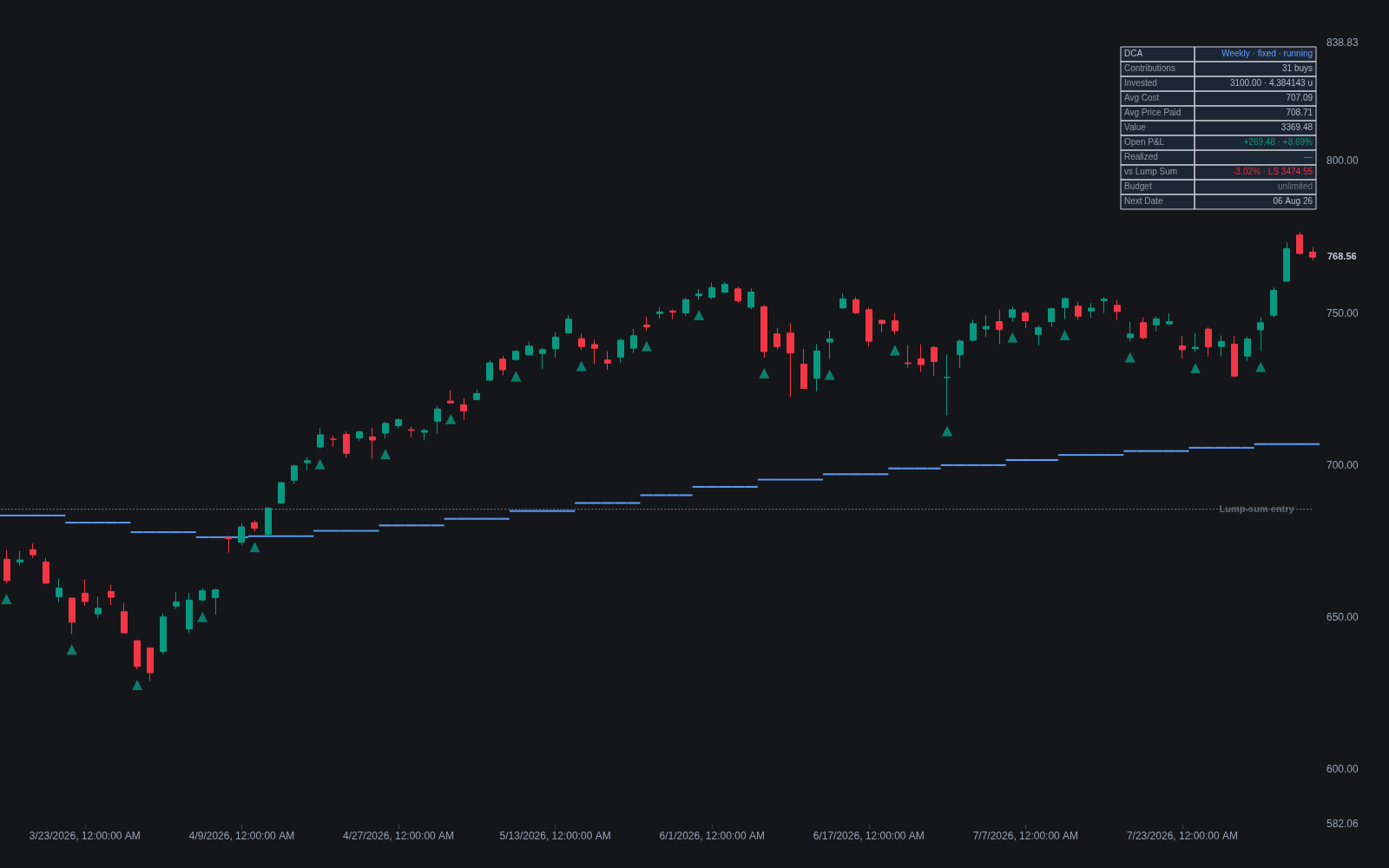
DCA, also known as value averaging, is a Risk, Sizing & Exits concept. The Library holds 1 implementation, a working definition you can pull into Quant.
Top DCA indicator
The top custom implementation, built on the original standard DCA formula.
1 total
Want to trade DCA? The implementation below is one prompt away from a backtested strategy in Quant.
What is DCA?
DCA, dollar-cost averaging, is buying a fixed cash amount of an asset on a fixed schedule regardless of price. Because the constant spend buys more units when price is low and fewer when it is high, the average cost per unit ends up no higher than the simple average of the prices paid; that is arithmetic, not edge. A related variant, Michael Edleson's value averaging, adjusts each contribution so the position's value tracks a preset growth path, buying more after weakness and less, or even selling, after strength.
The calendar version is old investment doctrine: Benjamin Graham endorsed it for ordinary investors in The Intelligent Investor, first published in 1949, and Edleson's refinement dates to the late 1980s. The academic verdict is cooler than the popular reputation. Because markets have historically risen more often than fallen, comparisons with immediate lump-sum investment, including a widely cited Vanguard study, found the lump sum ahead roughly two times in three. DCA's honest claims are narrower: it spreads timing risk across the path and turns investing into a rule that actually gets followed.
In trading-bot vocabulary the same acronym means something different: laddered entries that add to a position as price moves against it, often gated by oversold oscillator readings, with one take-profit for the blended position. That version is closer to averaging down and inherits its risk profile: exposure is largest precisely when the market keeps trending the wrong way, so the ladder needs a bounded budget or a hard stop to avoid open-ended drawdown.
A typical bot ladder is a base order plus safety orders, each spaced further below the last and often sized larger, with the take-profit recomputed from the blended entry as a fixed-percentage target in the sense of the profit-target taxonomy. Scaling the rung sizes makes the ladder martingale-flavored: most deals close quickly for a small profit, while the rare fully filled ladder holds the account's largest-ever position. Configuring one is therefore less about entries than about loss-control rules: the capital a deal may consume, and what ends it.
How to Structure a DCA Plan or Ladder
Calendar DCA and bot ladders share the same load-bearing decisions, made before the first order:
- 1Fix the total budget the schedule or ladder may deploy, sized as a fraction of equity in the spirit of fixed-fractional sizing.
- 2For calendar DCA, set the amount and interval, then automate execution so the plan survives headlines and mood.
- 3For a ladder, set the base order plus the count, spacing, and size scaling of safety orders; wider spacing survives trends longer.
- 4Price the worst case, the full ladder filled at the lowest rung; if that drawdown is unacceptable, the parameters are wrong whatever the backtest says.
- 5Define both exits up front: the take-profit from the blended entry, and the hard stop or maximum-loss kill switch that ends a failed deal.
How traders use it
- As an accumulation schedule: fixed buys weekly or monthly into a long-horizon holding, automated so execution does not depend on mood or headlines.
- As a bot entry ladder: safety orders spaced below the first fill, often triggered by oscillator conditions, with a single take-profit computed from the averaged entry.
- As an analysis baseline: a DCA series is the natural benchmark to compare lump-sum entries or timing models against over the same window.
- As an exit schedule in reverse: distributing out of a holding across dates or levels, a calendar cousin of scaling out of a winner.
- As a condition-aware variant: sizing purchases by drawdown or volatility instead of fixed cash, drifting toward value averaging and volatility-targeted sizing.
- As the passive leg of a book: DCA handles long-horizon accumulation while active trades run on separate sizing bases and risk budgets, keeping the two disciplines apart.
DCA vs Adjacent Position-building Concepts
Averaging Down: Price-triggered versus calendar-triggered. Classic DCA never references an entry price; averaging down exists only because of one. Bot-style DCA ladders sit on the averaging-down side despite the name.
Pyramiding: The mirror image: pyramiding adds only while a position wins, financing each add with open profit. DCA ladders add while losing, raising the stakes on eventually being right.
Scaling Out: The exit-side counterpart: releasing a position in parts rather than building one. Both replace one all-or-nothing decision with a schedule and blend the effective price across executions.
Fixed Fractional: A sizing rule rather than an entry schedule: it answers how much risk a trade may take, not when capital deploys. A ladder still needs a fixed-fractional cap so its total budget stays proportional to equity.
Concept family
Risk, Sizing & Exits
37 concepts mapped · 37 in the Library
DCA FAQ
Turn DCA into a trading strategy.
Take the implementation from this page into Quant, then build on it, backtest it on real data, and keep refining it in conversation.