Concept
Fixed Ratio
Fixed Ratio is a Risk, Sizing & Exits concept. The Library holds 1 implementation, a working definition you can pull into Quant.
Jones
Top Fixed Ratio indicator
The top custom implementation, built on the original standard Fixed Ratio formula.
1 total
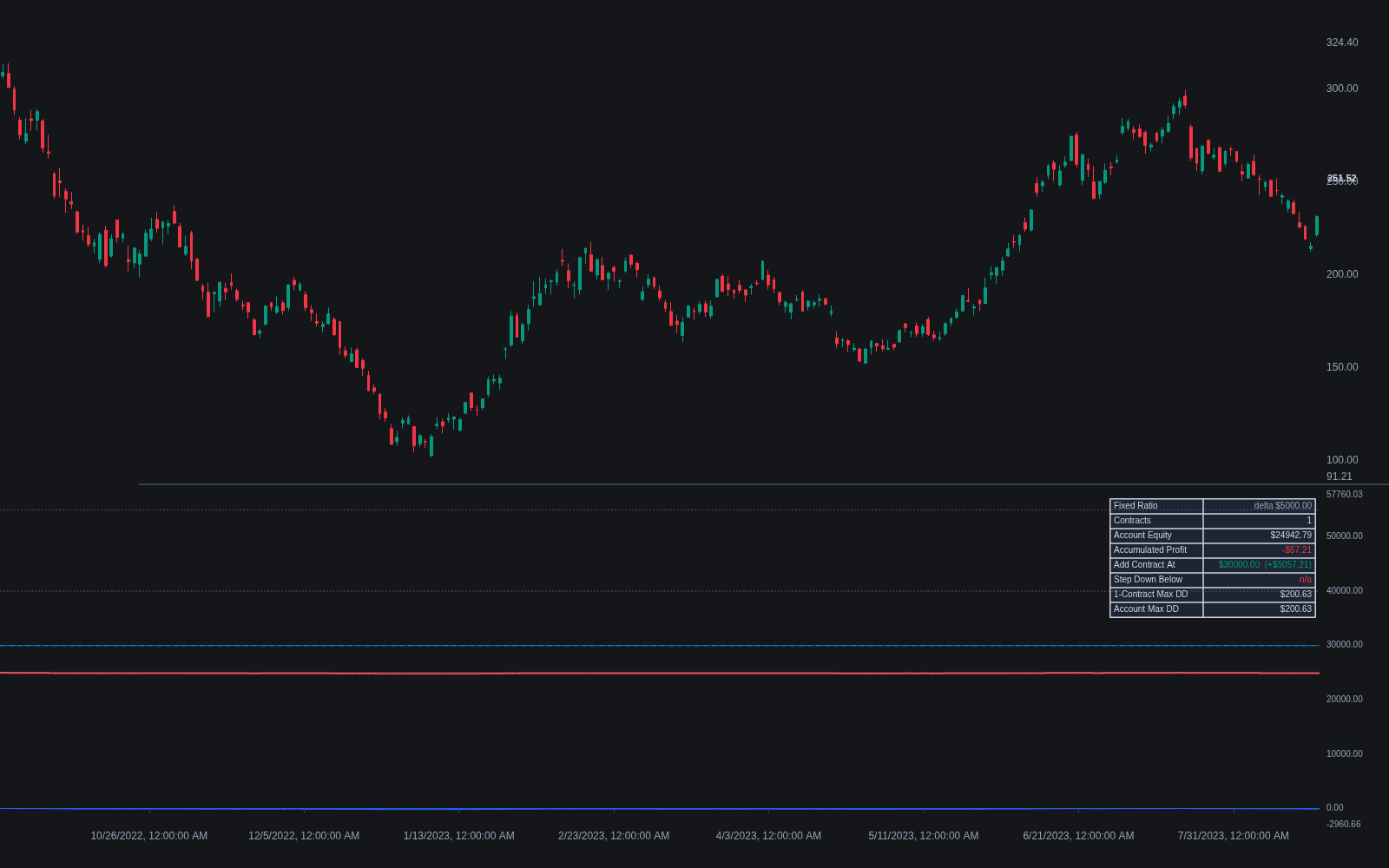
Want to trade Fixed Ratio? The implementation below is one prompt away from a backtested strategy in Quant.
What is Fixed Ratio Position Sizing?
Fixed ratio is a position sizing method introduced by Ryan Jones in his book The Trading Game (1999). It scales position size as a function of accumulated profit rather than as a percentage of account equity: to increase size from N contracts to N+1 contracts, the account must earn N times a chosen dollar amount, called the delta. Adding the first extra contract is therefore cheap, while each subsequent increase demands proportionally more profit, because a larger position must justify itself with larger accumulated gains.
Jones designed the method as an answer to a practical weakness of fixed fractional sizing for small accounts, especially in futures where contracts are indivisible. Risking a fixed percentage of a small account often means trading one contract for a very long time before the account grows enough to add a second, and then, at large size, adding contracts so quickly that risk balloons. Fixed ratio front-loads growth: it lets a small account increase size relatively early while making each later increase progressively harder to earn.
The honest trade-off is asymmetry of risk relative to account size. Because size is keyed to accumulated profit rather than current equity, two accounts of identical current value can trade very different size depending on their history, and percentage risk per trade is not held constant: it tends to be higher early in the growth curve than fixed fractional would allow. The delta parameter has no theoretically optimal value; it is a risk-appetite dial. Smaller deltas grow size aggressively, larger deltas conservatively, and the choice is best evaluated against drawdown behavior in simulation rather than picked by feel.
How it's calculated
Jones also discussed asymmetric variants where size is reduced on drawdown faster than it was added, using a fraction of delta on the way down.
How traders use it
- Growing small futures accounts: the method's main constituency is traders of indivisible contracts who want a rule for when the account has earned the right to add the next contract, without waiting as long as strict percent-risk rules require.
- As a risk-appetite dial: the delta is commonly set relative to the strategy's historical maximum drawdown per contract, so that each size increase is funded by profits comparable to what a bad stretch could take back.
- With an explicit de-leveraging rule: disciplined implementations define in advance how size steps down during drawdowns, since the original growth schedule alone says more about adding than subtracting.
- In comparison testing: because fixed ratio, fixed fractional, and Kelly-derived sizing produce very different equity curves from the same signals, traders often simulate all of them against the same trade list and judge by drawdown statistics and their own tolerance.
- With its limits acknowledged: the method contains no information about edge; applied to a losing strategy it sizes up noise early, and the early aggressiveness that makes it attractive for growth is exactly what raises risk of ruin if the edge was overestimated.
Fixed ratio vs other position sizing methods
Fixed Fractional: Risks a constant percentage of current equity per trade, so size tracks account value directly. Fixed ratio keys size to accumulated profit instead, growing faster from small bases and slower at large ones.
Kelly Criterion: Derives the growth-optimal fraction from the strategy's win rate and payoff ratio. Fixed ratio ignores edge statistics entirely; its delta is a chosen dial, not an optimum.
Optimal F: Ralph Vince's fraction that maximized historical growth on the observed trade series. Like Kelly it is edge-derived and aggressive; fixed ratio is schedule-based and indifferent to the trade distribution.
Concept family
Risk, Sizing & Exits
37 concepts mapped · 37 in the Library
Fixed Ratio FAQ
Turn Fixed Ratio into a trading strategy.
Take the implementation from this page into Quant, then build on it, backtest it on real data, and keep refining it in conversation.