Concept
Martingale / Anti-martingale
Martingale / Anti-martingale is a Risk, Sizing & Exits concept. The Library holds 1 implementation, a working definition you can pull into Quant.
labeled: ruin-prone
Top Martingale / Anti-martingale indicator
The top custom implementation, built on the original standard Martingale / Anti-martingale formula.
1 total
Want to trade Martingale / Anti-martingale? The implementation below is one prompt away from a backtested strategy in Quant.
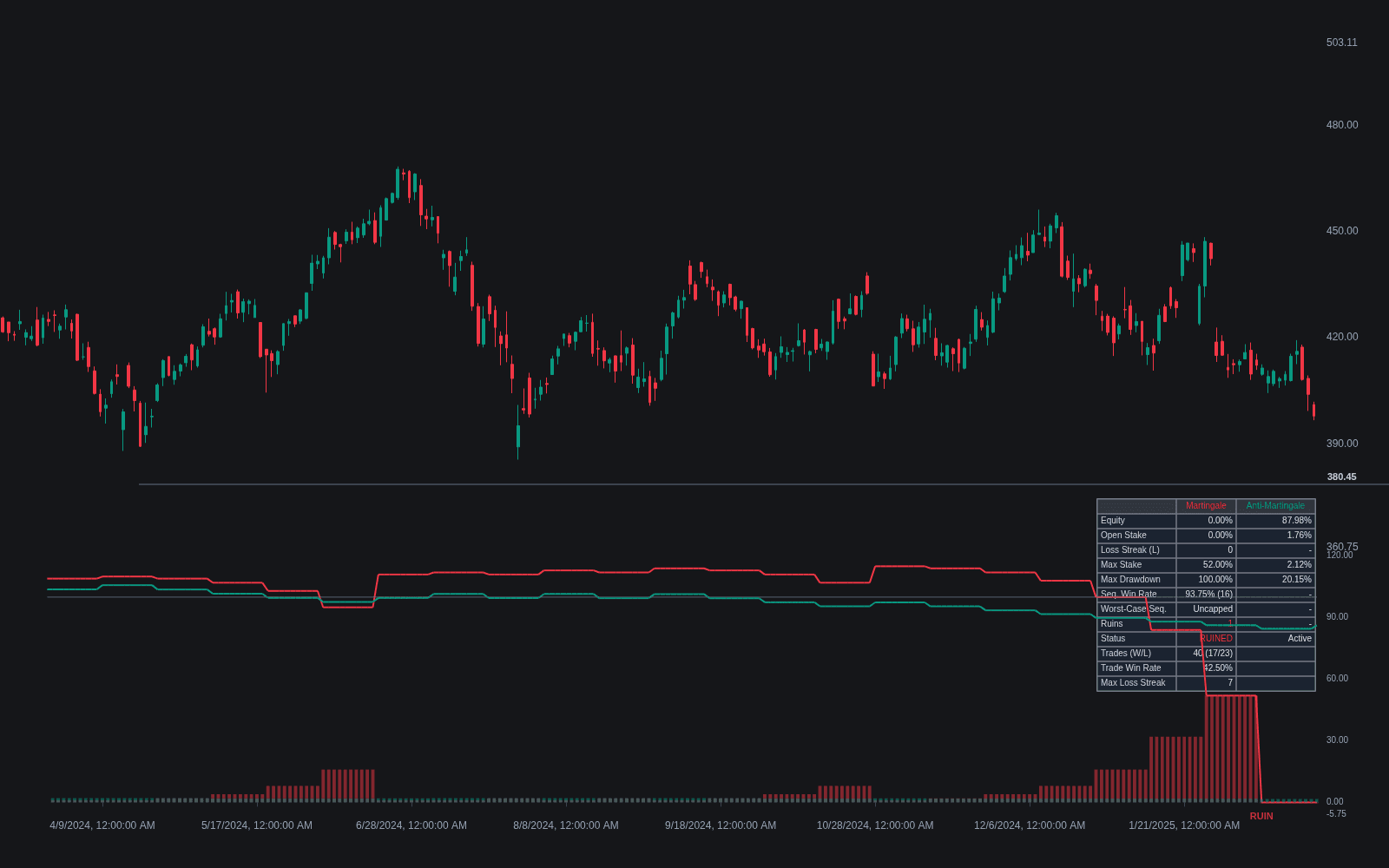
What are martingale and anti-martingale sizing schemes?
Martingale and anti-martingale are the two opposite ways of coupling position size to recent results. A martingale increases size after losses, classically doubling the stake so that the first win recovers every prior loss plus one original unit. An anti-martingale (sometimes called reverse martingale) does the reverse: size grows after wins, or more precisely with equity, and shrinks after losses. Both terms come from even-money casino betting; the martingale was already a documented gambling scheme in eighteenth-century Europe, long before it reached trading.
The martingale seduces because each individual cycle almost always ends in a small win, producing a high win rate and a smooth-looking equity curve right up to the failure. The arithmetic is unforgiving: consecutive losses force size to grow exponentially, and a finite account meets a long-enough losing streak eventually. When it does, the streak removes most or all of the capital in one sequence. This is not a tail curiosity; over enough trades, the risk of ruin of a true martingale on finite capital approaches certainty. Grid systems and undisciplined averaging down are the common market forms, softening the doubling but keeping the same direction of exposure growth.
The anti-martingale side is where nearly all professional sizing lives. Fixed-fractional risk, the Kelly criterion, and pyramiding into winners all increase absolute size as equity grows and cut it in drawdown, so losing streaks compress exposure instead of exploding it. The cost is the mirror image of the martingale's appeal: more frequent small losses and a choppier short-term curve, in exchange for survival.
How it's calculated
The classic even-money forms, stated per sequence:
With m = 2, ten consecutive losses require a stake of 1024 units to recover a cumulative loss of 1023 units, all to net one unit.
Trading variants often use m between 1.3 and 2 or fixed add tranches; this slows the growth of exposure without changing its direction.
How traders use it
- As a classification lens: before adopting any sizing scheme, traders identify whether it is martingale-like (size grows when losing) or anti-martingale-like (size grows when winning), because that single property dominates long-run survival.
- Anti-martingale sizing is the practical default: risking a fixed fraction of current equity automatically shrinks positions in drawdowns and is the basis most sizing frameworks build on.
- Martingale-style grids are sometimes run deliberately in ranging markets with a hard exposure cap and a total-loss budget, which converts open-ended ruin into a bounded, priced worst case; without that cap the scheme is a ruin engine.
- In evaluation, a suspiciously high win rate with rare catastrophic losses is a standard signature of hidden martingale behavior, and reviewers look for it in track records and published strategies.
- With honest limits: no sizing scheme creates edge. Martingale redistributes when losses arrive rather than reducing them, and anti-martingale merely stops sizing from destroying a real edge.
Martingale and anti-martingale vs adjacent sizing ideas
Averaging Down: The within-trade cousin of the martingale: adding to a losing position improves average entry while compounding exposure to a disproven idea. Planned, capped versions exist; improvised ones inherit the ruin arithmetic.
Fixed Fractional: The standard anti-martingale implementation: a constant percentage of current equity at risk per trade, so size falls geometrically in drawdowns instead of rising.
Pyramiding: Anti-martingale applied inside a single trade: size is added only after the position moves in favor, usually with the stop trailed so the added risk stays bounded.
Concept family
Risk, Sizing & Exits
37 concepts mapped · 37 in the Library
Martingale / Anti-martingale FAQ
Turn Martingale / Anti-martingale into a trading strategy.
Take the implementation from this page into Quant, then build on it, backtest it on real data, and keep refining it in conversation.