Concept
TWAP/VWAP/POV Execution
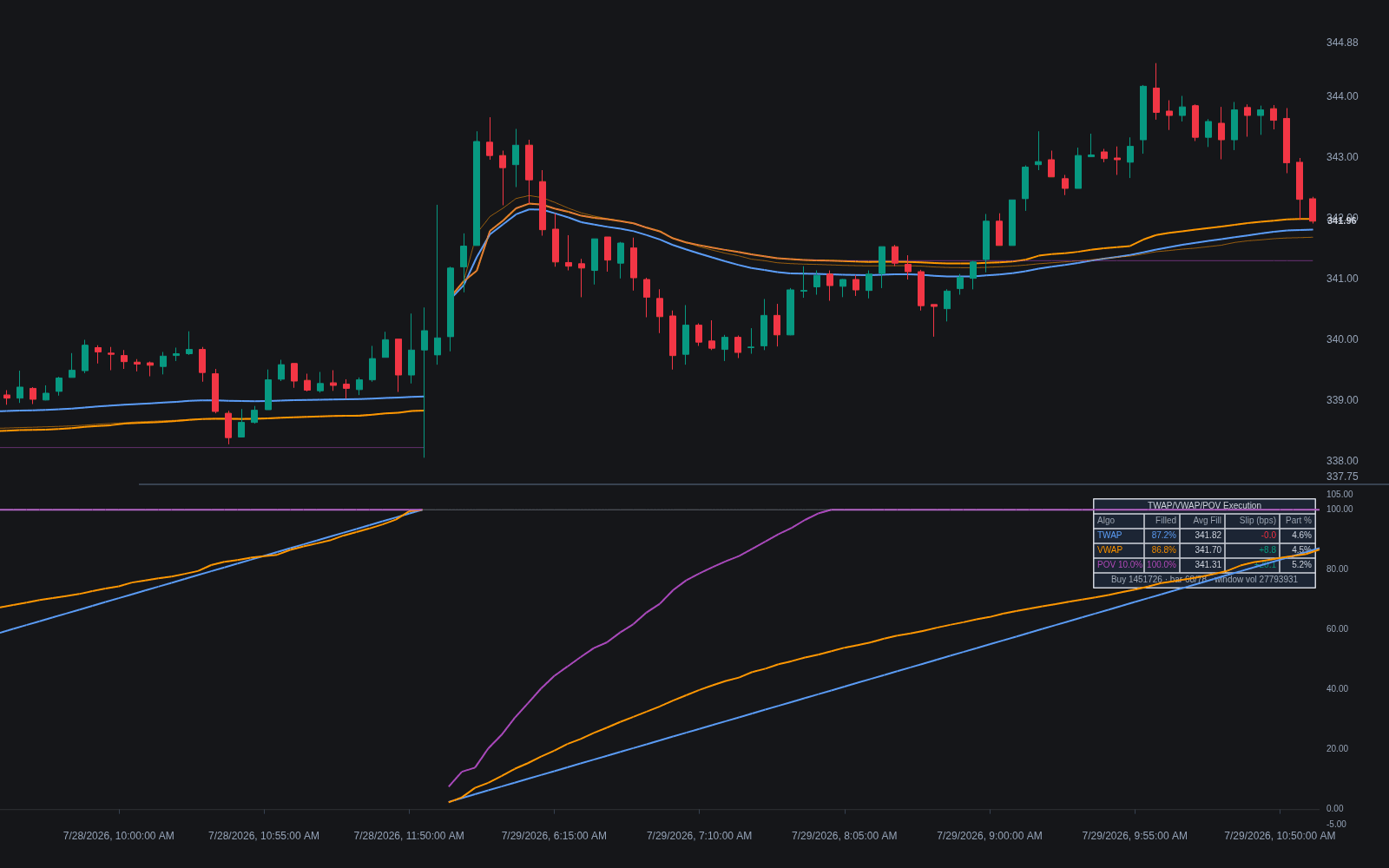
TWAP/VWAP/POV Execution is a Risk, Sizing & Exits concept. The Library holds 1 implementation, a working definition you can pull into Quant.
Top TWAP/VWAP/POV Execution indicator
The top custom implementation, built on the original standard TWAP/VWAP/POV Execution formula.
1 total
The TWAP/VWAP/POV Execution implementation below can become a backtested trading strategy — describe your rules and Quant writes the code.
What is TWAP/VWAP/POV Execution?
TWAP, VWAP, and POV are the three workhorse execution algorithms for working a large parent order into the market as a stream of smaller child orders. TWAP (time-weighted average price) slices the order evenly across a chosen time window. VWAP (volume-weighted average price) distributes the slices in proportion to the market's expected volume profile, trading more when the market typically trades more. POV (percentage of volume, also called participation) is reactive rather than scheduled: it targets a fixed share of whatever volume actually prints, speeding up in active markets and slowing down in quiet ones.
These algorithms exist because large orders move prices against themselves. Submitting institutional size at once consumes the visible book and signals intent, so the fill price degrades with every level swept. Slicing spreads the demand across time and liquidity, reducing market impact at the cost of exposure to price drift during the schedule. Each algorithm also defines its own fairness benchmark: a VWAP order is judged against the session's volume-weighted price, a TWAP order against the simple average price over its window, which gives traders and their clients an objective measure of execution quality.
The choice among them is a trade-off. TWAP is simple and predictable but ignores liquidity, so it can trade heavily into thin periods; its regularity also makes it the easiest schedule for others to detect. VWAP concentrates trading where liquidity historically sits but depends on the accuracy of the assumed volume curve. POV adapts to real conditions and caps footprint as a share of the tape, but its completion time is unknown in advance and it chases volume spikes, including ones caused by other large traders. In many implementations these run with limit-price constraints and randomization to reduce detectability.
How it's calculated
The benchmarks and the core scheduling rules in standard form:
Real implementations add limit constraints, minimum and maximum clip sizes, and randomized timing; the lines above describe the idealized schedules.
How traders use it
- Accumulating or unwinding size: position traders and funds use VWAP or POV to build positions over hours or days with limited footprint, accepting schedule risk in exchange for lower impact, a trade-off quantified through execution cost modeling.
- Benchmark discipline: institutions evaluate fills against the VWAP or TWAP benchmark, so the algorithms double as performance yardsticks; beating VWAP on a buy means paying less than the session's volume-weighted price.
- Choosing by urgency: POV at a higher participation rate suits orders with alpha that decays quickly, TWAP suits markets without reliable volume patterns (crypto weekends, thin hours), and VWAP suits patient orders in markets with stable intraday volume curves.
- Reading the other side: because these schedules leave rhythmic footprints, tape readers look for the telltale regularity of algorithmic slicing, the subject of execution algo footprints, and adjust their own trading around suspected institutional schedules.
- Chart context: the same VWAP calculation that benchmarks execution is plotted intraday as session VWAP, which is one reason price so often reacts around it: execution desks are being measured against it.
TWAP/VWAP/POV execution vs related concepts
Session VWAP: The same volume-weighted average plotted as a chart level. The execution algorithm targets it as a benchmark; the indicator displays it as evolving fair value for the session.
Execution Algo Footprints: The detection side: reading the tape for the periodic clips and refill patterns that scheduled execution leaves behind.
Execution Cost Modeling: The accounting framework that justifies slicing: it quantifies spread, slippage, and impact so the trade-off between impact reduction and schedule risk can be priced.
Concept family
Risk, Sizing & Exits
37 concepts mapped · 37 in the Library
TWAP/VWAP/POV Execution FAQ
Turn TWAP/VWAP/POV Execution into a trading strategy.
Take the implementation from this page into Quant, then build on it, backtest it on real data, and keep refining it in conversation.