Concept
Fixed Stops
Fixed Stops, also known as percent, dollar, time, session-close, are Risk, Sizing & Exits concepts. The Library holds 1 implementation, a working definition you can pull into Quant.
Top Fixed Stops indicator
The top custom implementation, built on the original standard Fixed Stops formula.
1 total
The Fixed Stops implementation below can become a backtested trading strategy — describe your rules and Quant writes the code.
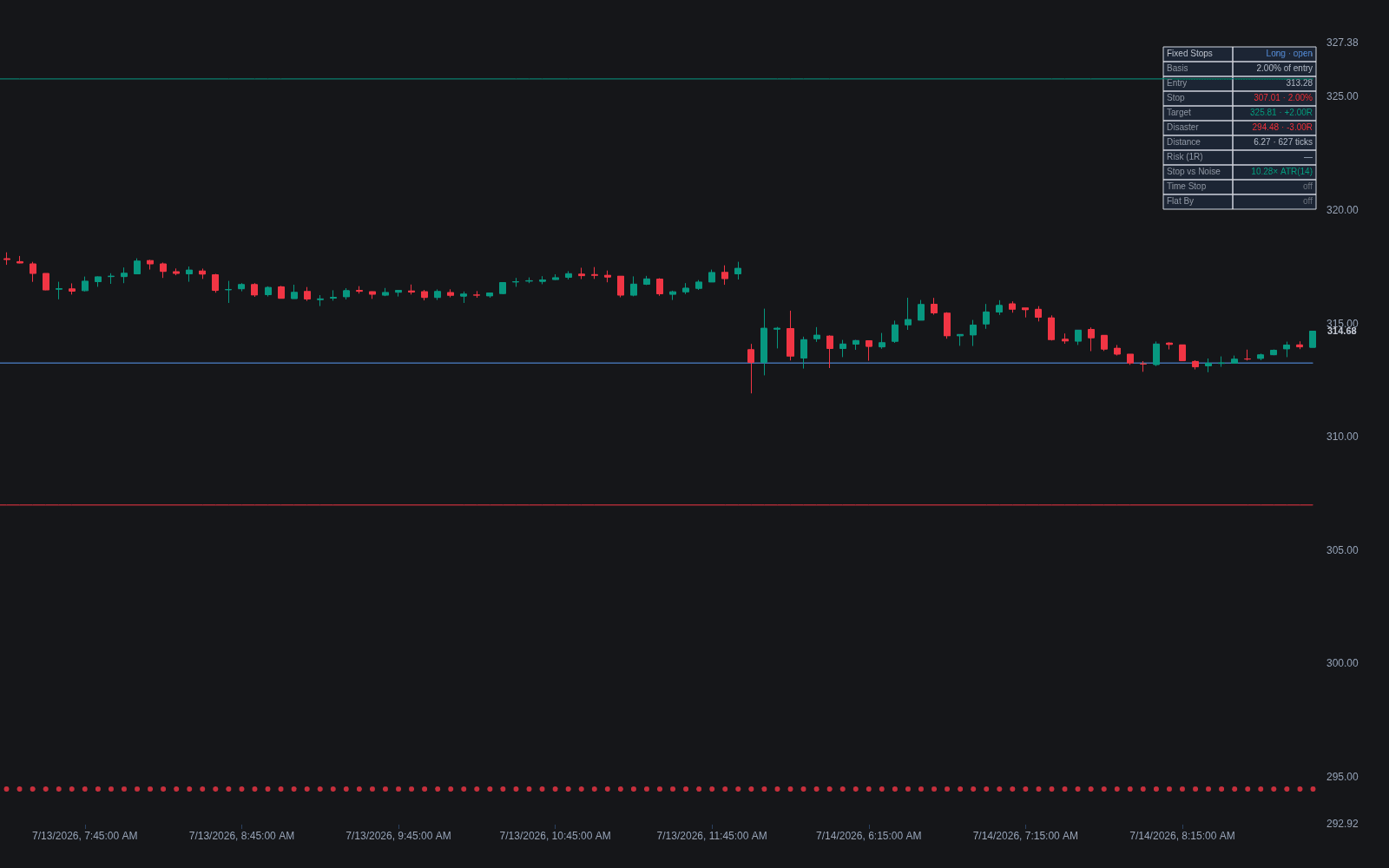
What are Fixed Stops?
Fixed stops are exits defined by a predetermined rule rather than by chart context: a set percentage or dollar distance from entry, a time stop that closes the trade after a set number of bars, or a session-close rule that flattens everything by a chosen time. The family also includes the disaster stop, a deliberately wide catastrophic order sitting behind subtler exit logic, and broker-side guaranteed stops, which for a premium fill at the exact level, while an ordinary stop converts to a market order when triggered and can slip or gap.
Their strength is that risk is known before entry, which keeps percent-risk sizing trivial and audits simple. Their weakness is context-blindness: the same 2% sits inside the noise of a volatile symbol and far outside the noise of a quiet one, which is the gap volatility stops and structure stops exist to close.
Each member of the family earns its place differently. The time stop encodes thesis expiry: a setup predicts something within a horizon, and a trade that has done nothing by then is dead capital still carrying open risk. The session-close stop is gap hygiene for intraday methods, refusing to hold exposure through halts the strategy never modeled. The disaster stop is sized in multiples of the normal exit, wide enough that it should never fill, existing purely so that a resting order survives a platform failure or a runaway move. Execution mechanics matter across all of them: the order type decides whether a triggered stop chases the market for a certain fill or holds a limit and risks no fill at all.
Fixed brackets also dominate the packaged-strategy world: signal scripts overwhelmingly ship take-profit and stop-loss as fixed ratios of entry, because the bracket is unambiguous to automate and produces comparable statistics per signal, the profit-target taxonomy's simplest members. The honest deployment logic runs on stability: fixed distances work where the instrument's volatility regime is stable or where external rules, evaluation drawdown caps, mandate hard numbers, and they degrade exactly when regimes shift, the moment adaptive stops were built for.
How to identify and deploy fixed stops
The family is defined by predetermination: every parameter is known before entry.
- 1Choose the rule type: percent or dollar distance, elapsed-time deadline, session-close flattening, or a catastrophic backstop behind other logic.
- 2Set the parameter from the plan rather than the chart: the fixed distance, the bar count, or the flatten time.
- 3Wire the mechanics: the order construct, typically an OCO bracket pairing stop and target, and the order type that decides fill-certainty versus price-certainty.
- 4Check the sizing consistency: the fixed distance feeds percent-risk sizing directly, which is the pairing that makes the whole scheme auditable.
- 5Layer the disaster stop: a resting order at a multiple of the normal distance, present at the broker regardless of what the primary logic is doing.
How it's calculated
An exit fixed at entry, as a price level, a cash loss, or a time limit, that closes the trade without further adjustment.
Fixed means the level or deadline never moves after entry, in contrast to a trailing stop.
An ordinary stop becomes a market order when touched, so gaps and fast markets can fill beyond the level; a paid broker stop product (GSLO) fills at the stop price even through a gap, in exchange for a premium and placement restrictions.
Sizes have no universal defaults; percent, cash, and time values are strategy and timeframe specific.
How traders use it
- As the sizing anchor in mechanical systems: a fixed percent or dollar stop gives every trade a known worst case before slippage, so size and R accounting stay simple.
- As clock discipline: time stops close trades whose thesis expired unfulfilled, and session-close stops keep intraday strategies from carrying overnight gap risk.
- As the backstop layer: a wide disaster stop ensures a resting order exists if the primary exit logic fails or a move runs away; gaps can still fill beyond it.
- As automated brackets: packaged signal strategies ship fixed TP/SL pairs because the bracket automates cleanly and every signal produces comparable risk-reward statistics.
- Under external mandates: evaluation accounts and prop rules cap losses in fixed dollars, making fixed stops the native dialect of those constraints regardless of what a volatility model would prefer.
Fixed stops vs adaptive exit families
Volatility Stop: The volatility stop scales its distance to current conditions, sitting outside the noise band wherever the noise band currently is. The fixed stop's constant distance is inside the noise on wild symbols and wastefully far on quiet ones, which is the exact failure volatility scaling repairs.
Structure Stop: The structure stop derives its level from the chart, beyond the swing that invalidates the trade thesis, so its distance varies trade by trade. The fixed stop ignores the chart entirely. One prices invalidation, the other prices convenience, and the honest choice depends on whether the setup has a real invalidation point.
Trailing Methods: Trailing stops move with the trade, converting open profit into protected profit; fixed stops stay where they were placed. The families answer different questions, initial risk versus profit management, and most complete plans use one of each.
Concept family
Risk, Sizing & Exits
37 concepts mapped · 37 in the Library
Fixed Stops FAQ
Turn Fixed Stops into a trading strategy.
Take the implementation from this page into Quant, then build on it, backtest it on real data, and keep refining it in conversation.