Concept
Elder SafeZone Stop
Elder SafeZone Stop is a Risk, Sizing & Exits concept. The Library holds 1 implementation, a working definition you can pull into Quant.
Top Elder SafeZone Stop indicator
The top custom implementation, built on the original standard Elder SafeZone Stop formula.
1 total
From studying Elder SafeZone Stop to trading it: take the implementation below into Quant and backtest it instantly.
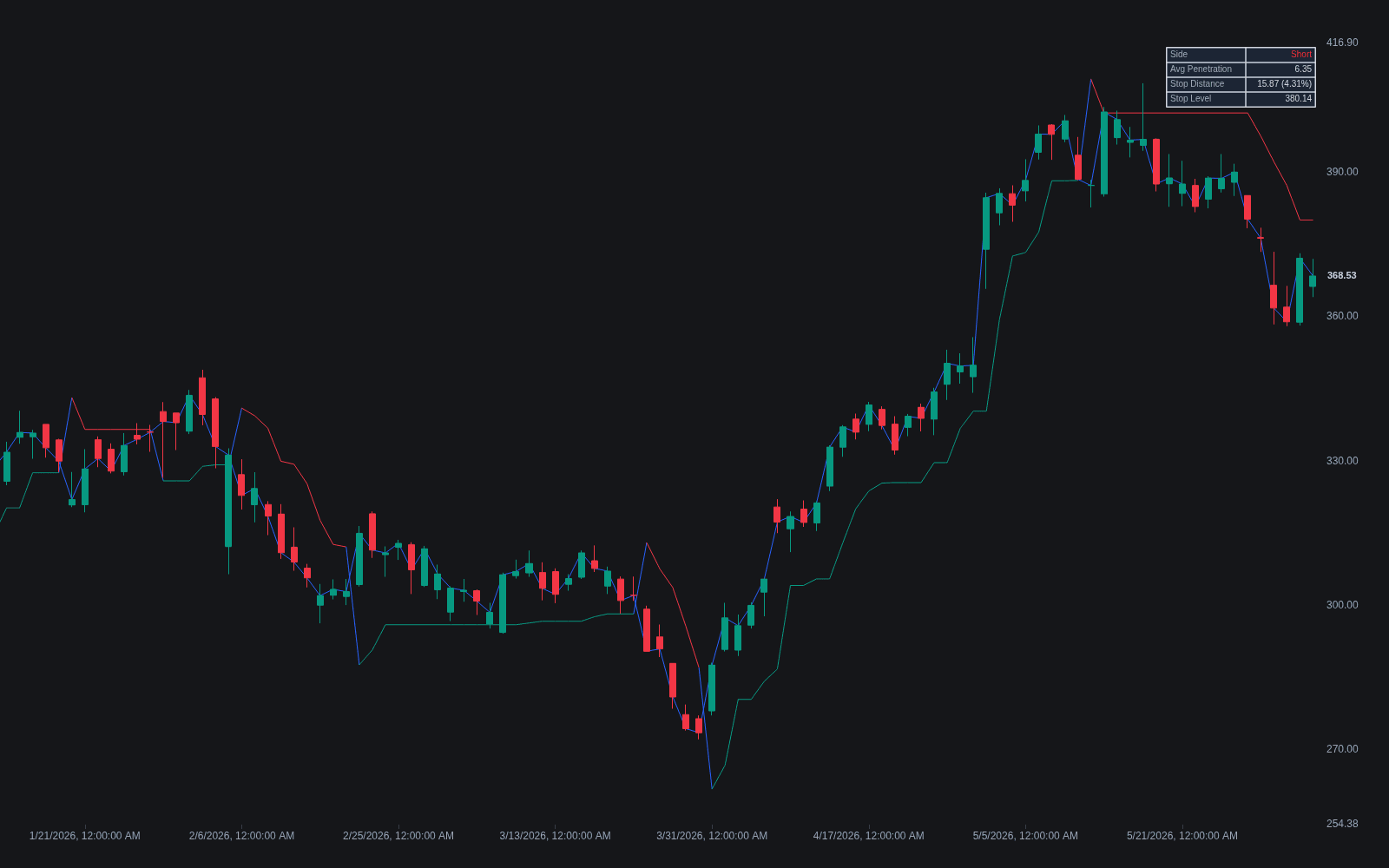
What is the Elder SafeZone Stop?
The SafeZone stop is Alexander Elder's noise-based trailing stop, introduced in his book Come Into My Trading Room (2002). Its premise is that every trend carries a normal amount of counter-trend penetration, bars that dip below the prior bar's low in an uptrend, and that a stop should sit outside that measured noise rather than at an arbitrary distance. SafeZone quantifies the noise directly: it averages the recent downside penetrations and places the stop a multiple of that average below the market.
The design goal is the same one behind every volatility stop: tight enough to protect capital, wide enough not to be shaken out by routine fluctuation. What distinguishes SafeZone from ATR-based methods is what it measures. ATR averages total bar range, movement in both directions; SafeZone averages only adverse penetrations, the specific behavior that actually hits a stop. In a steadily trending market with wide bars but few downside violations, SafeZone can sit much closer to price than an ATR stop would.
Like most trailing stops it ratchets: for a long position the stop rises or holds but is never lowered, so each advance locks in progress. Traders care about it as a systematic, self-adapting alternative to hand-placed stops, and as part of the broader Elder toolkit alongside Elder-ray and the Elder Impulse system.
How it's calculated
Stated for a long position; shorts mirror the logic using upside penetrations of prior highs.
Implementations differ on details: some average over all n bars rather than only penetrating bars, and some anchor to the current low instead of the prior bar's low. Elder presents the method as a template to adapt, not a fixed formula.
If no downside penetrations occur in the window, the method needs a fallback (prior value or a minimum distance), which implementations handle differently.
How traders use it
- As a trailing stop in trending positions: the stop follows price at a distance calibrated to how much adverse penetration this specific market has recently produced, tightening in orderly trends and widening in noisy ones.
- As an initial stop reference: on entry, the SafeZone distance gives a market-derived stop width that feeds position sizing the same way an ATR-based stop distance would.
- With coefficient tuning as the main control: k near 2 keeps the stop tight for shorter swings, while k near 3 gives trends more room; traders verify the choice against their strategy's holding period rather than trusting a default.
- In many implementations it is combined with a structure check, only trailing the stop up under confirmed swing lows, since raw SafeZone levels can sit inside obvious swing structure that the market is likely to test.
- With honest limits: SafeZone adapts to recent noise, so a sudden volatility regime change can leave it too tight (fresh volatility spike) or too loose (after a quiet stretch), and like all stops it offers no protection against gaps through the level.
SafeZone vs other volatility-based stops
ATR-Based Stop Distance: ATR measures average total range, both directions; SafeZone measures only adverse penetrations. ATR stops react to overall volatility, SafeZone specifically to counter-trend noise.
Chandelier Stop: Hangs an ATR multiple below the highest high since entry. Both ratchet, but the chandelier's distance is range-based while SafeZone's is penetration-based.
Parabolic SAR: Trails by an acceleration factor that increases each time the trend posts a new extreme, so it tightens as the move extends regardless of how much the market is actually pulling back; SafeZone's distance comes from measured pullback noise instead.
Concept family
Risk, Sizing & Exits
37 concepts mapped · 37 in the Library
Elder SafeZone Stop FAQ
Turn Elder SafeZone Stop into a trading strategy.
Take the implementation from this page into Quant, then build on it, backtest it on real data, and keep refining it in conversation.