Concept
Pyramiding
Pyramiding, also known as turtle units, scale-in plans, is a Risk, Sizing & Exits concept. The Library holds 1 implementation, a working definition you can pull into Quant.
Top Pyramiding indicator
The top custom implementation, built on the original standard Pyramiding formula.
1 total
Want to trade Pyramiding? The implementation below is one prompt away from a backtested strategy in Quant.
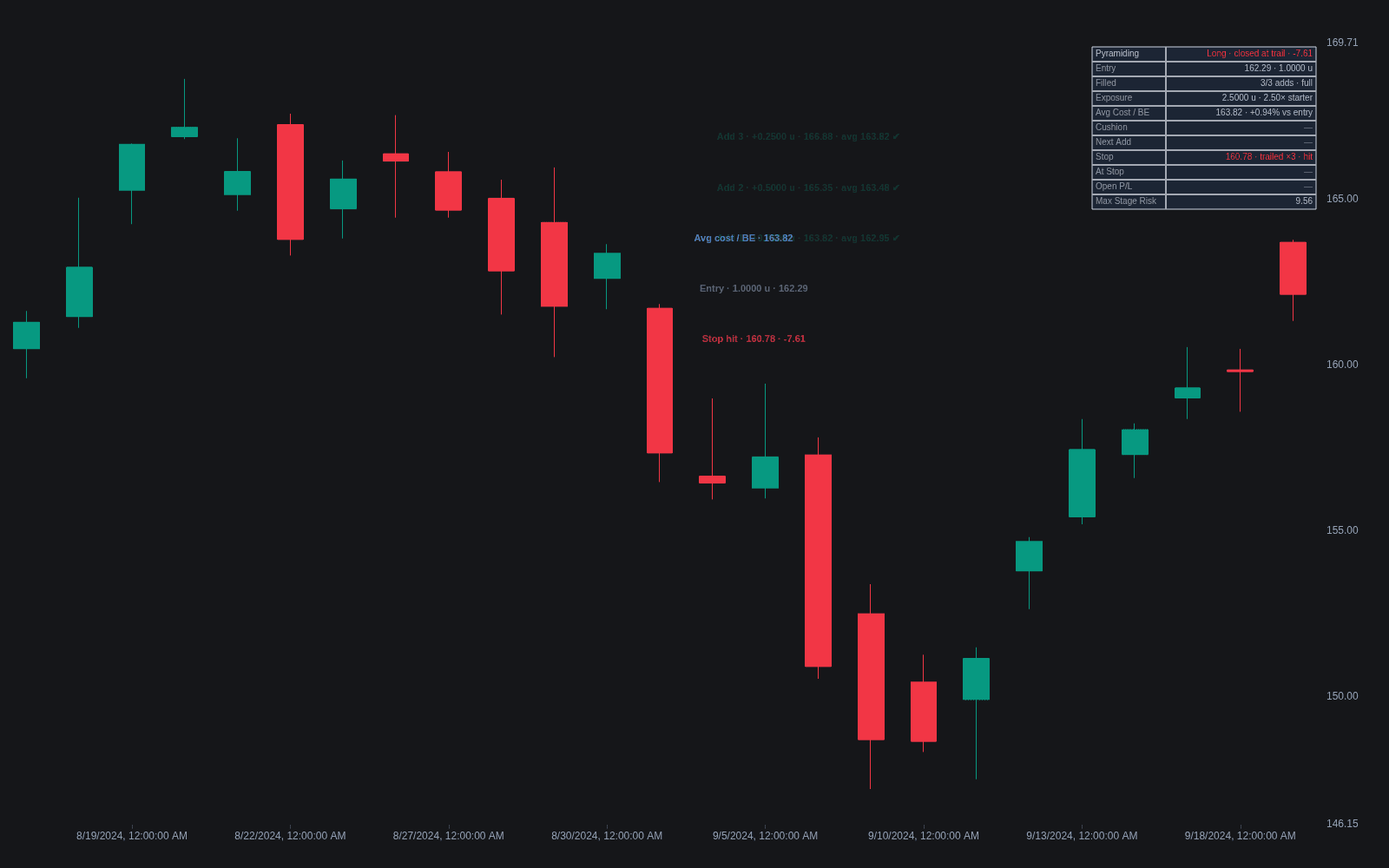
What is Pyramiding?
Pyramiding is scaling into a winning position: the trade opens with an initial unit, and further units are added only as price moves favorably and the idea keeps confirming. The name comes from the recommended size profile, largest tranche first and each add the same size or smaller, so the position resembles a pyramid rather than an inverted one. Because every add drags the average entry toward the current price, pyramiding converts open profit into fresh risk; disciplined versions therefore trail the stop for the whole position each time a new unit fills.
The practice long predates its formalization: Edwin Lefèvre's 1923 Reminiscences of a Stock Operator has Jesse Livermore, lightly fictionalized, feeling out a market with a partial line and committing in stages only as price confirmed his view. Six decades later the Turtle experiment of Richard Dennis and William Eckhardt turned the instinct into explicit, testable rules.
The Turtle rules remain the canonical template: positions sized in volatility units derived from average true range, a unit added at fixed intervals of favorable movement up to a hard cap, the aggregate stop tightened with each add. The same skeleton appears across breakout systems: add on strength, cap total units, let a trailed exit decide when the sequence ends.
The arithmetic explains the appeal and the cost. Adds concentrate size in trades already working, so failures are caught small while winners carry the full stack. In an R-multiple framework, pyramiding deliberately lowers the win rate, since ordinary pullbacks now stop out a larger, worse-priced position, in exchange for a fatter right tail when a trend keeps paying. It only stays sane when each unit's risk comes from an explicit rule such as fixed fractional sizing and the aggregate worst case is recomputed at every fill.
How to build a pyramiding plan
Pyramiding is a management technique rather than a chart pattern, so the work is specifying the plan before the first fill.
- 1Size the base unit with an explicit rule, such as volatility-targeted sizing, so the first tranche already reflects current conditions.
- 2Fix the add trigger before entry: favorable excursion in volatility multiples (the Turtle template), new structural breaks, or completed pullbacks. Discretionary 'looks strong' adds are how pyramids invert.
- 3Cap total units: decide the number of adds and each add's size, equal or shrinking, so maximum exposure is a known quantity.
- 4Pair every add with a stop update, ratcheting a volatility stop or structure stop for the whole position each time a unit fills.
- 5Define the ending: the trailing method or target ladder that closes the sequence, and the give-back you will tolerate at full size.
How traders use it
- In trend-following entries: a starter unit at the signal, further units at predefined intervals of favorable movement (often measured in ATR multiples), with the maximum unit count fixed before entry.
- In tiered entry plans that split one setup into several fills, pairing each add with an updated trailing stop so the combined position's worst case stays inside the original risk budget.
- As a risk-shaping tool: because adds only happen when the market pays the position, pyramiding concentrates size in trades that trend and keeps size minimal in trades that fail immediately, at the cost of a worse average entry and more give-back on reversals.
- In execution mechanics: adds are commonly resting stop-entry orders at the trigger levels, often wrapped in brackets using standard order constructs, so the plan fills without the trader acting at the moment of strength.
- Under portfolio loss-control rules: daily or per-theme loss caps should apply to the pyramid's aggregate risk, not the starter unit, keeping correlated adds from quietly becoming the account's dominant exposure.
Pyramiding vs related concepts
Averaging Down: Averaging down adds to losers to improve the break-even price; pyramiding adds to winners as confirmation arrives, financed by open profit and paired with trailed stops. The two sit at opposite ends of the risk-expansion spectrum.
Scaling Out: Scaling out is the exit-side mirror: reducing a winning position in tranches at successive targets. Pyramiding increases exposure as a trend develops; scaling out decreases it. Systems often combine both, building early and unwinding into strength.
DCA: Dollar-cost averaging schedules purchases by the calendar and accepts every price, including falling ones: an investing plan with no stop and no confirmation requirement. Pyramiding is conditional; adds come only on favorable movement, under a cap, with a trailed exit. The two share the arithmetic of multiple fills and little else.
Concept family
Risk, Sizing & Exits
37 concepts mapped · 37 in the Library
Pyramiding FAQ
Turn Pyramiding into a trading strategy.
Take the implementation from this page into Quant, then build on it, backtest it on real data, and keep refining it in conversation.