Concept
Astro Cycles
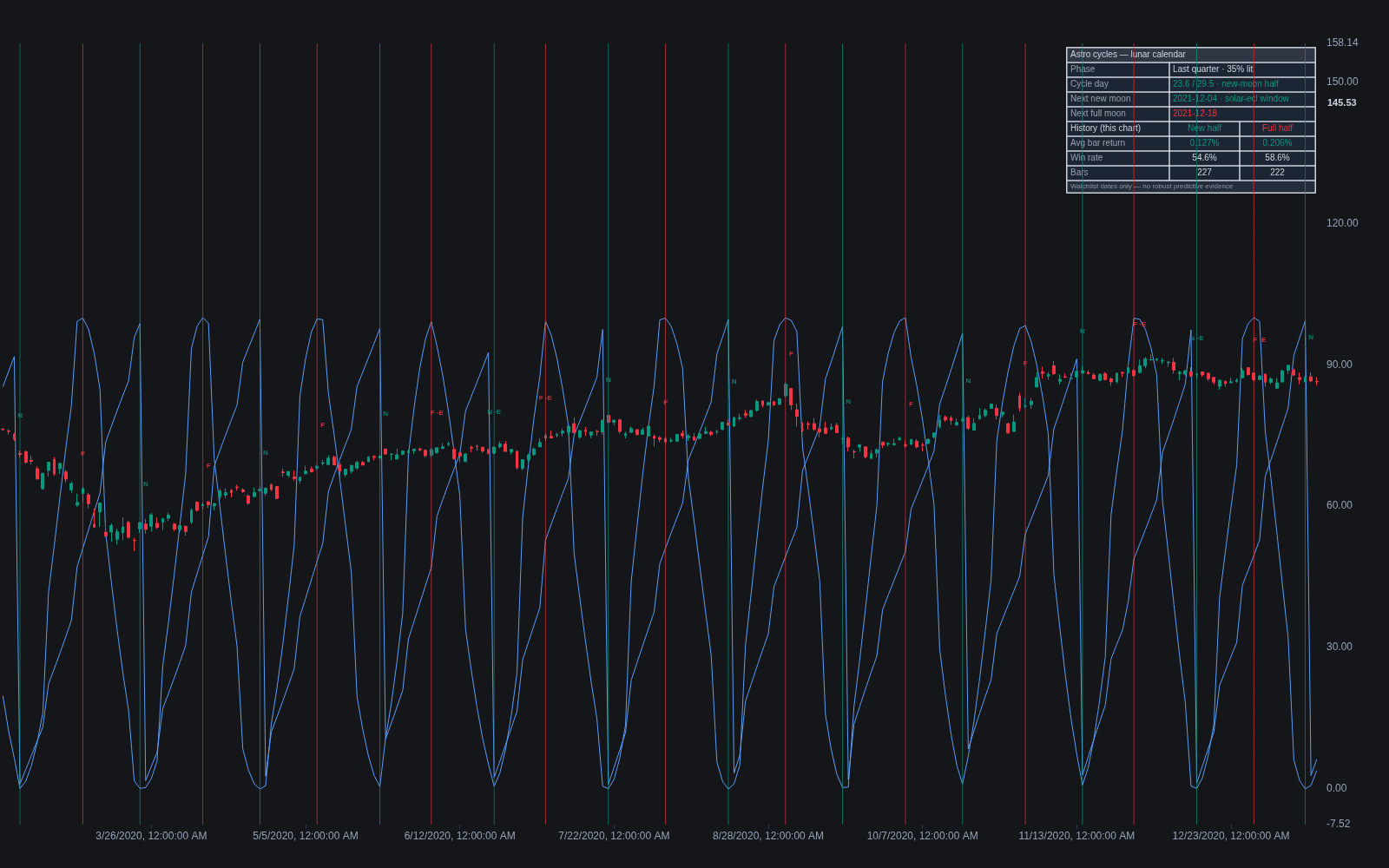
Astro Cycles, also known as lunar cycles, Bradley siderograph — no robust evidence, are Time, Sessions & Seasonality concepts. The Library holds 1 implementation, a working definition you can pull into Quant.
Top Astro Cycles indicator
The top custom implementation, built on the original standard Astro Cycles formula.
1 total
From studying Astro Cycles to trading it: take the implementation below into Quant and backtest it instantly.
What are Astro Cycles?
Astro cycles is the umbrella term for market-timing methods based on astronomical or astrological calendars: lunar cycles (new and full moons), planetary aspects and alignments, eclipses, and composite planetary indices. The best known composite is the Bradley siderograph, constructed by Donald Bradley in the 1940s, which converts a weighted sum of planetary aspect angles into a curve whose turning points are proposed as candidate dates for market turns. Lunar approaches are simpler, typically claiming a bias such as stronger returns around new moons than full moons.
It must be said plainly: there is no robust statistical evidence that astro cycles predict markets. A handful of academic papers have reported small lunar correlations in some samples, but the effects are tiny, unstable across periods and markets, and consistent with the false positives expected when many calendars are tested against noisy return data. Planetary-aspect methods fare worse under scrutiny, and even dedicated practitioners of the siderograph caution that it marks potential turn dates without indicating direction, which makes the claim close to unfalsifiable. The multiple testing problem is acute here, since an unlimited supply of astronomical events can be fitted to any price history after the fact.
The concept persists anyway, and understanding why is useful. Astronomical calendars are precisely computable years in advance, which gives them an aura of objectivity, and they slot naturally into the broader tradition of fixed-date turn forecasting that includes Gann time cycles and other fixed-time cycle methods. Confirmation bias does the rest: hits are remembered, misses are reinterpreted as inversions or minor turns.
How traders use it
- Practitioners who use astro cycles typically treat the dates as a watchlist, not a signal: a siderograph turn date or a lunar phase marks a day to look for reversal evidence from price action, with no trade taken on the calendar alone.
- Lunar traders commonly frame the cycle as a sentiment rhythm, favoring longs in the new-moon half of the cycle and caution in the full-moon half. Published support for this is weak and sample-dependent.
- Some combine astro dates with conventional cycle work, checking whether a proposed astronomical turn coincides with counts from Hurst cycle analysis or with lunar-anchored frameworks like the Delta phenomenon. Agreement between two weak methods is still weak evidence.
- The defensible use is as a null-hypothesis exercise: testing an astro calendar with randomization tests is an excellent way to learn how easily random date sets produce impressive-looking hit rates.
- Anyone evaluating a paid astro-timing service should demand a pre-registered, direction-specific forecast record. Retrospective chart annotations marking past turns carry no evidential weight.
Astro Cycles vs Other Time-Based Methods
Gann time cycles and anniversaries: Gann's time work projects turns from past market dates and numeric intervals; astro cycles derive dates from astronomical positions. Both are fixed-date turn methods with weak formal evidence, but their calendars come from different sources.
Fixed-time cycles: Fixed-time cycle analysis fits regular periodicities to price data itself; astro methods impose an external astronomical clock regardless of what the data shows.
Hurst cycle analysis: Hurst analysis estimates nested cycles empirically from price with explicit averaging and envelopes. It is testable and data-driven in a way astrological calendars are not, even though its own forecasting record is debated.
Concept family
Time, Sessions & Seasonality
32 concepts mapped · 32 in the Library
Astro Cycles FAQ
Turn Astro Cycles into a trading strategy.
Take the implementation from this page into Quant, then build on it, backtest it on real data, and keep refining it in conversation.