Concept
Buyback Blackout Windows
Buyback Blackout Windows are Time, Sessions & Seasonality concepts. The Library holds 1 implementation, a working definition you can pull into Quant.
Top Buyback Blackout Windows indicator
The top custom implementation, built on the original standard Buyback Blackout Windows formula.
1 total
This Buyback Blackout Windows implementation is strategy-ready: open it in Quant, set your rules, and it backtests automatically.
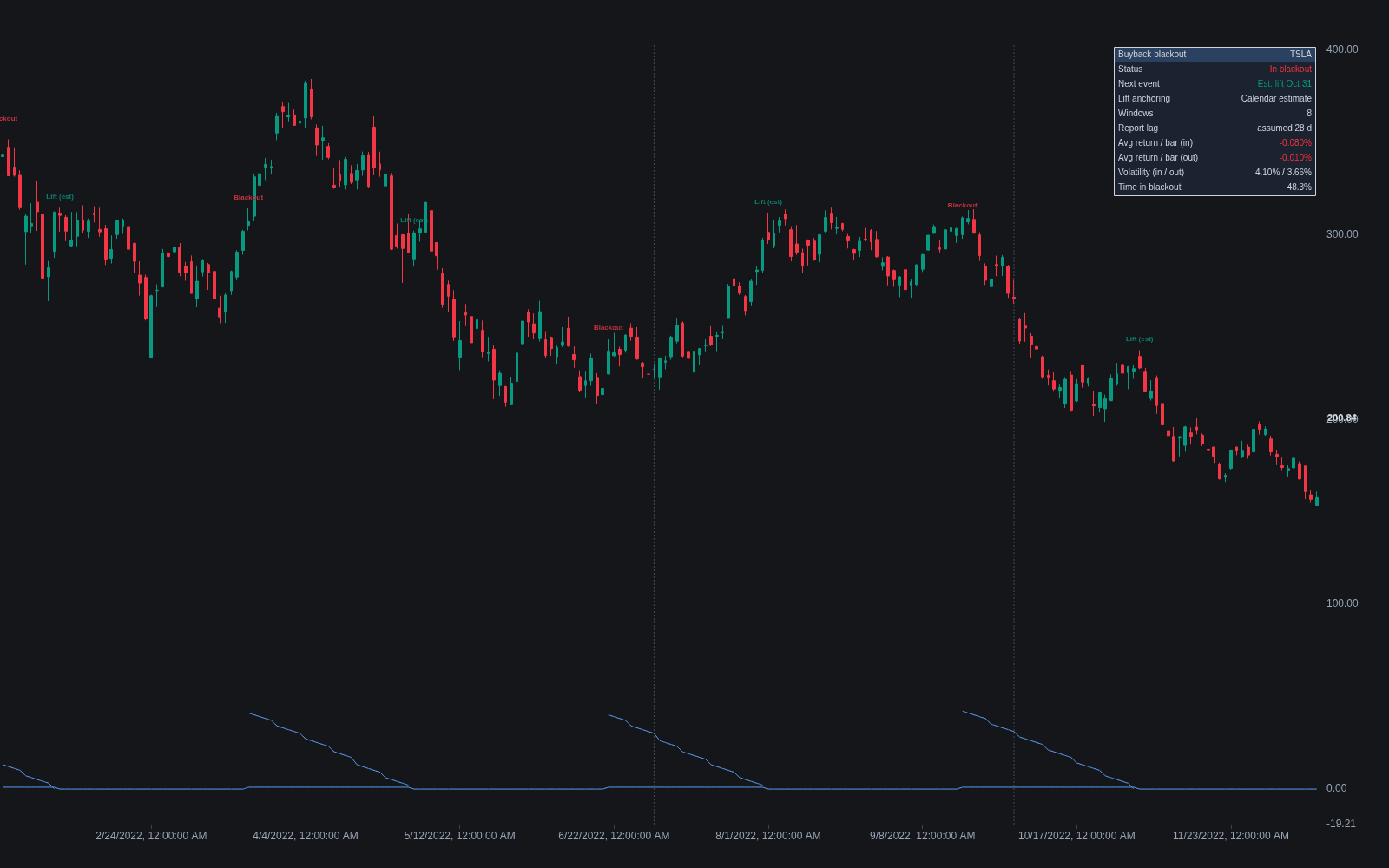
What are Buyback Blackout Windows?
Buyback blackout windows are the recurring periods around earnings releases when companies voluntarily suspend discretionary repurchases of their own stock. They are not mandated by a specific SEC rule; rather, most companies adopt them as internal policy to avoid trading on material non-public information while quarterly results are being finalized. A typical policy halts discretionary buying from roughly two weeks before quarter end until a day or two after results are published, though exact windows vary by company.
Traders care because corporate buybacks have been one of the largest recurring sources of demand for US equities in recent decades. When a large share of companies enters blackout at the same time, a meaningful bid is temporarily reduced, and when blackouts lift after earnings, that bid returns. This gives the earnings calendar a flow dimension on top of its information dimension, and it is one reason some desks track the percentage of index market cap currently in blackout alongside buyback flows themselves.
The honest caveat is that the effect is a tendency in aggregate demand, not a timing signal. Many companies run repurchases through pre-set 10b5-1 plans that continue mechanically through blackout, which blunts the flow swing. Studies and desk research disagree on how much blackout periods actually depress returns or raise volatility, and any single quarter is dominated by earnings results and macro news rather than by the blackout calendar.
How traders use it
- As background flow context: traders note when the blackout share of the index is peaking, typically in the weeks straddling quarter end, and temper expectations for dip-buying support during that stretch.
- As part of an earnings-season map: blackout entry and exit dates are layered onto the earnings season phases to anticipate when corporate demand fades and returns.
- As one input among many for seasonal studies: some analysts test whether drawdowns during heavy-blackout windows behave differently, alongside broader fund flow measures. Results are mixed, so conclusions should be held loosely.
- Never as a standalone signal: pre-set repurchase plans continue through blackout, execution is spread across the quarter, and the blackout share is an estimate. It adjusts probabilities at the margin rather than defining trades.
Buyback Blackout Windows vs Related Concepts
Buyback flows: Buyback flows concern the size and pace of corporate repurchase demand itself; blackout windows concern the calendar periods when the discretionary portion of that demand is switched off.
Quarterly earnings season phases: Earnings season phases track the information cycle of reports and reactions. Blackout windows are the flow shadow of that same calendar, driven by compliance policy rather than by the content of results.
Turn-of-month effects: Turn-of-month effects are a monthly flow pattern tied to payrolls and rebalancing; blackout windows follow the quarterly earnings calendar instead, so the two overlap only occasionally.
Concept family
Time, Sessions & Seasonality
32 concepts mapped · 32 in the Library
Buyback Blackout Windows FAQ
Turn Buyback Blackout Windows into a trading strategy.
Take the implementation from this page into Quant, then build on it, backtest it on real data, and keep refining it in conversation.