Concept
Gap Rules Interaction
Gap Rules Interaction is a Time, Sessions & Seasonality concept. The Library holds 1 implementation, a working definition you can pull into Quant.
Top Gap Rules Interaction indicator
The top custom implementation, built on the original standard Gap Rules Interaction formula.
1 total
This Gap Rules Interaction implementation is strategy-ready: open it in Quant, set your rules, and it backtests automatically.
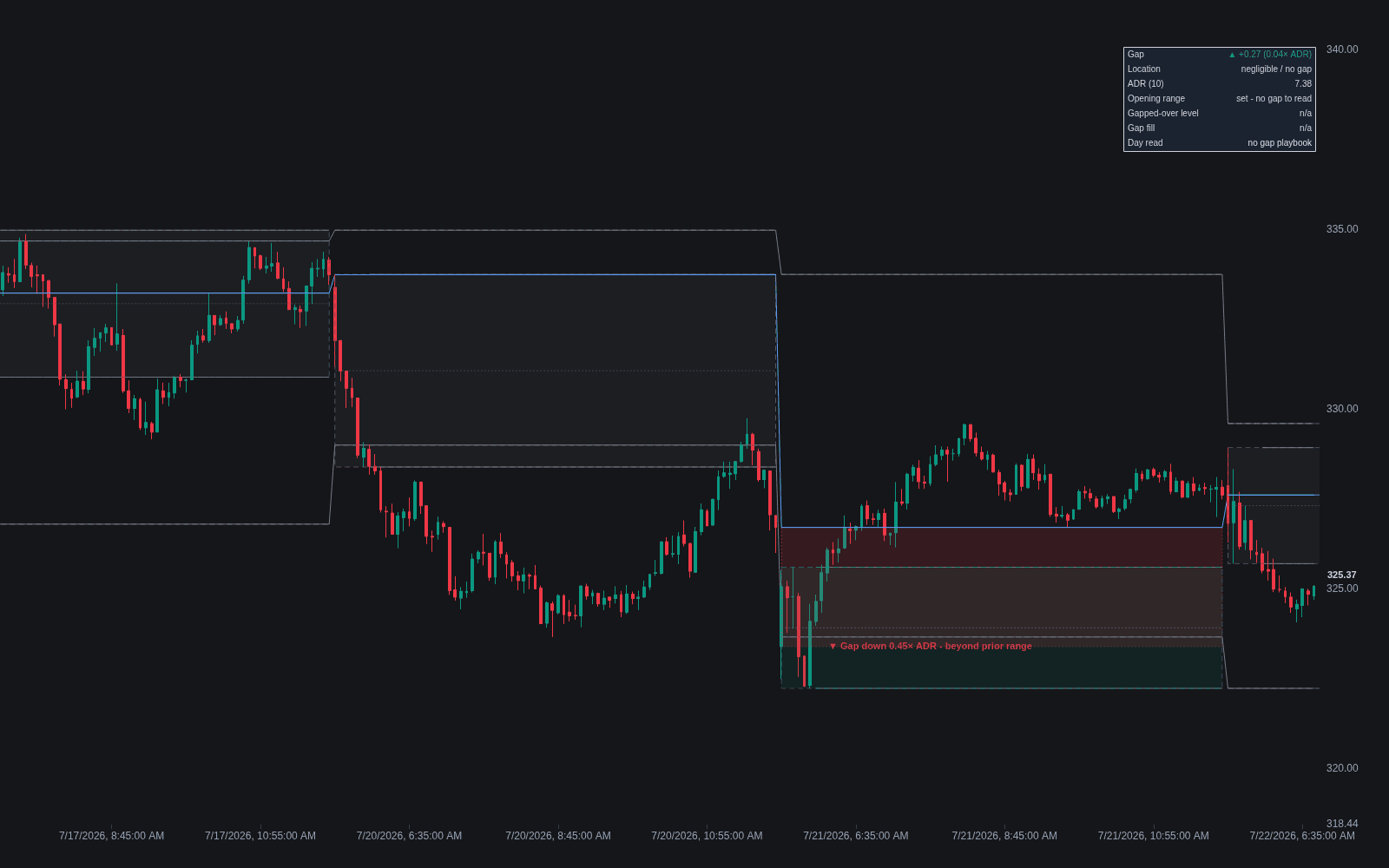
What is Gap Rules Interaction?
Gap rules interaction is the practice of reading an opening gap together with the session's opening-range levels and the prior day's reference levels, rather than in isolation. A gap changes the meaning of everything around it: the prior close becomes a magnet or a wall, the prior high or low may already be behind price at the open, and the opening range forms in territory the market never traded the day before. The interaction of these layers, not the gap alone, is what shapes the day's playbook.
The core distinctions are locational. A gap that opens beyond the prior day's entire range starts the session out of balance, and days that hold outside that range tend to trend more often than days that re-enter it. A gap that opens inside the prior range is structurally weaker: the market is still trading in accepted territory, and a fill of the gap back to the prior close is a routine outcome. Where the opening range then forms relative to the gap edge and the prior levels determines whether early trade is confirming the gap or rejecting it.
Traders care because the same gap size can imply opposite trades depending on this context. A gap above the prior high that holds the top of its opening range invites continuation logic, while an identical gap that trades back below the prior high has failed a level and often rotates toward the prior close. The interaction rules turn three separate observations, gap, opening range, and prior-day map, into one coherent read.
How to Read a Gap Against Its Levels
The read is a sequence of location checks in the first minutes of the session:
- 1Before the open, mark the prior day's high, low, and close (or settlement), and note whether the indicated open is inside or outside that range.
- 2Classify the gap: outside the prior range entirely, beyond the prior close but inside the range, or negligible relative to recent average daily range.
- 3Let the opening range form and note where it sits: an opening range building above a gapped-over prior high is acceptance; one forming back inside the prior range signals the gap is being rejected.
- 4Watch the first test of the nearest prior-day level; a clean hold of the prior high after a gap up is the continuation cue, while a failure back through it opens the path toward the unfilled gap and the prior close.
- 5Track the gap-fill level (prior close) explicitly; partial fills that hold above the prior close preserve the bullish structure, full fills that keep going negate it.
How traders use it
- Continuation traders require alignment before joining a gap-and-go: gap beyond the prior range, opening range holding its upper half, and no re-entry through the gapped-over level.
- Fade traders take the opposite alignment, treating an open back inside the prior day's range after a gap as the setup for a rotation to the prior close, the standard gap fill trade with defined risk at the opening-range extreme.
- The prior close doubles as a management level: gap-up longs are often reduced or exited if price trades below it, since a full fill converts the day's structure from imbalance back to balance.
- An opening range breakout in the gap's direction is generally rated stronger than one against it, though on large gaps much of the move may already be spent, so targets are set conservatively.
- None of these tendencies approaches certainty; base rates for gap continuation versus fill vary by instrument, gap size, and regime, and are worth measuring directly with prior-period level statistics on your own market.
Gap Rules Interaction vs Related Concepts
Opening Gap: The opening gap is the raw event: an open away from the prior close. Gap rules interaction is the layer above it, reading that event against the opening range and the prior day's map to choose between continuation and fade logic.
Opening Range and ORB: Opening-range analysis works on any day. The interaction view adds the gap as context, since an ORB in the direction of an unfilled gap and an ORB back into a gapped-over range are very different trades.
Gap Fill: Gap fill is one outcome path: price returning to the prior close. The interaction rules describe the conditions under which the fill becomes likely, chiefly a failed hold of the gap edge and re-entry into prior value.
Concept family
Time, Sessions & Seasonality
32 concepts mapped · 32 in the Library
Gap Rules Interaction FAQ
Turn Gap Rules Interaction into a trading strategy.
Take the implementation from this page into Quant, then build on it, backtest it on real data, and keep refining it in conversation.