Concept
Fixed Time Cycles
Fixed Time Cycles are Time, Sessions & Seasonality concepts. The Library holds 1 implementation, a working definition you can pull into Quant.
Top Fixed Time Cycles indicator
The top custom implementation, built on the original standard Fixed Time Cycles formula.
1 total
The Fixed Time Cycles implementation below can become a backtested trading strategy — describe your rules and Quant writes the code.
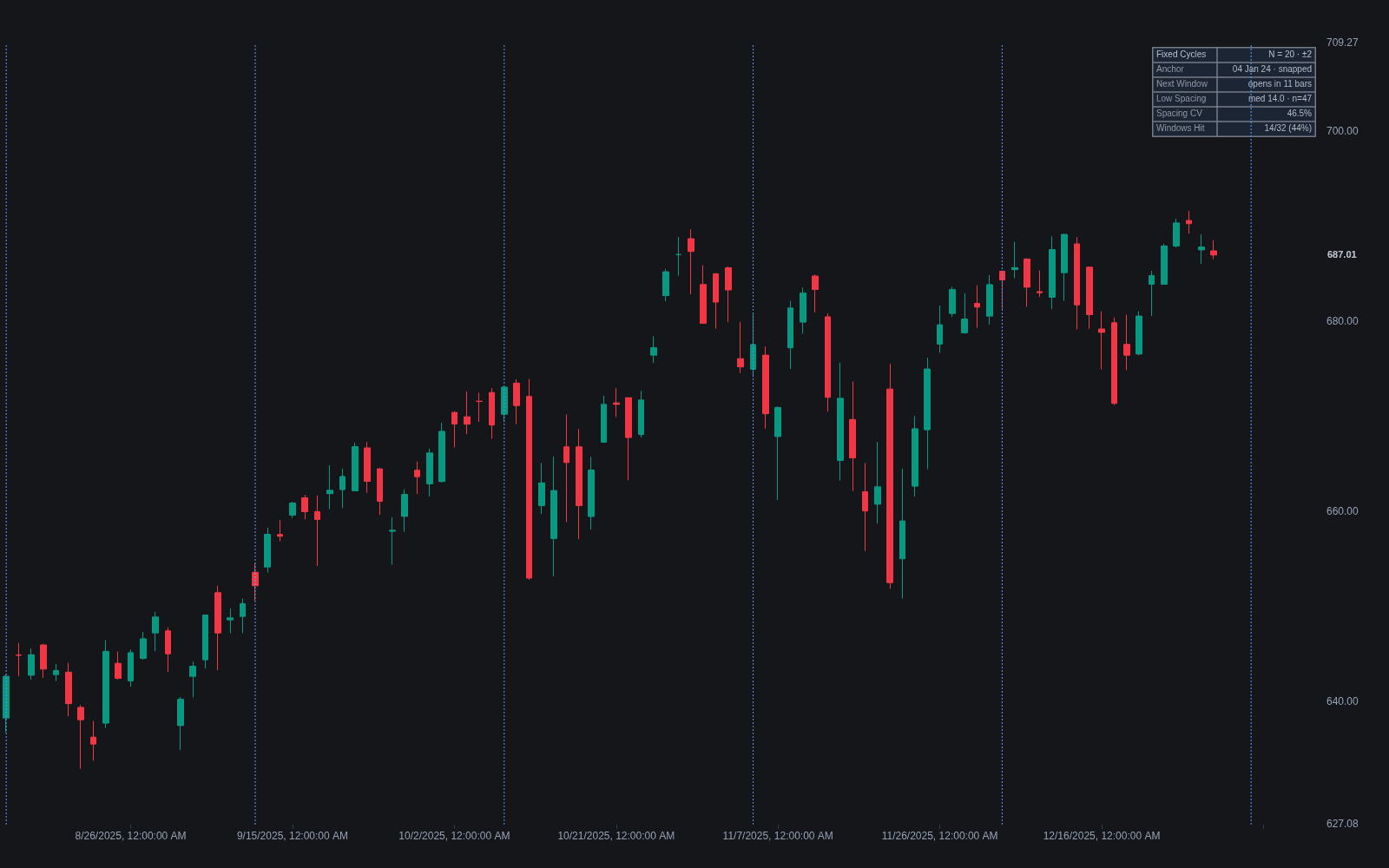
What are Fixed Time Cycles?
Fixed time cycles model a market as repeating a rhythm of constant length: a low or a turn every N bars, days, or weeks, projected forward from a chosen anchor. The analyst measures the spacing between past swing lows, settles on a period, and marks vertical lines or arcs at each multiple ahead, creating windows where the next turn is 'due'. It is the oldest style of cycle work, running from Gann's time counts to Hurst's nominal cycle model, and it contrasts with dominant-cycle detection, which re-estimates the period bar by bar instead of fixing it.
The honest limitation is drift: cycle lows arrive early or late, periods stretch and compress, and a fixed projection degrades the further it extrapolates. Practitioners treat the marked dates as attention windows that need a price trigger, in the same spirit as Fib time tools, not as appointments the market must keep.
The traditions differ in what they fix. Gann-derived counts project sacred numbers, 45, 90, 144 bars or degrees, from significant extremes; Fibonacci cycle work spaces its verticals by the familiar sequence, the approach automated in cycle-finder tools; Hurst's nominal model proposes a nest of harmonically related periods, each roughly half the one above, with observed lows shared between them, easily the most systematic of the fixed frameworks. The exotic fringe is real too, calendar systems and astronomy-adjacent schemes, which chart tooling occasionally implements as curiosities. What unites them is the epistemic shape: a period asserted in advance, then imposed on the data.
The craft that survives skepticism is procedural. Windows get tolerance, commonly ten to fifteen percent of the period either side of the due date, because even genuine rhythms wobble; anchors matter enormously, since a projection from the wrong low marks noise with confidence; and Hurst's diagnostics add the useful concept of translation, cycle troughs arriving right of schedule in uptrends and left in downtrends, so the skew of arrivals reads as trend evidence. Fixed counts also cross-check naturally against the calendar: a count window landing on a known seasonal turn date is two weak clocks agreeing, which is more than either alone.
How to identify fixed time cycles
The workflow is measure, fix, project, and then insist on price confirmation.
- 1Choose the anchor: a major, unambiguous swing low from which the count begins; the projection inherits every flaw of this choice.
- 2Measure the spacing between successive significant lows across a long sample, looking for a repeating typical interval.
- 3Fix the period only if the spacings agree tightly; scattered spacings mean no stable rhythm exists at that scale and the method does not apply.
- 4Project the windows forward with honest tolerance, roughly ten to fifteen percent of the period either side of each due date.
- 5Trade triggers, not dates: inside a window, hunt for reversal evidence, divergence, failed breaks, structure shifts, and skip windows where nothing sets up.
How traders use it
- Projecting turn windows: anchoring on a major low, marking every Nth bar forward, and hunting for reversal evidence (divergence, reversal bars, structure breaks) only inside those windows.
- Auditing whether the model fits at all: if the spacing of historical swing lows varies widely, a fixed period is the wrong tool and adaptive cycle estimation is the better fit.
- Combining time with price: a cycle window plus a level or pattern gives a testable setup; time alone carries no direction and is rarely traded bare.
- Nesting the periods: Hurst-style analysis runs several harmonically related cycles at once, and windows where multiple periods project lows together are weighted above any single count's date.
- Cross-checking the calendar: fixed-count windows that coincide with recurring calendar-cycle dates or seasonal turn zones get extra attention, two independent clocks agreeing where one would be guesswork.
Fixed cycles vs related time frameworks
Dominant-cycle Detection: The adaptive alternative: measure the current period continuously and let it change, rather than asserting one in advance. Fixed cycles win on simplicity and testability; adaptive detection wins wherever the rhythm genuinely drifts, which is most markets most of the time.
Fib Time Tools: Fib time projections space their verticals by ratio, expanding intervals from an anchor, where fixed cycles repeat a constant interval. Both mark attention windows needing price triggers; they disagree about whether market time is periodic or proportional.
Seasonality Tooling: Seasonality anchors recurrence to the calendar, the same dates each year, with averages measured across many years. Fixed cycles anchor to a count from a chosen low, calendar-free. When a count window lands on a seasonal date, the two independent clocks reinforce each other.
Concept family
Time, Sessions & Seasonality
32 concepts mapped · 32 in the Library
Fixed Time Cycles FAQ
Turn Fixed Time Cycles into a trading strategy.
Take the implementation from this page into Quant, then build on it, backtest it on real data, and keep refining it in conversation.