Concept
RTH vs ETH
RTH vs ETH, also known as Globex vs pit hours, is a Time, Sessions & Seasonality concept. The Library holds 1 implementation, a working definition you can pull into Quant.
Top RTH vs ETH indicator
The top custom implementation, built on the original standard RTH vs ETH formula.
1 total
The RTH vs ETH implementation below can become a backtested trading strategy — describe your rules and Quant writes the code.
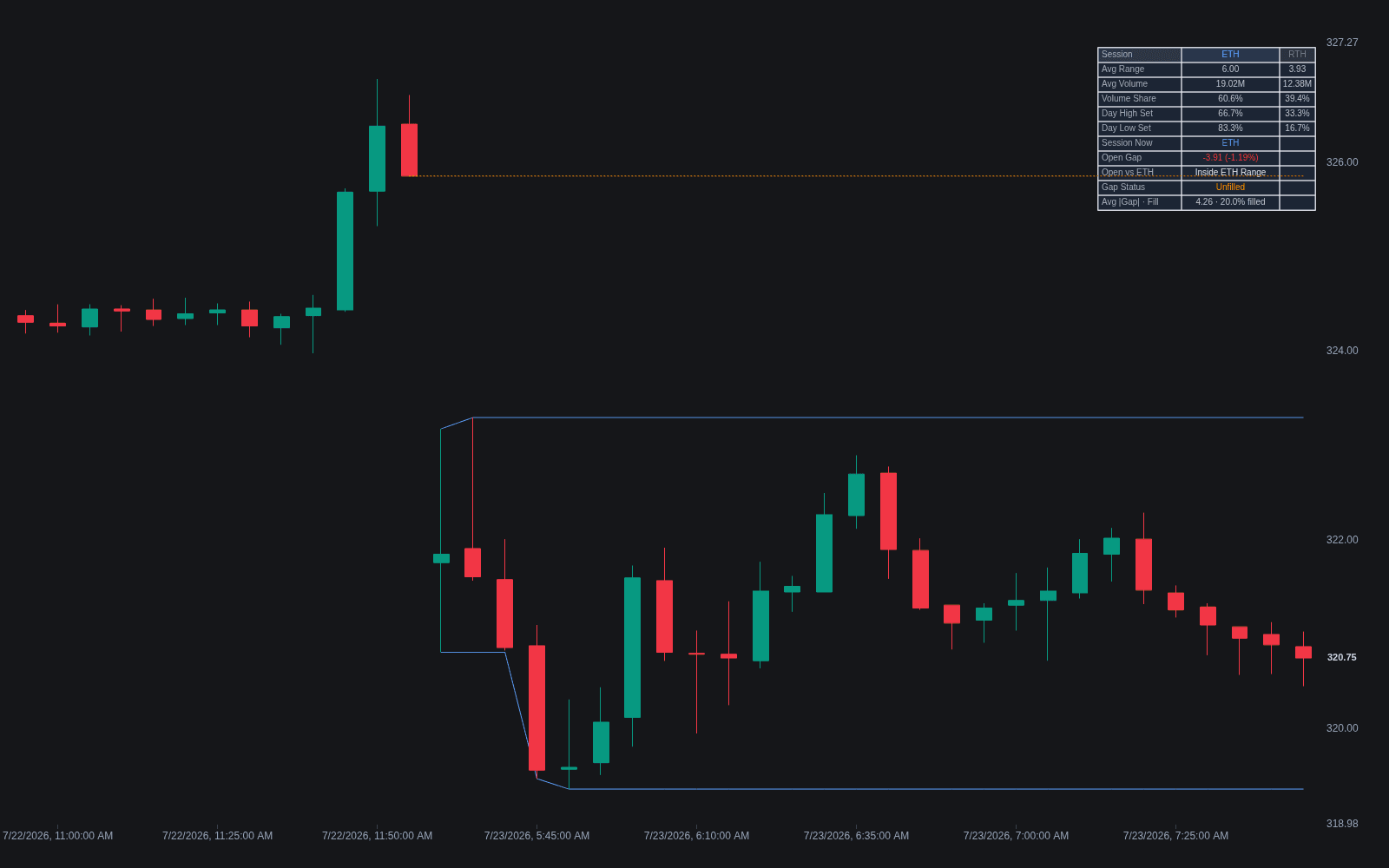
What is RTH vs ETH?
RTH vs ETH is the split between Regular Trading Hours, the official cash session (9:30am to 4:00pm ET for US equities, with index futures' RTH conventionally aligned to it), and Extended or Electronic Trading Hours: the overnight Globex session in futures, pre-market and after-hours in stocks. The older shorthand was pit hours versus Globex. Participation differs sharply between the two: RTH carries the bulk of institutional volume, while ETH is thinner, so overnight moves happen on less volume and can be easier to push and quicker to reverse.
The split is a legacy of market structure. Until the early 1990s futures traded only while the exchange floor was open, so the pit session defined the trading day. CME launched its Globex electronic platform in 1992, extending futures into the night, and US equities gained ECN-driven pre-market and after-hours trading later that decade. An S&P 500 futures contract now trades roughly 23 hours a day on weekdays, yet the old floor schedule survives as the RTH convention because the cash market it tracks still runs 9:30am to 4:00pm ET, with opening and closing auctions anchoring institutional flow to those times.
The split matters because reference levels are convention-dependent. VWAPs, opening ranges, profiles, and high/low statistics all change depending on whether they are computed on RTH-only or full 24-hour data, and overnight ETH levels such as the Globex high and low form their own reference set heading into the day session.
Participation drives everything downstream. Because RTH concentrates institutional volume, statistical work from time-of-day effects to session high and low timing is usually computed on RTH data, and mixing conventions quietly corrupts such studies. Much of the calendar also lands inside ETH: major US economic releases at 8:30am ET print an hour before the equity open, so macro event days often do their first repricing on thin overnight books. The boundaries themselves breed distinct behavior, which is why open and close effects are studied as a topic of their own.
How to see the RTH/ETH split on a chart
Futures charts make the comparison direct; the session choice lives in chart or symbol settings.
- 1Load an index futures chart with full ETH data, then switch to an RTH-only template: bars between 4:00pm and 9:30am ET disappear and net overnight movement reappears as gaps.
- 2Mark yesterday's RTH high, low, and close, then separately mark the overnight (Globex) high and low; the two sets rarely coincide.
- 3Anchor a VWAP or opening range from the 9:30am RTH open and again from the 6:00pm Globex open, and compare the levels; the difference is the convention at work.
- 4Before trading any published level, ask which session built it; an RTH-only value area will not line up with a 24-hour chart.
How traders use it
- Choosing and keeping a convention: building a volume profile or session VWAP on RTH-only data to match cash-session structure, or on full ETH data to capture the whole auction, and not mixing the two mid-analysis.
- Reading overnight inventory at the open: where ETH traded relative to the prior RTH close frames the opening gap and whether early trade is likely to correct an overnight extreme; a tendency, not a rule.
- Treating ETH extremes as references: overnight highs and lows are widely watched levels the day session frequently tests, which makes them natural planning spots rather than automatic trade triggers.
- Defining the opening range: opening range and ORB conventions almost always start from the RTH open rather than the Globex open, so the session choice silently decides where the range sits and how wide it is.
- Splitting return research: separating overnight close-to-open moves from intraday open-to-close moves is the ETH/RTH boundary applied to returns, and studies of day-of-week effects can change materially depending on which leg they include.
RTH vs ETH vs related session concepts
Trading Sessions: The global session map divides the day by when Asia, London, and New York participants are active. RTH vs ETH divides it by one exchange's official schedule; a single overnight Globex stretch spans several global sessions. Different lenses for different questions.
Opening Range & ORB: Opening-range techniques consume the convention rather than define it: the range is measured from a session open, so the RTH or ETH choice determines where it starts. One is the data convention, the other a method built on top.
Session High/low Statistics: Statistics on when the day's extremes form only mean something once the session is pinned down; computed on 24-hour data they answer a different question than on RTH-only data. The session choice is the denominator of every such figure.
Concept family
Time, Sessions & Seasonality
32 concepts mapped · 32 in the Library
RTH vs ETH FAQ
Turn RTH vs ETH into a trading strategy.
Take the implementation from this page into Quant, then build on it, backtest it on real data, and keep refining it in conversation.