Concept
Day-of-week Effects
Day-of-week Effects, also known as Monday effect, turnaround Tuesday, are Time, Sessions & Seasonality concepts. The Library holds 5 implementations, each one a working definition you can pull into Quant.
Top Day-of-week Effects indicators
The top custom implementations, built on the original standard Day-of-week Effects formula.
5 total
Want to trade Day-of-week Effects? Any of the 5 implementations below is one prompt away from a backtested strategy in Quant.
What are Day-of-week Effects?
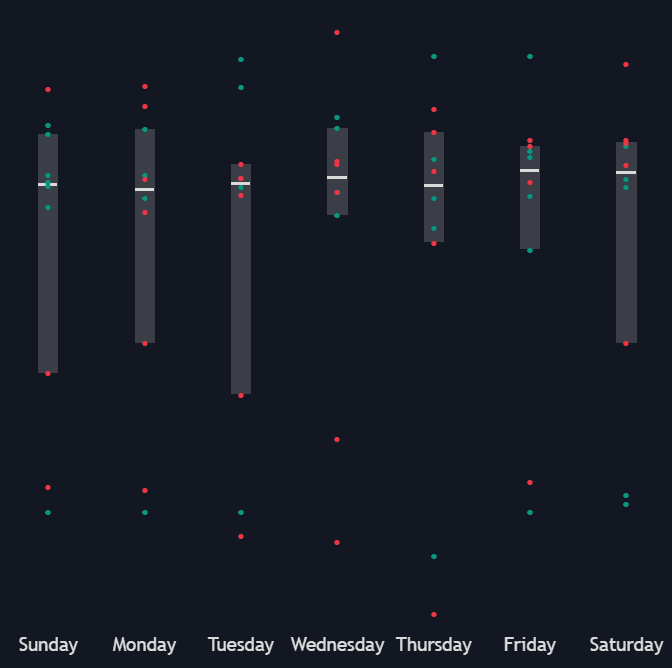
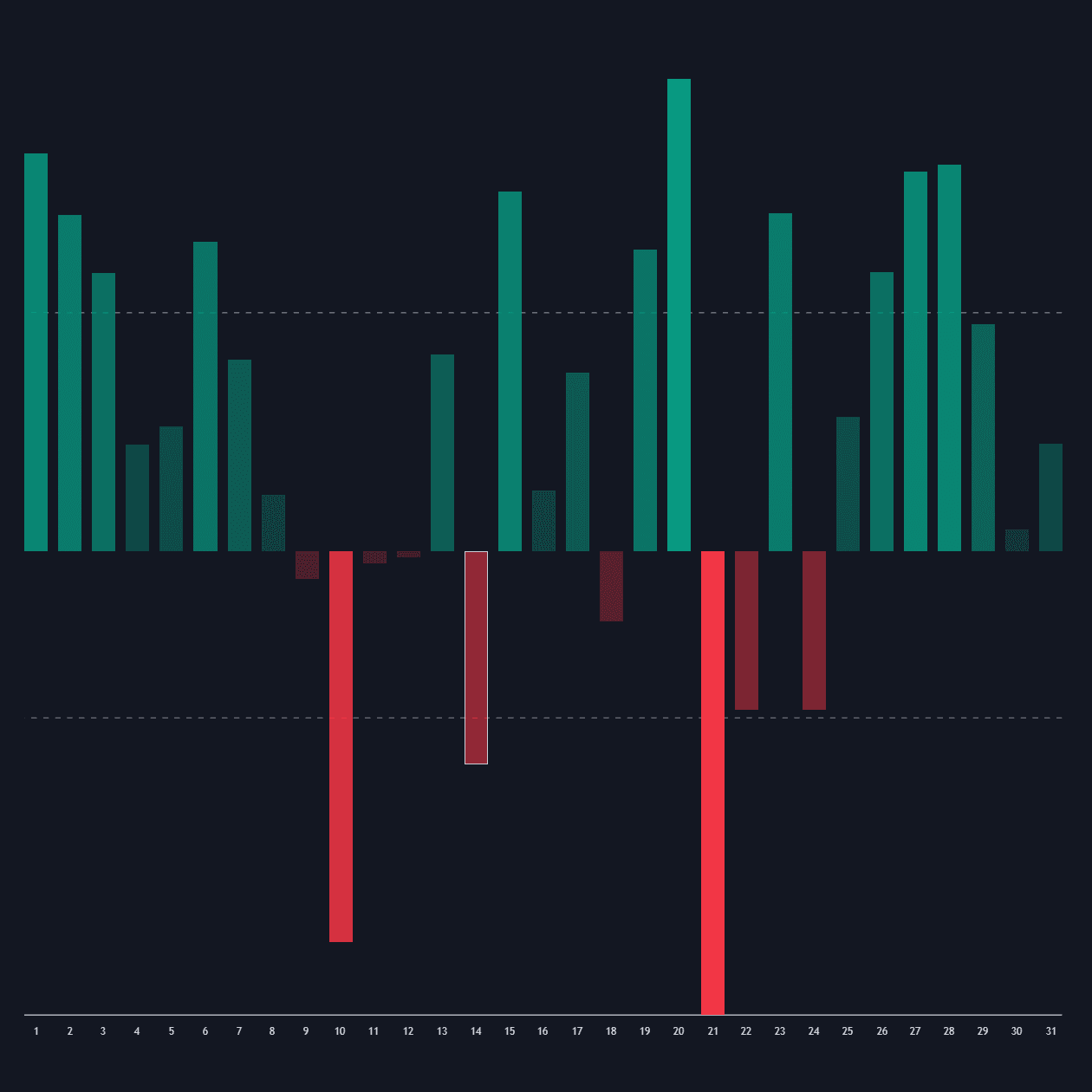
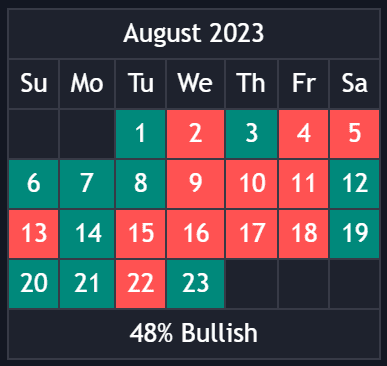
Day-of-week effects are calendar tendencies in which average return, volatility, or volume differs by weekday. The classic examples come from the equity literature: the Monday (or weekend) effect, where Mondays showed the weakest average returns in twentieth-century US stock data, and 'turnaround Tuesday', the folk tendency for Tuesday to reverse Monday weakness. Measurement is simple: bucket daily returns by weekday and compare each bucket's average return, win rate, and range, the same machinery as month-of-year seasonality at a finer grain.
The anomaly has real academic pedigree. Frank Cross documented the Friday-strong, Monday-weak pattern in Standard & Poor's index data in 1973, Kenneth French's 1980 weekend-effect study made it one of the most cited calendar anomalies in finance, and Gibbons and Hess soon extended the evidence beyond equities. Proposed explanations included weekend news timing, the settlement conventions of the era, and investor mood; none was ever settled, and none gave a reason to expect permanence.
Two caveats define the concept. The measured effects are small relative to daily noise, so they only appear in aggregates, and several classic anomalies weakened or vanished in the decades after publication. Weekday statistics are context to re-verify on your own market and sample, often alongside intraday time-of-day effects, not standing edges.
Doing the measurement well matters more than the folklore. Five weekday buckets across many instruments and lookbacks invite data mining, so a tendency worth attention should survive subsample splits, have a plausible driver, and be large enough to clear costs. Structural drivers age best: weekly options expiry, futures roll flows, and the concentration of releases on macro event days (US employment reports on Fridays, Fed decisions on Wednesdays) give some weekdays a mechanical character that return averages miss.
For most traders the practical payoff is structure rather than direction. In markets with defined trading sessions, Monday opens on a weekend of accumulated news and can gap, while Friday afternoons carry expiry mechanics and pre-weekend position squaring. In 24/7 venues such as crypto the week still shows up through thinner weekend participation. Weekday tendencies sit between intraday effects and monthly or longer calendar cycles, and read best alongside both.
How to Measure Day-of-week Effects
A weekday profile takes minutes with a seasonality tool or a spreadsheet export:
- 1Take several years of daily bars at minimum, planning to split the sample into at least two subperiods.
- 2Bucket each close-to-close return by weekday, or apply a day-of-week distribution indicator that does the grouping on the chart.
- 3Compare each weekday's average return, median return, and win rate, then repeat for range and volume, usually the steadier statistics.
- 4Re-run the buckets per subperiod; a tilt that exists in one half of the data and not the other is noise until proven otherwise.
- 5Tag scheduled events before crediting the weekday itself: recurring weekday behavior often turns out to be the economic calendar in disguise.
- 6For session-based markets, repeat the exercise on regular-hours data; including overnight moves can flip which weekday looks strong.
How traders use it
- Profiling a market's week: bucketing range and volume by weekday shows where movement historically concentrates, which helps schedule attention and avoid forcing trades into typically quiet sessions.
- Filtering a strategy: testing whether a system's results concentrate on particular weekdays before adding a day filter, with out-of-sample checks so noise is not mistaken for pattern.
- Planning around recurring flows: weekly closes, options expiries, and Monday gaps give some weekdays a distinct character worth preparing for even when average returns are statistically indistinguishable.
- Managing weekend risk: where markets gap across the close, Friday reviews of size and stops apply weekday thinking to risk rather than prediction, informed by session open/close behaviors.
- Keeping the statistic current: seasonality tooling that renders weekday distributions on the chart replaces remembered folklore with the live number for the instrument at hand.
Day-of-week Effects vs Related Calendar Concepts
Month-of-year Seasonality: The same bucketing logic at coarser grain: twelve monthly buckets instead of five weekday ones. A weekday recurs about fifty times a year while a month recurs once, so weekday statistics stabilize sooner. Both are small tendencies demanding out-of-sample checks.
Intraday Time-of-day Effects: The next level down: behavior that varies by hour or session segment within the day. The two interact, since a Friday afternoon does not trade like a Tuesday afternoon, and serious calendar work conditions on both at once.
Macro Event Days: Event-anchored rather than calendar-anchored. Payrolls Fridays and Fed Wednesdays leak scheduled volatility into weekday buckets, so separating event days from ordinary ones sharpens both statistics.
Fixed Time Cycles: Fixed-length periodicities hunted in price itself. Day-of-week analysis starts from a known five-day calendar period; cycle tools search for whatever period the data suggests, calendar or not.
More Day-of-week Effects implementations
Concept family
Time, Sessions & Seasonality
32 concepts mapped · 32 in the Library
Day-of-week Effects FAQ
Turn Day-of-week Effects into a trading strategy.
Take any implementation from this page into Quant, then build on it, backtest it on real data, and keep refining it in conversation.